
Republic of Moldova Rule of Law Index by Country 2026: 55.42 %
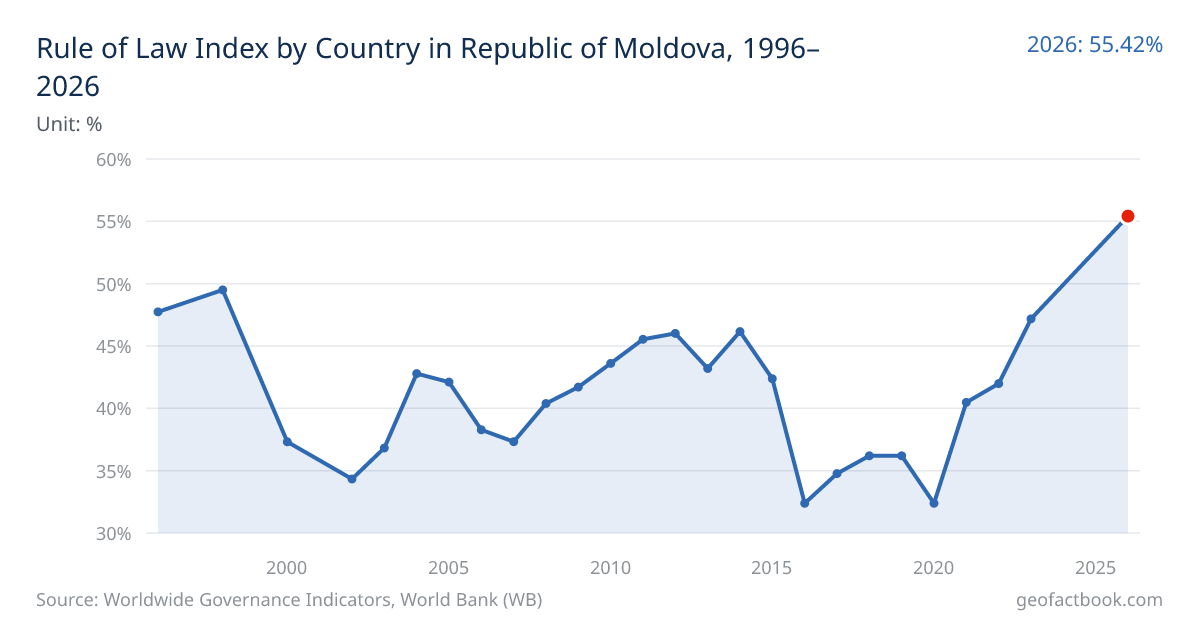
Republic of Moldova's rule of law index by country in 2026 is 55.42 % (estimate), up 17.5% from 2023. It ranks #97 of 209 countries.
Compare countries by Rule of Law percentile rank, reflecting confidence in laws, courts, police, property rights, and protection from crime and violence.
Estimated value for 2026 (interpolated, no direct source).
Where Republic of Moldova ranks (2026)
#97 of 209- #95
 Thailand56.88%
- #96
 Nauru56.37%
- #97
 Republic of Moldova55.42%
- #98
 Fiji55.36%
- #99
 Vanuatu54.55%
Rule of Law Index by Country over timeSome values are estimated based on historical trends
| Year | Value | Change | % Change | Actions |
|---|---|---|---|---|
| 2026 | 55.42 % | — | — | |
| 2025 | — | — | — | |
| 2024 | — | — | — | |
| 2023 | 47.17 % | +5.19 % | +12.36% | |
| 2022 | 41.98 % | +1.5 % | +3.72% | |
| 2021 | 40.48 % | +8.1 % | +25.00% | |
| 2020 | 32.38 % | 3.81 % | -10.53% | |
| 2019 | 36.19 % | 0 % | 0.00% | |
| 2018 | 36.19 % | +1.43 % | +4.11% | |
| 2017 | 34.76 % | +2.38 % | +7.35% | |
| 2016 | 32.38 % | 10 % | -23.60% | |
| 2015 | 42.38 % | 3.77 % | -8.17% | |
| 2014 | 46.15 % | +2.96 % | +6.86% | |
| 2013 | 43.19 % | 2.82 % | -6.12% | |
| 2012 | 46.01 % | +0.47 % | +1.03% | |
| 2011 | 45.54 % | +1.94 % | +4.44% | |
| 2010 | 43.6 % | +1.9 % | +4.55% | |
| 2009 | 41.71 % | +1.32 % | +3.27% | |
| 2008 | 40.38 % | +3.06 % | +8.21% | |
| 2007 | 37.32 % | 0.96 % | -2.50% | |
| 2006 | 38.28 % | 3.83 % | -9.09% | |
| 2005 | 42.11 % | 0.68 % | -1.60% | |
| 2004 | 42.79 % | +5.97 % | +16.22% | |
| 2003 | 36.82 % | +2.49 % | +7.25% | |
| 2002 | 34.33 % | — | — | |
| 2001 | — | — | — | |
| 2000 | 37.31 % | — | — | |
| 1999 | — | — | — | |
| 1998 | 49.5 % | — | — | |
| 1997 | — | — | — | |
| 1996 | 47.74 % | — | — |
Rule of Law Index by Country in Republic of Moldova, 1996–2026: chart
Cite this page
Geo Factbook. (n.d.). Republic of Moldova: Rule of Law Index by Country. Retrieved November 29, 2026, from https://geofactbook.com/countries/republic-of-moldova/rule-of-law-index-by-country
The figures on this page come from Worldwide Governance Indicators, World Bank (WB). For academic work, cite the original source as well.
Frequently Asked Questions About Republic of Moldova Rule of Law Index by Country
What is Republic of Moldova's rule of law index by country in 2026?▾
Republic of Moldova's rule of law index by country is 55.42 % in 2026 (estimate), according to Worldwide Governance Indicators, World Bank (WB).
Is Republic of Moldova's rule of law index by country increasing or decreasing?▾
Republic of Moldova's rule of law index by country rose by 17.5% from 2023 (47.17 %) to 2026 (55.42 %). Over the past decade (2016–2026) it rose by 71.1%.
How does Republic of Moldova rank for rule of law index by country?▾
In 2026, Republic of Moldova has the 97th highest rule of law index by country out of 209 countries with data.
What was Republic of Moldova's rule of law index by country in 1996?▾
In 1996, Republic of Moldova's rule of law index by country was 47.74 %. By 2026 it rose by 16.1%.
Explore additional statistical insights
Corruption Perception Index in Republic of Moldova
Corruption Perception Index ranks countries by perceived corruption levels. It influences investment decisions.
Corruption Perceptions Index in Republic of Moldova
Corruption Perceptions Index scores countries based on perceived levels of public sector corruption according to experts and businesspeople.
Public Sector Employment Share in Republic of Moldova
Public sector employment share measures the percentage of a country's workforce employed by the government.
Prison Population Rate in Republic of Moldova
Explore prison population rate per 100,000 people; measure incarceration levels across countries and understand justice system trends.
Control of Corruption Score in Republic of Moldova
Control of Corruption score measures governance quality and public sector transparency across countries.
Women, Business and the Law Index in Republic of Moldova
Measures women's legal rights in business and work across countries; higher scores indicate more equitable laws.