
Panama Female population of reproductive age 2026: 1.16 Million
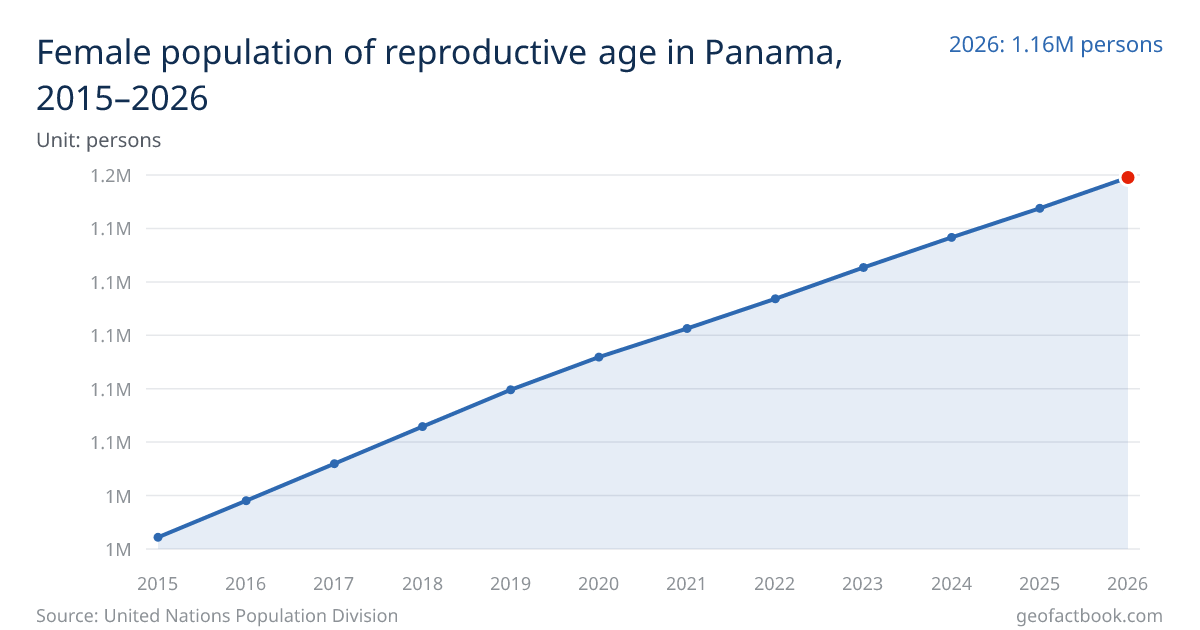
Panama's female population of reproductive age in 2026 is 1.16 Million (estimate), up 1.0% from 2025. It ranks #129 of 236 countries.
The female population of reproductive age is a crucial demographic statistic that influences healthcare, economic growth, and social policies in countries. Understanding this population helps address reproductive health needs and support family planning initiatives.
Estimated value for 2026 (interpolated, no direct source).
Where Panama ranks (2026)
#129 of 236- #127
 New Zealand1.2M persons
- #128
 Finland1.18M persons
- #129
 Panama1.16M persons
- #130
 Eritrea923,482.65 persons
- #131
 Georgia876,225.75 persons
Female population of reproductive age over timeSome values are estimated based on historical trends
| Year | Value | Change | % Change | Actions |
|---|---|---|---|---|
| 2026 | 1.16M persons | +11.51K persons | +1.00% | |
| 2025 | 1.15M persons | +10.91K persons | +0.96% | |
| 2024 | 1.14M persons | +11.28K persons | +1.00% | |
| 2023 | 1.13M persons | +11.70K persons | +1.05% | |
| 2022 | 1.11M persons | +11.14K persons | +1.01% | |
| 2021 | 1.10M persons | +10.67K persons | +0.98% | |
| 2020 | 1.09M persons | +12.26K persons | +1.14% | |
| 2019 | 1.08M persons | +13.76K persons | +1.29% | |
| 2018 | 1.07M persons | +13.88K persons | +1.32% | |
| 2017 | 1.05M persons | +13.88K persons | +1.34% | |
| 2016 | 1.04M persons | +13.70K persons | +1.34% | |
| 2015 | 1.02M persons | — | — |
Female population of reproductive age in Panama, 2015–2026: chart
Cite this page
Geo Factbook. (n.d.). Panama: Female population of reproductive age. Retrieved November 28, 2026, from https://geofactbook.com/countries/panama/female-population-of-reproductive-age
The figures on this page come from United Nations Population Division. For academic work, cite the original source as well.
Frequently Asked Questions About Panama Female population of reproductive age
What is Panama's female population of reproductive age in 2026?▾
Panama's female population of reproductive age is 1.16 Million in 2026 (estimate), according to United Nations Population Division.
Is Panama's female population of reproductive age increasing or decreasing?▾
Panama's female population of reproductive age rose by 1.0% from 2025 (1.15 Million) to 2026 (1.16 Million). Over the past decade (2016–2026) it rose by 11.7%.
How does Panama rank for female population of reproductive age?▾
In 2026, Panama has the 129th highest female population of reproductive age out of 236 countries with data.
What was Panama's female population of reproductive age in 2015?▾
In 2015, Panama's female population of reproductive age was 1.02 Million. By 2026 it rose by 13.1%.
Explore additional statistical insights
Population Change in Panama
This statistic measures population change across countries, highlighting shifts in demographics. Understanding these changes is crucial for planning resources, economic growth, and social services.
Mathematics Proficiency Scores in Panama
Mathematics proficiency scores assess students' ability to understand and apply mathematical concepts across countries.
Voter Turnout (% of Voting-Age Population) in Panama
Voting age population denotes individuals eligible to vote based on age, providing insights into electoral demographics.
Currently married (Percent) in Panama
The percentage of currently married individuals by country highlights societal trends in family structure and relationships. Understanding these statistics can provide insights into cultural norms and demographic shifts, influencing policies and social programs.
Urban Population Annual Growth Rate in Panama
Urban population annual growth rate measures the year-over-year percentage increase in a country's urban population.
Median age of population in Panama
The median age of a population is a key demographic indicator, reflecting the age distribution within a country. Understanding median age helps assess economic development, healthcare needs, and social dynamics. Countries with a higher median age may face challenges related to aging populations, while younger populations often indicate growth potential.