
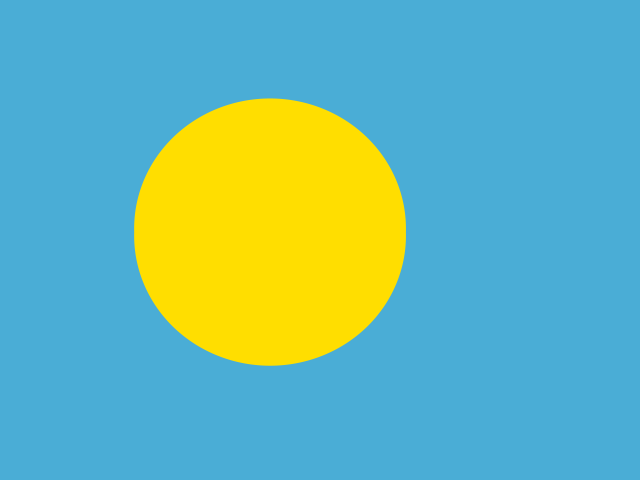
Key Statistics for 2026
Total population
Population Change
Median age of population
Population density
Life expectancy at birth
Agricultural land
Female population of reproductive age
Health Care Spending per Capita
Learning-adjusted years of school
Length of paid parental leave for mother
Percentage of population by degree of urbanization
History
Palau's history is rich and complex, beginning with its earliest inhabitants, who are believed to have arrived around 3,000 years ago. These initial settlers were likely Austronesian peoples, whose seafaring capabilities allowed them to navigate the vast Pacific Ocean. Archaeological evidence suggests that they established a vibrant culture characterized by sophisticated political and social systems. By the time of European contact in the late 19th century, Palau had developed a chiefdom-based society, with each island maintaining a degree of autonomy while forming social and trade networks with neighboring islands.
During the medieval period, Palau experienced significant changes due to external influences, particularly from European explorers and traders. In 1687, Spanish explorer Francisco de Paula Mariner arrived, marking the beginning of European interest in the islands. The Spanish claimed Palau in the late 19th century as part of their larger colonial ambitions in the Pacific. This era saw the introduction of Christianity and Western education, which profoundly impacted local customs and social structures. However, the islands also faced challenges, such as the introduction of diseases to which the indigenous population had no immunity.
The modern history of Palau is marked by its complex relationship with colonial powers and its eventual path to independence. Following World War II, the islands were administered by the United States as part of the Trust Territory of the Pacific Islands established by the United Nations in 1947. Palau took significant steps towards self-governance when it established its constitution in 1981, and after a lengthy negotiation process, it became a sovereign nation with the signing of a Compact of Free Association with the United States in 1994. This agreement granted Palau financial assistance while allowing the U.S. to maintain military presence in the region.
In recent years, Palau has gained recognition for its commitment to environmental conservation and sustainable tourism, particularly in the context of global climate change. The nation has also played a role in international diplomacy, advocating for ocean conservation and participating actively in global discussions about environmental issues. As of 2020, Palau has sought to strengthen its international ties, including efforts to diversify its economy and promote its rich cultural heritage, showcasing its significance on the global stage.
Geography
Palau is an island nation located in the western Pacific Ocean, situated approximately 500 miles (800 kilometers) northeast of New Guinea and 2,000 miles (3,200 kilometers) southwest of Hawaii. The country comprises over 340 islands, with the largest being Babeldaob, which is the most significant in terms of land area. Palau is bordered by the waters of the Philippine Sea to the east and the Coral Sea to the south. It shares maritime boundaries with the Philippines to the west and Indonesia to the south, making it a strategically located archipelago in the central Pacific.
The physical features of Palau are characterized by its rugged terrain and stunning biodiversity. The islands are predominantly volcanic in origin, with Babeldaob featuring mountainous regions that rise to about 600 feet (183 meters) above sea level. The islands are rich in limestone, resulting in unique karst landscapes, particularly on the smaller islands. Palau’s rivers are typically short and seasonal, flowing through the lush tropical forests that cover much of the land. The terrain is varied, ranging from steep hills and valleys to flat coastal plains, which support diverse ecosystems, including mangroves and coral reefs.
Palau experiences a tropical rainforest climate, which is marked by high humidity and consistent temperatures throughout the year. The average temperature ranges from 77°F to 88°F (25°C to 31°C). The country receives substantial rainfall, averaging around 130 inches (3,300 mm) annually, with a distinct wet season from May to November. This climate supports a rich array of flora and fauna, making Palau one of the world’s biodiversity hotspots. Weather patterns can be influenced by the El Niño phenomenon, leading to variations in precipitation and potential droughts.
Natural resources in Palau include marine resources such as fish and other seafood, which are vital to the local economy. The surrounding waters provide rich fishing grounds, supporting both subsistence and commercial fisheries. Additionally, Palau is known for its pristine coral reefs, which are part of the larger Coral Triangle, renowned for its marine biodiversity. However, the country faces environmental challenges, including the impacts of climate change, rising sea levels, and the need for sustainable resource management to preserve its unique ecosystems and protect its natural heritage.
Government
The government of Palau operates as a democratic republic, characterized by a political system that emphasizes both local governance and national representation. The country gained independence in 1994, following its status as a United Nations Trust Territory administered by the United States. Palau's government is guided by the Constitution, which was ratified in 1981, establishing the framework for a system that balances power among the executive, legislative, and judicial branches.
Palau's government structure consists of three branches: the executive, the legislative, and the judicial. The executive branch is headed by the President, who serves a four-year term and is elected by popular vote. The President is supported by a Cabinet of appointed officials responsible for various governmental departments. The legislative branch is a bicameral body known as the Olbiil Era Kelulau, which comprises the Senate and the House of Delegates. The Senate consists of 13 members serving four-year terms, while the House has 16 members representing the states of Palau, elected for two-year terms. The judicial branch includes a Supreme Court and lower courts, ensuring the rule of law and the administration of justice throughout the nation.
Key institutions within Palau's government include the Office of the President and the National Congress, which is responsible for enacting laws and overseeing the executive branch. The political leadership is marked by a collaborative approach, with the President often working closely with the legislature to address issues facing the nation. Political parties in Palau, while present, do not dominate the political landscape as independent candidates often play a significant role in elections, reflecting the country’s emphasis on personal reputation and local connections over party affiliation.
The electoral system in Palau is characterized by a direct voting process, where citizens participate in elections for both the President and members of the legislature. Elections are held every four years, with the most recent presidential election taking place in 2020. The political landscape is dynamic, with a mix of established leaders and emerging figures, and is shaped by various factors, including traditional practices and contemporary governance issues. Overall, Palau's government reflects a unique blend of traditional and modern democratic principles, striving to balance local autonomy with national unity.
Economy
The economy of Palau is characterized by its reliance on tourism, agriculture, and fishing, supported by a compact relationship with the United States. As of 2023, Palau's gross domestic product (GDP) was approximately $300 million, with a per capita GDP of about $12,000. This indicates a relatively high standard of living for its population, which is around 18,000. The country operates as a free-market economy, but its economic activities are significantly influenced by external financial assistance and remittances from overseas workers.
Major industries in Palau include tourism, which accounts for a substantial portion of the GDP and provides a significant number of jobs. The pristine marine environment, including the famous Rock Islands and diverse coral reefs, attracts divers and eco-tourists from around the world. Additionally, fishing, particularly tuna fishing, plays a critical role in the economy, contributing to both local food supplies and exports. Agriculture, while less dominant, produces crops such as taro, cassava, and vegetables, primarily for local consumption.
Palau's trade relationships are largely shaped by its geographic location and economic policies. The country exports primarily fish and some agricultural products, while it imports a wide range of goods, including food, machinery, and petroleum products. The United States remains Palau's largest trading partner, providing economic aid and support through the Compact of Free Association. This agreement allows for U.S. military presence and financial assistance, crucial for the nation’s development and infrastructure projects.
Despite its economic advantages, Palau faces several challenges, including vulnerability to climate change, limited natural resources, and reliance on tourism, which can be affected by global economic fluctuations. However, opportunities exist in sustainable tourism development, enhancing fisheries management, and exploring renewable energy sources. By diversifying its economy and investing in resilience strategies, Palau can work towards a more sustainable economic future while preserving its unique environmental heritage.
Culture
Palau is a vibrant nation located in the western Pacific Ocean, known for its rich cultural heritage shaped by its diverse ethnic groups and historical influences. The majority of the population belongs to the Palauan ethnic group, which is complemented by small communities of Micronesians, Filipinos, and other nationalities. The official languages of Palau are Palauan and English, with Palauan being a unique Austronesian language that reflects the island's traditions and identity. In terms of religion, the predominant faith is Christianity, with a significant majority practicing various denominations, including Roman Catholicism and Protestantism. This religious landscape plays a crucial role in the daily lives of Palauan people, influencing cultural practices and community gatherings.
Palauan culture is deeply rooted in customs and traditions that have been passed down through generations. Traditional practices, such as the *bai* (men's meeting house), serve as important social and political venues where community decisions are made. Festivals and ceremonies, such as the *Belau National Museum Day* and the *Omechei Festival*, celebrate the island's history and promote cultural preservation. One notable custom is the *bai's* ceremonial role in welcoming guests, highlighting the Palauan value of hospitality. These traditions are not merely historical; they are actively celebrated and taught to younger generations, ensuring the continuity of Palauan identity.
The arts in Palau are a vibrant expression of its cultural identity, with traditional music, dance, and crafts playing significant roles in community life. Music often features the *belau*, a traditional string instrument, and is accompanied by rhythmic dance that tells stories of Palauan history and mythology. Visual arts, including weaving and carving, showcase the skill and creativity of Palauan artisans, often using local materials to create intricate designs reflective of nature and ancestral heritage. Literature, while not as extensively documented, includes oral traditions and storytelling that pass down moral lessons and historical narratives.
Palauan cuisine is an integral aspect of daily life, characterized by fresh ingredients sourced from the surrounding ocean and land. Traditional dishes often include seafood, taro, and pandanus, with preparations that highlight communal sharing and feasting during special occasions. One of the most popular dishes is *tatiy*, a form of fish soup that is enjoyed by locals and visitors alike. Daily life in Palau is often centered around community, with social gatherings reinforcing bonds among families and friends. The blend of traditional practices with modern influences creates a unique cultural landscape that continues to evolve while honoring its rich heritage.
About This Data
This page displays comprehensive statistical data for Palau for the year 2026. All data points are sourced from authoritative international organizations and are regularly updated to ensure accuracy and reliability.
Click on any statistic to explore more detailed information, see how Palau compares with other countries, and view historical trends.
Primary Data Sources
CIA World Factbook
Comprehensive country profiles and demographic statistics from the Central Intelligence Agency
Learn moreUnited Nations Statistics
Global demographic data and population projections from UN agencies and research divisions
Learn moreWorld Bank Open Data
Development indicators and comprehensive population metrics from the World Bank database
Learn moreCompare Palau with other countries
Side-by-side comparisons across population, GDP, geography, and more.
Frequently Asked Questions About Palau
Which continent is Palau in?▾
Palau is in Oceania, in the Micronesia subregion according to the UN geoscheme.
What is the population of Palau in 2026?▾
The population of Palau in 2026 is approximately 17,630 persons.
What is the GDP of Palau?▾
The Gross Domestic Product (GDP) of Palau is approximately 244,887,552 US dollars.
What is the life expectancy in Palau?▾
The life expectancy at birth in Palau is 72.3 years.
What is the official language of Palau?▾
The official languages of Palau are Palauan and English.
What is the total fertility rate in Palau?▾
The total fertility rate in Palau is approximately 1.84 children per woman.