
Pakistan Hospital Beds per Capita 2020: 0.63 beds per 1,000
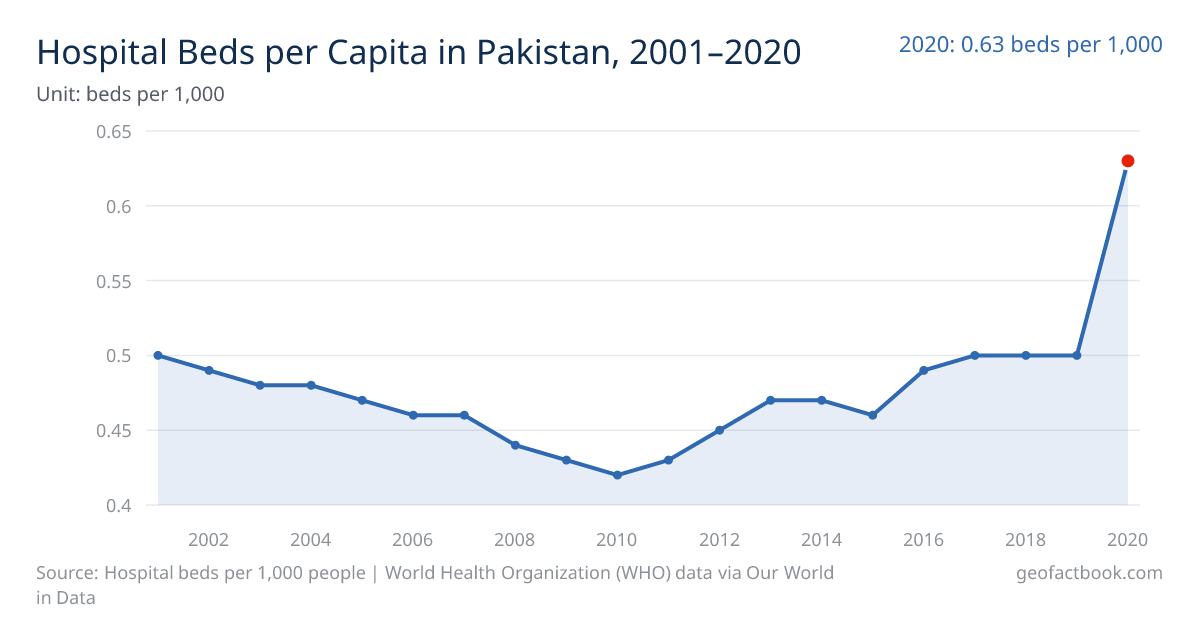
Pakistan's hospital beds per capita in 2020 is 0.63 beds per 1,000, up 26.0% from 2019. It ranks #123 of 132 countries.
Hospital beds per capita highlights healthcare infrastructure by showing available hospital beds per 1,000 people globally.
Source (2020): Hospital beds per 1,000 people | Our World in Data
Where Pakistan ranks (2020)
#123 of 132- #121
 Sudan0.66 beds per 1,000
- #122
 Tanzania0.64 beds per 1,000
- #123
 Pakistan0.63 beds per 1,000
- #124
 Benin0.45 beds per 1,000
- #125
 Guatemala0.43 beds per 1,000
Hospital Beds per Capita over time
| Year | Value | Change | % Change | Actions |
|---|---|---|---|---|
| 2020 | 0.63 beds per 1,000 | +0.13 beds per 1,000 | +26.00% | |
| 2019 | 0.5 beds per 1,000 | 0 beds per 1,000 | 0.00% | |
| 2018 | 0.5 beds per 1,000 | 0 beds per 1,000 | 0.00% | |
| 2017 | 0.5 beds per 1,000 | +0.01 beds per 1,000 | +2.04% | |
| 2016 | 0.49 beds per 1,000 | +0.03 beds per 1,000 | +6.52% | |
| 2015 | 0.46 beds per 1,000 | 0.01 beds per 1,000 | -2.13% | |
| 2014 | 0.47 beds per 1,000 | 0 beds per 1,000 | 0.00% | |
| 2013 | 0.47 beds per 1,000 | +0.02 beds per 1,000 | +4.44% | |
| 2012 | 0.45 beds per 1,000 | +0.02 beds per 1,000 | +4.65% | |
| 2011 | 0.43 beds per 1,000 | +0.01 beds per 1,000 | +2.38% | |
| 2010 | 0.42 beds per 1,000 | 0.01 beds per 1,000 | -2.33% | |
| 2009 | 0.43 beds per 1,000 | 0.01 beds per 1,000 | -2.27% | |
| 2008 | 0.44 beds per 1,000 | 0.02 beds per 1,000 | -4.35% | |
| 2007 | 0.46 beds per 1,000 | 0 beds per 1,000 | 0.00% | |
| 2006 | 0.46 beds per 1,000 | 0.01 beds per 1,000 | -2.13% | |
| 2005 | 0.47 beds per 1,000 | 0.01 beds per 1,000 | -2.08% | |
| 2004 | 0.48 beds per 1,000 | 0 beds per 1,000 | 0.00% | |
| 2003 | 0.48 beds per 1,000 | 0.01 beds per 1,000 | -2.04% | |
| 2002 | 0.49 beds per 1,000 | 0.01 beds per 1,000 | -2.00% | |
| 2001 | 0.5 beds per 1,000 | — | — |
Hospital Beds per Capita in Pakistan, 2001–2020: chart
Cite this page
Geo Factbook. (n.d.). Pakistan: Hospital Beds per Capita. Retrieved November 28, 2026, from https://geofactbook.com/countries/pakistan/hospital-beds-per-capita
The figures on this page come from Hospital beds per 1,000 people | World Health Organization (WHO) data via Our World in Data. For academic work, cite the original source as well.
Frequently Asked Questions About Pakistan Hospital Beds per Capita
What is Pakistan's hospital beds per capita in 2020?▾
Pakistan's hospital beds per capita is 0.63 beds per 1,000 in 2020, according to Hospital beds per 1,000 people | World Health Organization (WHO) data via Our World in Data.
Is Pakistan's hospital beds per capita increasing or decreasing?▾
Pakistan's hospital beds per capita rose by 26.0% from 2019 (0.50 beds per 1,000) to 2020 (0.63 beds per 1,000). Over the past decade (2010–2020) it rose by 50.0%.
How does Pakistan rank for hospital beds per capita?▾
In 2020, Pakistan has the 123rd highest hospital beds per capita out of 132 countries with data.
What was Pakistan's hospital beds per capita in 2001?▾
In 2001, Pakistan's hospital beds per capita was 0.50 beds per 1,000. By 2020 it rose by 26.0%.
Explore additional statistical insights
Female Life Expectancy Leaders in Pakistan
Explore which countries lead in female life expectancy. Japan and Switzerland often top the list.
Male Smoking Prevalence in Pakistan
Male smoking prevalence indicates the percentage of men who smoke in each country. Understand global trends and health impacts.
Physician Density in Pakistan
Physician density measures healthcare access, showing the number of doctors per square kilometer. Compare countries and explore interactive maps.
Birth Rate (%) in Pakistan
Explore birth rate data across countries. Compare rankings, view interactive maps, and analyze historical trends.
Maternal Mortality Ratio in Pakistan
Maternal Mortality Ratio (%) measures deaths during childbirth. Compare countries, explore rankings, and view trends with our interactive maps.
Pharmacists Density in Pakistan
Pharmacists density indicates healthcare accessibility; a higher number suggests better pharmaceutical services per 10,000 people.