
Sudan Hospital Beds per Capita 2021: 0.66 beds per 1,000
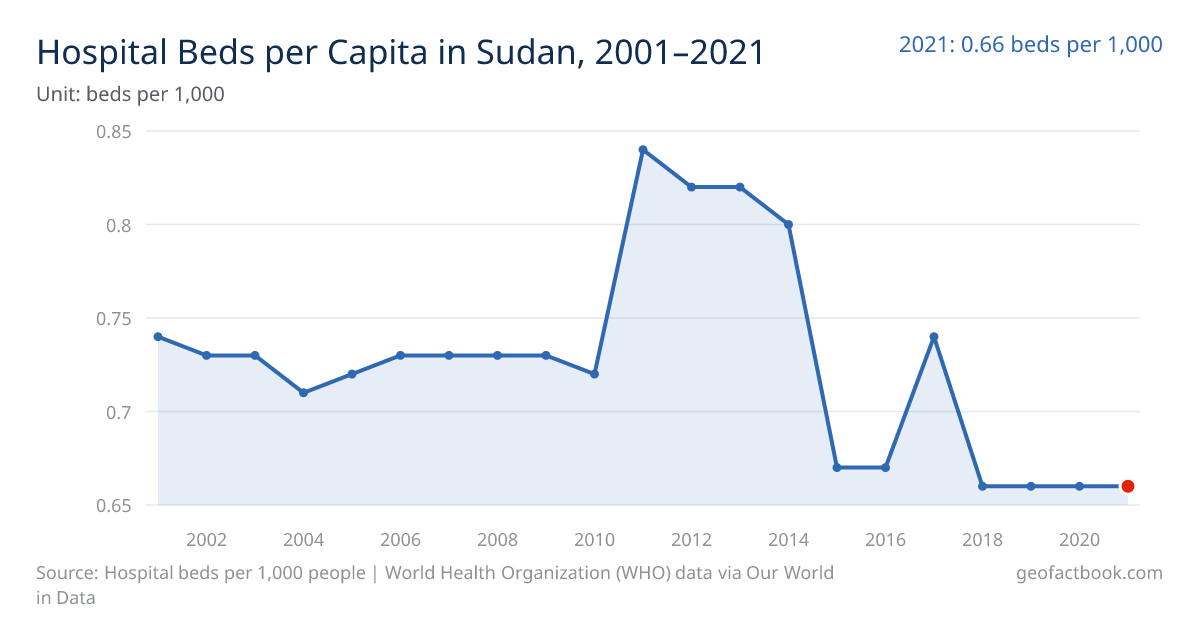
Sudan's hospital beds per capita in 2021 is 0.66 beds per 1,000, unchanged from 2020. It ranks #116 of 125 countries.
Hospital beds per capita highlights healthcare infrastructure by showing available hospital beds per 1,000 people globally.
Source (2021): Hospital beds per 1,000 people | Our World in Data
Where Sudan ranks (2021)
#116 of 125- #115
 Morocco0.72 beds per 1,000
- #116
 Honduras0.66 beds per 1,000
- #116
 Sudan0.66 beds per 1,000
- #118
 Tanzania0.64 beds per 1,000
- #119
 Guatemala0.44 beds per 1,000
Hospital Beds per Capita over time
| Year | Value | Change | % Change | Actions |
|---|---|---|---|---|
| 2021 | 0.66 beds per 1,000 | 0 beds per 1,000 | 0.00% | |
| 2020 | 0.66 beds per 1,000 | 0 beds per 1,000 | 0.00% | |
| 2019 | 0.66 beds per 1,000 | 0 beds per 1,000 | 0.00% | |
| 2018 | 0.66 beds per 1,000 | 0.08 beds per 1,000 | -10.81% | |
| 2017 | 0.74 beds per 1,000 | +0.07 beds per 1,000 | +10.45% | |
| 2016 | 0.67 beds per 1,000 | 0 beds per 1,000 | 0.00% | |
| 2015 | 0.67 beds per 1,000 | 0.13 beds per 1,000 | -16.25% | |
| 2014 | 0.8 beds per 1,000 | 0.02 beds per 1,000 | -2.44% | |
| 2013 | 0.82 beds per 1,000 | 0 beds per 1,000 | 0.00% | |
| 2012 | 0.82 beds per 1,000 | 0.02 beds per 1,000 | -2.38% | |
| 2011 | 0.84 beds per 1,000 | +0.12 beds per 1,000 | +16.67% | |
| 2010 | 0.72 beds per 1,000 | 0.01 beds per 1,000 | -1.37% | |
| 2009 | 0.73 beds per 1,000 | 0 beds per 1,000 | 0.00% | |
| 2008 | 0.73 beds per 1,000 | 0 beds per 1,000 | 0.00% | |
| 2007 | 0.73 beds per 1,000 | 0 beds per 1,000 | 0.00% | |
| 2006 | 0.73 beds per 1,000 | +0.01 beds per 1,000 | +1.39% | |
| 2005 | 0.72 beds per 1,000 | +0.01 beds per 1,000 | +1.41% | |
| 2004 | 0.71 beds per 1,000 | 0.02 beds per 1,000 | -2.74% | |
| 2003 | 0.73 beds per 1,000 | 0 beds per 1,000 | 0.00% | |
| 2002 | 0.73 beds per 1,000 | 0.01 beds per 1,000 | -1.35% | |
| 2001 | 0.74 beds per 1,000 | — | — |
Hospital Beds per Capita in Sudan, 2001–2021: chart
Cite this page
Geo Factbook. (n.d.). Sudan: Hospital Beds per Capita. Retrieved November 28, 2026, from https://geofactbook.com/countries/sudan/hospital-beds-per-capita
The figures on this page come from Hospital beds per 1,000 people | World Health Organization (WHO) data via Our World in Data. For academic work, cite the original source as well.
Frequently Asked Questions About Sudan Hospital Beds per Capita
What is Sudan's hospital beds per capita in 2021?▾
Sudan's hospital beds per capita is 0.66 beds per 1,000 in 2021, according to Hospital beds per 1,000 people | World Health Organization (WHO) data via Our World in Data.
Is Sudan's hospital beds per capita increasing or decreasing?▾
Sudan's hospital beds per capita was essentially unchanged from 2020 (0.66 beds per 1,000) to 2021 (0.66 beds per 1,000). Over the past decade (2011–2021) it fell by 21.4%.
How does Sudan rank for hospital beds per capita?▾
In 2021, Sudan has the 116th highest hospital beds per capita out of 125 countries with data.
What was Sudan's hospital beds per capita in 2001?▾
In 2001, Sudan's hospital beds per capita was 0.74 beds per 1,000. By 2021 it fell by 10.8%.
Explore additional statistical insights
Global Stillbirth Rate Trends in Sudan
Explore global trends in stillbirth rates, highlighting improvements or setbacks over time across different countries.
Psychiatrist Density Per 100,000 People in Sudan
Psychiatrist density measures the number of psychiatrists available per 100,000 people, indicating mental health access.
Change in Measles Immunization Rate in Sudan
Tracks the change in measles immunization rates over time. Positive trends highlight successful vaccination programs.
Average Non-HDL Cholesterol Levels in Sudan
Average non-HDL cholesterol levels indicate heart disease risk and vary across countries.
Nurses and Midwives Density in Sudan
Nurses and midwives density measures healthcare accessibility. Learn about countries with the highest and lowest density per 1,000 people.
Physicians per 1,000 People in Sudan
The total number of doctors in each country reflects healthcare workforce size and capacity to serve the population.