
New Zealand Fertilizer Use Per Hectare 2024: 1,341 kg/ha
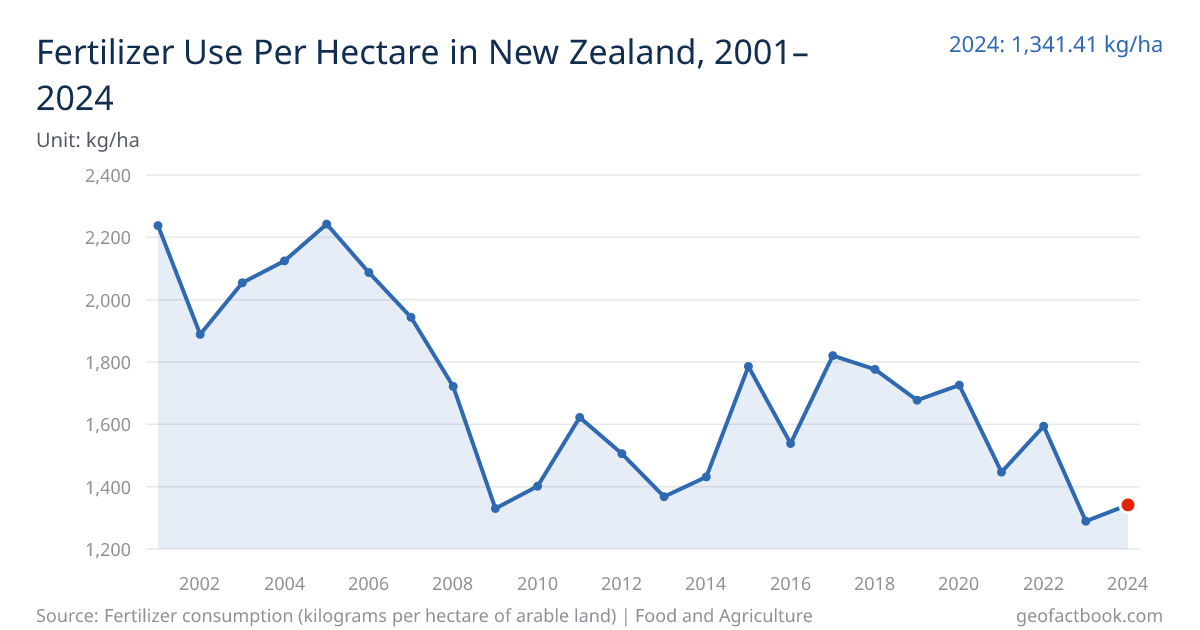
New Zealand's fertilizer use per hectare in 2024 is 1,341 kg/ha, up 4.0% from 2023. It ranks #5 of 189 countries.
Fertilizer use per hectare shows how much fertilizer is applied to agricultural land in different countries, impacting crop yield.
Source (2024): Fertilizer use per hectare
Where New Zealand ranks (2024)
#5 of 189- #3
 United Arab Emirates1,648.46 kg/ha
- #4
 Costa Rica1,402.54 kg/ha
- #5
 New Zealand1,341.41 kg/ha
- #6
 Ireland986.62 kg/ha
- #7
 Bahrain769.05 kg/ha
Fertilizer Use Per Hectare over time
| Year | Value | Change | % Change | Actions |
|---|---|---|---|---|
| 2024 | 1.34K kg/ha | +52.21 kg/ha | +4.05% | |
| 2023 | 1.29K kg/ha | 304.82 kg/ha | -19.12% | |
| 2022 | 1.59K kg/ha | +147.36 kg/ha | +10.19% | |
| 2021 | 1.45K kg/ha | 279.22 kg/ha | -16.18% | |
| 2020 | 1.73K kg/ha | +48.6 kg/ha | +2.90% | |
| 2019 | 1.68K kg/ha | 98.95 kg/ha | -5.57% | |
| 2018 | 1.78K kg/ha | 44.45 kg/ha | -2.44% | |
| 2017 | 1.82K kg/ha | +282.25 kg/ha | +18.35% | |
| 2016 | 1.54K kg/ha | 247.56 kg/ha | -13.86% | |
| 2015 | 1.79K kg/ha | +354.6 kg/ha | +24.77% | |
| 2014 | 1.43K kg/ha | +63.56 kg/ha | +4.65% | |
| 2013 | 1.37K kg/ha | 137.93 kg/ha | -9.16% | |
| 2012 | 1.51K kg/ha | 116.32 kg/ha | -7.17% | |
| 2011 | 1.62K kg/ha | +220.55 kg/ha | +15.74% | |
| 2010 | 1.40K kg/ha | +71.62 kg/ha | +5.39% | |
| 2009 | 1.33K kg/ha | 391.65 kg/ha | -22.75% | |
| 2008 | 1.72K kg/ha | 221.76 kg/ha | -11.41% | |
| 2007 | 1.94K kg/ha | 143.72 kg/ha | -6.89% | |
| 2006 | 2.09K kg/ha | 155.27 kg/ha | -6.92% | |
| 2005 | 2.24K kg/ha | +118 kg/ha | +5.55% | |
| 2004 | 2.12K kg/ha | +70.3 kg/ha | +3.42% | |
| 2003 | 2.05K kg/ha | +165.33 kg/ha | +8.75% | |
| 2002 | 1.89K kg/ha | 348.87 kg/ha | -15.59% | |
| 2001 | 2.24K kg/ha | — | — |
Fertilizer Use Per Hectare in New Zealand, 2001–2024: chart
Cite this page
Geo Factbook. (n.d.). New Zealand: Fertilizer Use Per Hectare. Retrieved November 27, 2026, from https://geofactbook.com/countries/new-zealand/fertilizer-use-per-hectare
The figures on this page come from Fertilizer consumption (kilograms per hectare of arable land) | Food and Agriculture Organization of the United Nations (FAO) via World Bank. For academic work, cite the original source as well.
Frequently Asked Questions About New Zealand Fertilizer Use Per Hectare
What is New Zealand's fertilizer use per hectare in 2024?▾
New Zealand's fertilizer use per hectare is 1,341 kg/ha in 2024, according to Fertilizer consumption (kilograms per hectare of arable land) | Food and Agriculture Organization of the United Nations (FAO) via World Bank.
Is New Zealand's fertilizer use per hectare increasing or decreasing?▾
New Zealand's fertilizer use per hectare rose by 4.0% from 2023 (1,289 kg/ha) to 2024 (1,341 kg/ha). Over the past decade (2014–2024) it fell by 6.3%.
How does New Zealand rank for fertilizer use per hectare?▾
In 2024, New Zealand has the 5th highest fertilizer use per hectare out of 189 countries with data.
What was New Zealand's fertilizer use per hectare in 2001?▾
In 2001, New Zealand's fertilizer use per hectare was 2,238 kg/ha. By 2024 it fell by 40.1%.
Explore additional statistical insights
Total Threatened Mammal Species in New Zealand
Total threatened mammal species highlight biodiversity risks. Track conservation efforts worldwide.
Total Renewable Groundwater Resources by Country in New Zealand
Total renewable groundwater represents the combined volume of internally generated and externally sourced groundwater that is naturally replenished and available for use.
Average Annual Temperature in New Zealand
Average annual temperature measures the typical warmth of a country over a year, crucial for climate studies.
Threatened Bird Species Count in New Zealand
Threatened bird species count measures the number of bird species at risk of extinction in each country.
Protected Land Area for Adaptation in New Zealand
Protected land as a climate adaptation strategy ensures biodiversity and resilience against climate impacts.
Protected Land Area Percentage in New Zealand
Protected land area percentage shows the share of a country's land dedicated to conservation and biodiversity.