
Micronesia (Fed. States of) Percentage of land area by degree of urbanization 2026: 3.36 %
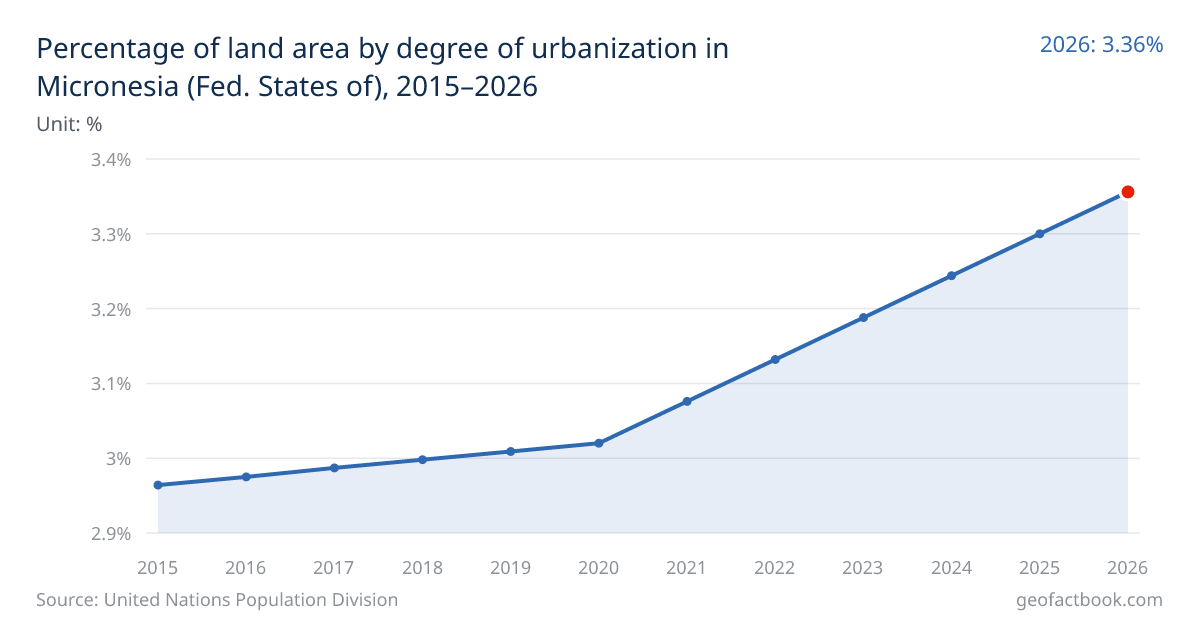
Micronesia (Fed. States of)'s percentage of land area by degree of urbanization in 2026 is 3.36 % (estimate), up 1.7% from 2025. It ranks #116 of 237 countries.
Explore the percentage of land area by degree of urbanization, highlighting how urban development shapes countries' landscapes and influences economic growth. Understanding this statistic reveals the balance between urban and rural spaces, essential for sustainable planning.
Estimated value for 2026 (interpolated, no direct source).
Where Micronesia (Fed. States of) ranks (2026)
#116 of 237- #114
 Armenia3.42%
- #115
 Costa Rica3.41%
- #116
 Micronesia (Fed. States of)3.36%
- #117
 Egypt3.14%
- #118
 Albania2.95%
Percentage of land area by degree of urbanization over timeSome values are estimated based on historical trends
| Year | Value | Change | % Change | Actions |
|---|---|---|---|---|
| 2026 | 3.36 % | +0.06 % | +1.70% | |
| 2025 | 3.3 % | +0.06 % | +1.73% | |
| 2024 | 3.24 % | +0.06 % | +1.76% | |
| 2023 | 3.19 % | +0.06 % | +1.79% | |
| 2022 | 3.13 % | +0.06 % | +1.82% | |
| 2021 | 3.08 % | +0.06 % | +1.85% | |
| 2020 | 3.02 % | +0.01 % | +0.37% | |
| 2019 | 3.01 % | +0.01 % | +0.37% | |
| 2018 | 3 % | +0.01 % | +0.37% | |
| 2017 | 2.99 % | +0.01 % | +0.40% | |
| 2016 | 2.98 % | +0.01 % | +0.37% | |
| 2015 | 2.96 % | — | — |
Percentage of land area by degree of urbanization in Micronesia (Fed. States of), 2015–2026: chart
Cite this page
Geo Factbook. (n.d.). Micronesia (Fed. States of): Percentage of land area by degree of urbanization. Retrieved November 29, 2026, from https://geofactbook.com/countries/micronesia-fed-states-of/percentage-of-land-area-by-degree-of-urbanization
The figures on this page come from United Nations Population Division. For academic work, cite the original source as well.
Frequently Asked Questions About Micronesia (Fed. States of) Percentage of land area by degree of urbanization
What is Micronesia (Fed. States of)'s percentage of land area by degree of urbanization in 2026?▾
Micronesia (Fed. States of)'s percentage of land area by degree of urbanization is 3.36 % in 2026 (estimate), according to United Nations Population Division.
Is Micronesia (Fed. States of)'s percentage of land area by degree of urbanization increasing or decreasing?▾
Micronesia (Fed. States of)'s percentage of land area by degree of urbanization rose by 1.7% from 2025 (3.30 %) to 2026 (3.36 %). Over the past decade (2016–2026) it rose by 12.8%.
How does Micronesia (Fed. States of) rank for percentage of land area by degree of urbanization?▾
In 2026, Micronesia (Fed. States of) has the 116th highest percentage of land area by degree of urbanization out of 237 countries with data.
What was Micronesia (Fed. States of)'s percentage of land area by degree of urbanization in 2015?▾
In 2015, Micronesia (Fed. States of)'s percentage of land area by degree of urbanization was 2.96 %. By 2026 it rose by 13.2%.
Explore additional statistical insights
Arable Land Per Person in Micronesia (Fed. States of)
Arable land per person measures the amount of farmable land available to each individual in a country.
Banana Yield Per Hectare in Micronesia (Fed. States of)
Compare the efficiency of banana production by examining yield per hectare across different countries.
Rule of Law Index by Country in Micronesia (Fed. States of)
Compare countries by Rule of Law percentile rank, reflecting confidence in laws, courts, police, property rights, and protection from crime and violence.
Urban Population Share 2050 in Micronesia (Fed. States of)
Urban population share by 2050 shows urbanization trends. Discover which countries will be most urbanized.
Population living in slums in Micronesia (Fed. States of)
This statistic measures the percentage of a country's population living in slums, highlighting urban poverty and living conditions. Understanding slum populations is crucial for addressing housing challenges and improving the quality of life.
Oil Production in Micronesia (Fed. States of)
Oil Production data reveals output levels across countries. Compare rankings, explore trends, and view interactive maps.