
Mauritius Female population of reproductive age 2026: 320,972
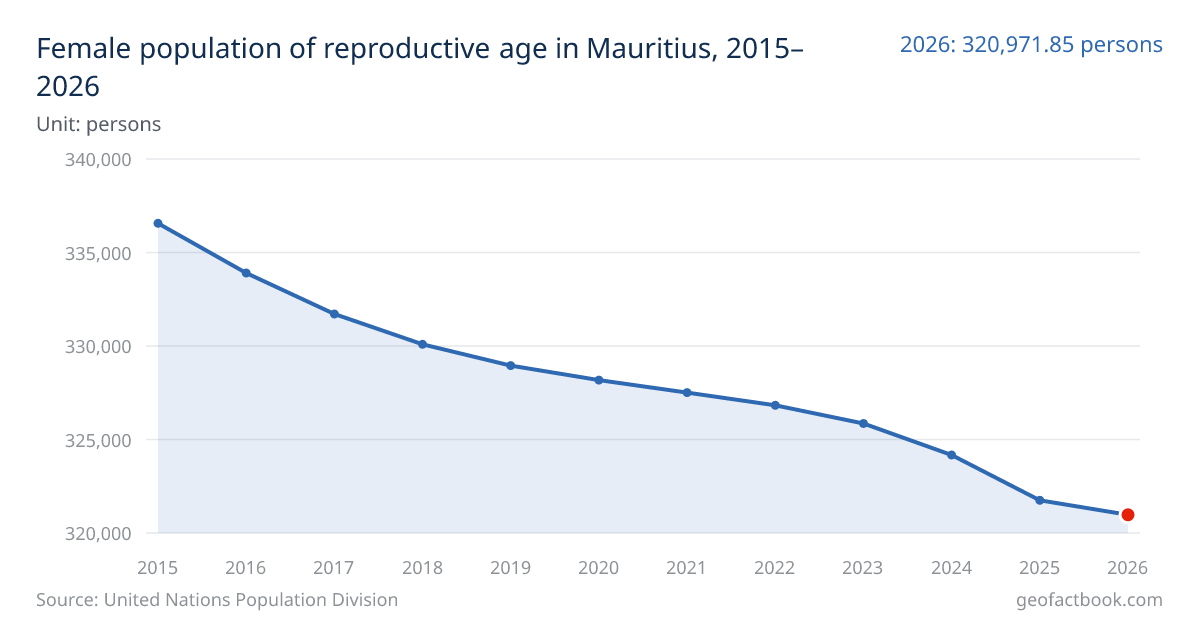
Mauritius's female population of reproductive age in 2026 is 320,972 (estimate), down 0.2% from 2025. It ranks #160 of 236 countries.
The female population of reproductive age is a crucial demographic statistic that influences healthcare, economic growth, and social policies in countries. Understanding this population helps address reproductive health needs and support family planning initiatives.
Estimated value for 2026 (interpolated, no direct source).
Where Mauritius ranks (2026)
#160 of 236- #158
 Cyprus337,997.2 persons
- #159
 Djibouti329,733.3 persons
- #160
 Mauritius320,971.85 persons
- #161
 Estonia284,919.6 persons
- #162
 Fiji250,618.15 persons
Female population of reproductive age over timeSome values are estimated based on historical trends
| Year | Value | Change | % Change | Actions |
|---|---|---|---|---|
| 2026 | 320.97K persons | 778.15 persons | -0.24% | |
| 2025 | 321.75K persons | 2.42K persons | -0.75% | |
| 2024 | 324.17K persons | 1.68K persons | -0.52% | |
| 2023 | 325.86K persons | 972.5 persons | -0.30% | |
| 2022 | 326.83K persons | 680 persons | -0.21% | |
| 2021 | 327.51K persons | 671 persons | -0.20% | |
| 2020 | 328.18K persons | 773.5 persons | -0.24% | |
| 2019 | 328.95K persons | 1.14K persons | -0.34% | |
| 2018 | 330.09K persons | 1.62K persons | -0.49% | |
| 2017 | 331.71K persons | 2.20K persons | -0.66% | |
| 2016 | 333.90K persons | 2.65K persons | -0.79% | |
| 2015 | 336.56K persons | — | — |
Female population of reproductive age in Mauritius, 2015–2026: chart
Cite this page
Geo Factbook. (n.d.). Mauritius: Female population of reproductive age. Retrieved November 28, 2026, from https://geofactbook.com/countries/mauritius/female-population-of-reproductive-age
The figures on this page come from United Nations Population Division. For academic work, cite the original source as well.
Frequently Asked Questions About Mauritius Female population of reproductive age
What is Mauritius's female population of reproductive age in 2026?▾
Mauritius's female population of reproductive age is 320,972 in 2026 (estimate), according to United Nations Population Division.
Is Mauritius's female population of reproductive age increasing or decreasing?▾
Mauritius's female population of reproductive age fell by 0.2% from 2025 (321,750) to 2026 (320,972). Over the past decade (2016–2026) it fell by 3.9%.
How does Mauritius rank for female population of reproductive age?▾
In 2026, Mauritius has the 160th highest female population of reproductive age out of 236 countries with data.
What was Mauritius's female population of reproductive age in 2015?▾
In 2015, Mauritius's female population of reproductive age was 336,560. By 2026 it fell by 4.6%.
Explore additional statistical insights
Contraceptive Prevalence Rate in Mauritius
Contraceptive Prevalence Rate indicates the percentage of women using contraception. Explore global rankings, compare countries, and view trends.
Crude Birth Rate in Mauritius
Crude birth rate measures births per 1,000 people. Identify regions with high or low birth rates globally.
Academic Freedom Index in Mauritius
Explore the Academic Freedom Index measuring educational liberties globally. Compare countries' scores, view rankings, and analyze historical trends.
Total net-migration in Mauritius
Total net-migration measures the difference between the number of immigrants and emigrants in a country, reflecting population shifts and economic opportunities. Understanding this statistic is crucial for analyzing demographic trends and policy impacts in nations worldwide.
Length of paid parental leave for mother in Mauritius
Discover how the length of paid parental leave for mothers varies by country, impacting family well-being and workforce participation. Explore the statistics that highlight this critical social issue.
Population living in slums in Mauritius
This statistic measures the percentage of a country's population living in slums, highlighting urban poverty and living conditions. Understanding slum populations is crucial for addressing housing challenges and improving the quality of life.