
Marshall Islands Total demand for family planning (Percent) 2026: 48.29 %
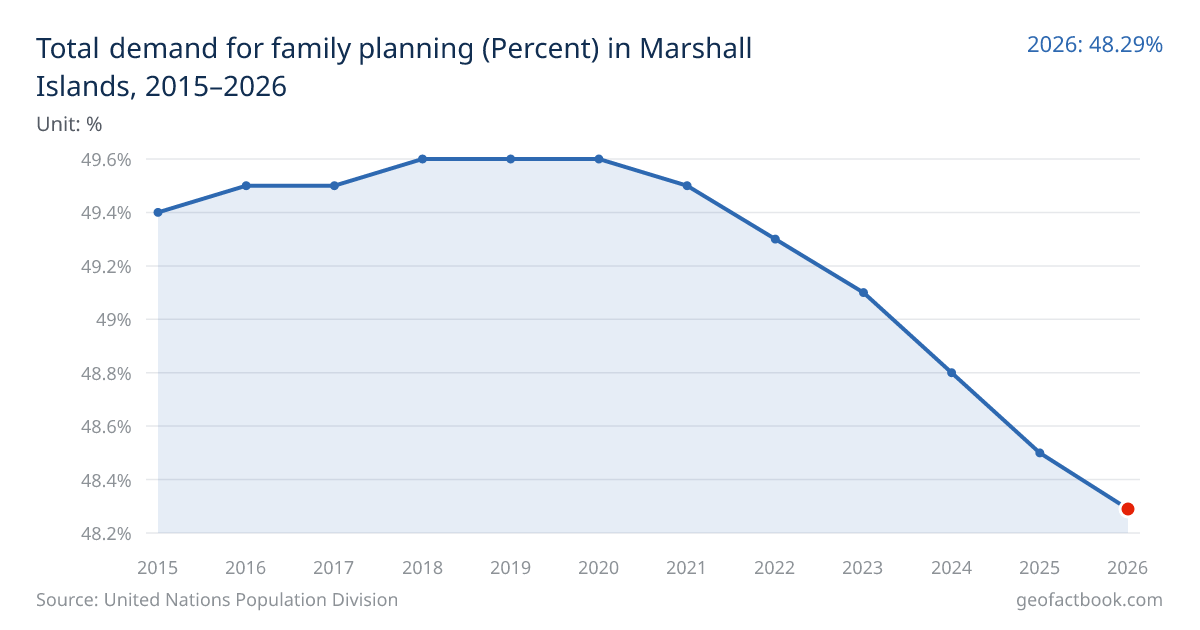
Marshall Islands's total demand for family planning (percent) in 2026 is 48.29 % (estimate), down 0.4% from 2025. It ranks #122 of 199 countries.
Total demand for family planning measures the percentage of individuals seeking access to reproductive health services. Understanding this statistic is crucial for addressing global population growth and improving health outcomes.
Estimated value for 2026 (interpolated, no direct source).
Where Marshall Islands ranks (2026)
#122 of 199- #120
 Bhutan48.35%
- #121
 Trinidad and Tobago48.31%
- #122
 Marshall Islands48.29%
- #123
 Indonesia48.28%
- #124
 Tanzania48.21%
Total demand for family planning (Percent) over timeSome values are estimated based on historical trends
| Year | Value | Change | % Change | Actions |
|---|---|---|---|---|
| 2026 | 48.29 % | 0.21 % | -0.43% | |
| 2025 | 48.5 % | 0.3 % | -0.61% | |
| 2024 | 48.8 % | 0.3 % | -0.61% | |
| 2023 | 49.1 % | 0.2 % | -0.41% | |
| 2022 | 49.3 % | 0.2 % | -0.40% | |
| 2021 | 49.5 % | 0.1 % | -0.20% | |
| 2020 | 49.6 % | 0 % | 0.00% | |
| 2019 | 49.6 % | 0 % | 0.00% | |
| 2018 | 49.6 % | +0.1 % | +0.20% | |
| 2017 | 49.5 % | 0 % | 0.00% | |
| 2016 | 49.5 % | +0.1 % | +0.20% | |
| 2015 | 49.4 % | — | — |
Total demand for family planning (Percent) in Marshall Islands, 2015–2026: chart
Cite this page
Geo Factbook. (n.d.). Marshall Islands: Total demand for family planning (Percent). Retrieved November 28, 2026, from https://geofactbook.com/countries/marshall-islands/total-demand-for-family-planning-percent
The figures on this page come from United Nations Population Division. For academic work, cite the original source as well.
Frequently Asked Questions About Marshall Islands Total demand for family planning (Percent)
What is Marshall Islands's total demand for family planning (percent) in 2026?▾
Marshall Islands's total demand for family planning (percent) is 48.29 % in 2026 (estimate), according to United Nations Population Division.
Is Marshall Islands's total demand for family planning (percent) increasing or decreasing?▾
Marshall Islands's total demand for family planning (percent) fell by 0.4% from 2025 (48.50 %) to 2026 (48.29 %). Over the past decade (2016–2026) it fell by 2.4%.
How does Marshall Islands rank for total demand for family planning (percent)?▾
In 2026, Marshall Islands has the 122nd highest total demand for family planning (percent) out of 199 countries with data.
What was Marshall Islands's total demand for family planning (percent) in 2015?▾
In 2015, Marshall Islands's total demand for family planning (percent) was 49.40 %. By 2026 it fell by 2.2%.
Explore additional statistical insights
Human Capital Index in Marshall Islands
The Human Capital Index measures a country's investment in education and health, reflecting its potential for economic growth and productivity. This vital statistic highlights the importance of nurturing human resources for sustainable development.
Female population of reproductive age in Marshall Islands
The female population of reproductive age is a crucial demographic statistic that influences healthcare, economic growth, and social policies in countries. Understanding this population helps address reproductive health needs and support family planning initiatives.
Human Development Index in Marshall Islands
The Human Development Index combines indicators of health, education, and income to assess development levels.
Total fertility rate in Marshall Islands
The total fertility rate measures the average number of children a woman is expected to have during her lifetime, reflecting population growth and demographic trends. Understanding this statistic is crucial for analyzing economic development, healthcare needs, and societal changes across countries.
Share of Population Born Abroad in Marshall Islands
Share of the population born in another country; reflects immigration impact on demographics; varies widely across nations.
Urban Population Share 2050 in Marshall Islands
Urban population share by 2050 shows urbanization trends. Discover which countries will be most urbanized.