
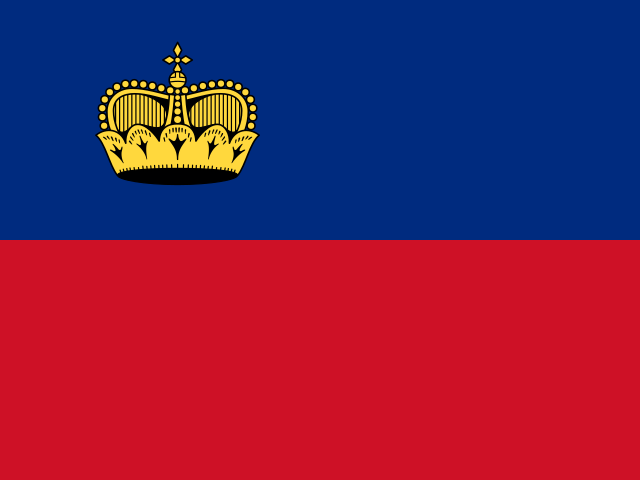
Location
Liechtenstein is in Central Europe, between Austria and Switzerland. It shares land borders with Switzerland (41 km) and Austria (34 km) and is landlocked. The capital is Vaduz.
Liechtenstein population 2026: 40,386 — growth, rank & history →Key Statistics for 2026
Total population
Population Change
Median age of population
Population density
Life expectancy at birth
Agricultural land
Female population of reproductive age
Health Care Spending per Capita
Percentage of population by degree of urbanization
Protected Land Area for Adaptation
Total deaths
History
Liechtenstein's history dates back to ancient times, with evidence of human settlement in the region as early as the 1st century BC. The area was originally inhabited by the Celts, and later became part of the Roman Empire. Following the fall of Rome, the territory underwent significant changes, eventually becoming part of the Frankish Empire in the early Middle Ages. By the 13th century, the region began to emerge as a distinct entity, marked by the establishment of the Lordship of Schellenberg, which would later play a crucial role in the formation of the modern Principality of Liechtenstein.
During the medieval period, Liechtenstein was significantly influenced by its noble families. The counts of Liechtenstein, who held lands in Moravia and were granted the title of princes in 1719, played a pivotal role in the development of the region. The Principality was officially founded in 1806 when it became a sovereign state under the Holy Roman Empire. Throughout the 19th century, Liechtenstein navigated complex political landscapes, remaining relatively neutral during the tumultuous events of the Napoleonic Wars, which allowed it to maintain its independence while other neighboring regions were absorbed into larger nations.
In the 20th century, Liechtenstein faced significant challenges, particularly during the Great Depression and World War II. Despite its small size, the country maintained its sovereignty and even managed to thrive economically through banking and industry. The post-war period saw the establishment of a parliamentary democracy in 1945 and a new constitution in 2003, which further solidified its democratic framework. The economy grew rapidly in the latter half of the century, transforming Liechtenstein into one of the wealthiest countries in the world, known for its low taxes and high standard of living.
In recent decades, Liechtenstein has gained increased significance on the international stage. It became a member of the United Nations in 1990 and has been active in promoting international cooperation and diplomacy. The country has also focused on enhancing its reputation as a global financial center while addressing challenges related to financial transparency and compliance with international regulations. Today, Liechtenstein stands as a testament to resilience and adaptability, maintaining a unique identity while engaging with global issues.
Geography
Liechtenstein is a small, landlocked country located in Central Europe, bordered by Switzerland to the west and south and Austria to the east and north. Spanning an area of just 160 square kilometers (62 square miles), it is the sixth smallest country in the world. The country's geographical position in the Alpine region grants it a picturesque landscape characterized by rolling hills and steep mountains, making it a notable destination for outdoor enthusiasts and nature lovers.
The physical features of Liechtenstein are dominated by the rugged terrain of the Alps, with the highest peak being Grauspitz, which rises to an elevation of 2,599 meters (8,400 feet). The country is traversed by the Rhine River, which forms part of its western border with Switzerland. This river plays a crucial role in the local ecosystem and serves as a vital waterway for the region. The terrain is generally hilly, with a mix of flat valley floors, steep slopes, and mountainous areas, providing a diverse habitat for various flora and fauna.
Liechtenstein experiences a temperate continental climate, characterized by four distinct seasons. Winters can be cold and snowy, particularly in the higher altitudes, while summers are generally mild to warm, with average temperatures ranging from 15 to 25 degrees Celsius (59 to 77 degrees Fahrenheit). Precipitation is fairly evenly distributed throughout the year, but the summer months tend to see increased rainfall. This climate supports a rich biodiversity, including both Alpine and lowland species, and contributes to the lush landscapes that define the country.
The natural resources of Liechtenstein are relatively limited, primarily due to its small size and mountainous terrain. However, the country does benefit from hydroelectric power, derived from its rivers, which is a significant source of renewable energy. The environmental characteristics of Liechtenstein are marked by its commitment to sustainability and conservation, reflected in its well-preserved natural parks and protected areas. These initiatives aim to balance economic development with environmental stewardship, ensuring that the stunning landscapes and ecosystems are preserved for future generations.
Government
Liechtenstein is a constitutional monarchy that operates under a unique political system combining elements of democracy and monarchy. The head of state is the Prince, who holds significant powers, while the head of government is the Prime Minister. The political landscape is characterized by a high degree of political stability and a strong tradition of direct democracy, where citizens have the opportunity to participate in decision-making through referendums and initiatives.
The structure of government in Liechtenstein is composed of three branches: the executive, legislative, and judicial. The executive branch is headed by the Prince, currently Prince Hans-Adam II, although day-to-day responsibilities are primarily managed by his son, Hereditary Prince Alois. The legislative branch is represented by the Landtag, or Parliament, which consists of 25 members elected by the citizens of Liechtenstein for a four-year term. The judicial branch is independent and includes the Supreme Court, which serves as the highest court of appeal in the country, ensuring adherence to the rule of law and the protection of citizens' rights.
Key institutions in the governance of Liechtenstein include the Landtag, the Government (Regierung), and the Constitutional Court. The Government is responsible for the execution of laws and administration of public policy, whereas the Landtag plays a crucial role in shaping legislation and representing the electorate. The ruling Prince also holds the power to veto legislation and dissolve the Landtag, demonstrating the duality of power in this small yet influential nation.
Liechtenstein employs a proportional representation electoral system, which allows for a diverse political landscape. The most prominent political parties include the Progressive Citizens' Party (FBP) and the Patriotic Union (VU), which often collaborate in a coalition government. Voter turnout in national elections is relatively high, reflecting the active engagement of citizens in the democratic process. This political environment fosters a sense of national identity and unity, contributing to the overall stability and prosperity of Liechtenstein.
Economy
Liechtenstein has a highly developed and prosperous economy characterized by a strong financial sector and an industrial base that significantly contributes to its gross domestic product (GDP). As of 2023, the GDP of Liechtenstein is approximately $6 billion, with a per capita income that ranks among the highest in the world, exceeding $150,000. The country's economic system is classified as a free-market economy, which allows for minimal governmental intervention in business operations, promoting innovation and entrepreneurship.
The major industries in Liechtenstein include manufacturing, particularly in precision instruments, machinery, and high-tech products, which account for about 30% of the GDP. Additionally, the financial services sector plays a critical role, contributing approximately 40% to the economy. The country is known for its favorable tax environment, attracting numerous international businesses and wealthy individuals. Other significant sectors include tourism and agriculture, albeit on a smaller scale, that support the local economy by providing employment and enhancing the quality of life.
Liechtenstein's trade relationships are vital for its economic stability, with the country being a member of the European Economic Area (EEA). This membership facilitates access to the European market, allowing for seamless trade in goods and services. Exports primarily consist of machinery, pharmaceuticals, and financial services, while imports are mainly machinery, raw materials, and food products. In 2022, Liechtenstein's exports were valued at approximately $6.5 billion, while imports totaled around $4 billion, showcasing a strong trade surplus that further underlines the country’s robust economic position.
Despite its economic strengths, Liechtenstein faces several challenges, including its small domestic market and reliance on external trade. The country is also navigating the complexities of international tax regulations and increasing scrutiny from global entities regarding tax practices. However, opportunities abound, particularly in diversifying its economy and investing in technology and green initiatives, which could enhance sustainability and long-term growth. As Liechtenstein continues to adapt to global economic changes, it remains well-positioned to leverage its strengths and address potential challenges in the future.
Culture
Liechtenstein, a small yet culturally rich principality nestled between Switzerland and Austria, has a predominantly German-speaking population, with German as the official language. The nation is characterized by a blend of cultural influences primarily stemming from its neighboring countries. Approximately 76% of the population identifies as Roman Catholic, reflecting the significant role of religion in daily life, while a small number of Protestant and other religious communities coexist. Ethnically, the majority of Liechtensteiners are of German descent, but the country is home to a diverse mix of nationalities, thanks to its open immigration policies that attract a varied workforce.
The cultural traditions of Liechtenstein are deeply rooted in its agrarian past, with strong influences from Alpine customs. Notable traditions include the celebration of Fasnacht, a vibrant pre-Lenten festival that features parades, costumes, and lively music. Additionally, the National Day on August 15 is marked by festivities including fireworks, speeches by the Prince, and community gatherings, fostering a sense of national pride. The country also takes pride in its annual events such as the Liechtenstein Music Festival, which showcases both local and international talent, further enriching its cultural landscape.
In the arts, Liechtenstein has a flourishing scene that encompasses various forms of expression, including visual arts, music, and literature. The Liechtenstein National Museum and the Vaduz Castle host collections that reflect the country's history and artistic heritage. Music plays a vital role in cultural life, with traditional songs and folk music being celebrated alongside contemporary genres. The literary scene, though modest, has produced notable authors and poets, contributing to a unique narrative that captures the essence of Liechtenstein's identity.
Cuisine in Liechtenstein is a reflection of its Alpine heritage, featuring hearty dishes that often include locally sourced ingredients. Staple foods include käsknöpfle (a type of cheese noodle), rösti (Swiss-style potato pancakes), and various meat dishes such as venison and pork. Daily life in Liechtenstein is marked by a blend of tradition and modernity, with a high standard of living and a strong sense of community. Residents engage in outdoor activities, reflective of the picturesque landscapes, and take part in various cultural events that celebrate their unique heritage, making Liechtenstein a vibrant and welcoming nation.
About This Data
This page displays comprehensive statistical data for Liechtenstein for the year 2026. All data points are sourced from authoritative international organizations and are regularly updated to ensure accuracy and reliability.
Click on any statistic to explore more detailed information, see how Liechtenstein compares with other countries, and view historical trends.
Primary Data Sources
CIA World Factbook
Comprehensive country profiles and demographic statistics from the Central Intelligence Agency
Learn moreUnited Nations Statistics
Global demographic data and population projections from UN agencies and research divisions
Learn moreWorld Bank Open Data
Development indicators and comprehensive population metrics from the World Bank database
Learn moreCompare Liechtenstein with other countries
Side-by-side comparisons across population, GDP, geography, and more.
Frequently Asked Questions About Liechtenstein
Which continent is Liechtenstein in?▾
Liechtenstein is in Europe, in the Western Europe subregion according to the UN geoscheme.
What is the population of Liechtenstein in 2026?▾
The population of Liechtenstein in 2026 is 40,386 persons.
What is the capital of Liechtenstein?▾
The capital of Liechtenstein is Vaduz.
What is the GDP of Liechtenstein?▾
The Gross Domestic Product (GDP) of Liechtenstein is 9,597,640,453.45 USD.
What is the total area of Liechtenstein?▾
Liechtenstein covers an area of 160 square kilometers.
What is the official language of Liechtenstein?▾
The official language of Liechtenstein is German.
What is the life expectancy in Liechtenstein?▾
The life expectancy at birth in Liechtenstein is 85.77 years.