
Lesotho Fertilizer Use Per Hectare 2024: 6.09 kg/ha
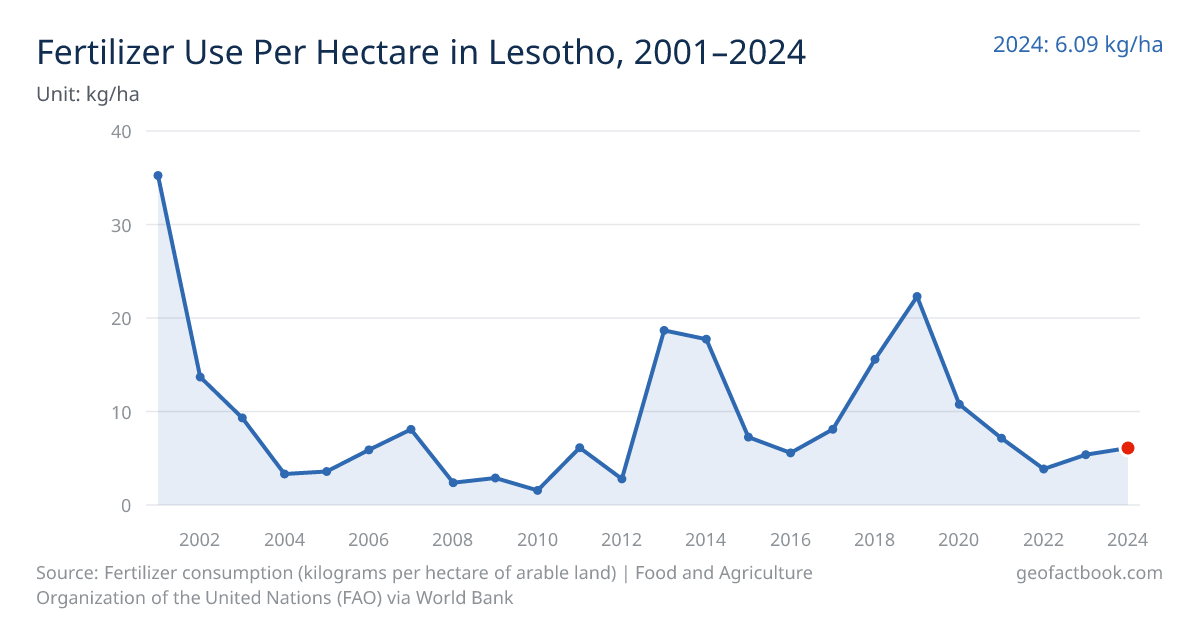
Lesotho's fertilizer use per hectare in 2024 is 6.09 kg/ha, up 13.4% from 2023. It ranks #169 of 189 countries.
Fertilizer use per hectare shows how much fertilizer is applied to agricultural land in different countries, impacting crop yield.
Source (2024): Fertilizer use per hectare
Where Lesotho ranks (2024)
#169 of 189- #167
 Sudan7.1 kg/ha
- #168
 Madagascar6.46 kg/ha
- #169
 Lesotho6.09 kg/ha
- #170
 Chad5.86 kg/ha
- #171
 Gambia5.58 kg/ha
Fertilizer Use Per Hectare over time
| Year | Value | Change | % Change | Actions |
|---|---|---|---|---|
| 2024 | 6.09 kg/ha | +0.72 kg/ha | +13.38% | |
| 2023 | 5.37 kg/ha | +1.52 kg/ha | +39.50% | |
| 2022 | 3.85 kg/ha | 3.3 kg/ha | -46.11% | |
| 2021 | 7.15 kg/ha | 3.62 kg/ha | -33.62% | |
| 2020 | 10.77 kg/ha | 11.53 kg/ha | -51.70% | |
| 2019 | 22.3 kg/ha | +6.72 kg/ha | +43.15% | |
| 2018 | 15.58 kg/ha | +7.48 kg/ha | +92.39% | |
| 2017 | 8.1 kg/ha | +2.52 kg/ha | +45.27% | |
| 2016 | 5.57 kg/ha | 1.69 kg/ha | -23.28% | |
| 2015 | 7.26 kg/ha | 10.47 kg/ha | -59.03% | |
| 2014 | 17.73 kg/ha | 0.94 kg/ha | -5.03% | |
| 2013 | 18.67 kg/ha | +15.88 kg/ha | +568.32% | |
| 2012 | 2.79 kg/ha | 3.33 kg/ha | -54.37% | |
| 2011 | 6.12 kg/ha | +4.56 kg/ha | +291.22% | |
| 2010 | 1.57 kg/ha | 1.32 kg/ha | -45.83% | |
| 2009 | 2.89 kg/ha | +0.51 kg/ha | +21.27% | |
| 2008 | 2.38 kg/ha | 5.71 kg/ha | -70.55% | |
| 2007 | 8.09 kg/ha | +2.19 kg/ha | +37.16% | |
| 2006 | 5.9 kg/ha | +2.32 kg/ha | +64.65% | |
| 2005 | 3.58 kg/ha | +0.26 kg/ha | +7.93% | |
| 2004 | 3.32 kg/ha | 6 kg/ha | -64.38% | |
| 2003 | 9.32 kg/ha | 4.37 kg/ha | -31.91% | |
| 2002 | 13.69 kg/ha | 21.56 kg/ha | -61.17% | |
| 2001 | 35.24 kg/ha | — | — |
Fertilizer Use Per Hectare in Lesotho, 2001–2024: chart
Cite this page
Geo Factbook. (n.d.). Lesotho: Fertilizer Use Per Hectare. Retrieved November 27, 2026, from https://geofactbook.com/countries/lesotho/fertilizer-use-per-hectare
The figures on this page come from Fertilizer consumption (kilograms per hectare of arable land) | Food and Agriculture Organization of the United Nations (FAO) via World Bank. For academic work, cite the original source as well.
Frequently Asked Questions About Lesotho Fertilizer Use Per Hectare
What is Lesotho's fertilizer use per hectare in 2024?▾
Lesotho's fertilizer use per hectare is 6.09 kg/ha in 2024, according to Fertilizer consumption (kilograms per hectare of arable land) | Food and Agriculture Organization of the United Nations (FAO) via World Bank.
Is Lesotho's fertilizer use per hectare increasing or decreasing?▾
Lesotho's fertilizer use per hectare rose by 13.4% from 2023 (5.37 kg/ha) to 2024 (6.09 kg/ha). Over the past decade (2014–2024) it fell by 65.6%.
How does Lesotho rank for fertilizer use per hectare?▾
In 2024, Lesotho has the 169th highest fertilizer use per hectare out of 189 countries with data.
What was Lesotho's fertilizer use per hectare in 2001?▾
In 2001, Lesotho's fertilizer use per hectare was 35.24 kg/ha. By 2024 it fell by 82.7%.
Explore additional statistical insights
Agricultural land in Lesotho
Agricultural land measures the area dedicated to farming and cultivation in countries, impacting food production and sustainability. Understanding this statistic is crucial for assessing agricultural capacity and economic development.
Electricity from Other Renewables in Lesotho
Electricity from other renewables measures alternative energy sources. Explore country comparisons, rankings, and historical trends with interactive maps.
Annual Forest Area Change Rate in Lesotho
Annual forest area change rate indicates how quickly a country's forests are expanding or shrinking each year.
Protected Land Area for Adaptation in Lesotho
Protected land as a climate adaptation strategy ensures biodiversity and resilience against climate impacts.
Electricity from Fossil Fuels in Lesotho
Electricity from fossil fuels measures energy generation trends. Compare countries, explore rankings, and analyze historical data with interactive maps.
Threatened Bird Species Count in Lesotho
Threatened bird species count measures the number of bird species at risk of extinction in each country.