
Lesotho Female population of reproductive age 2026: 673,613
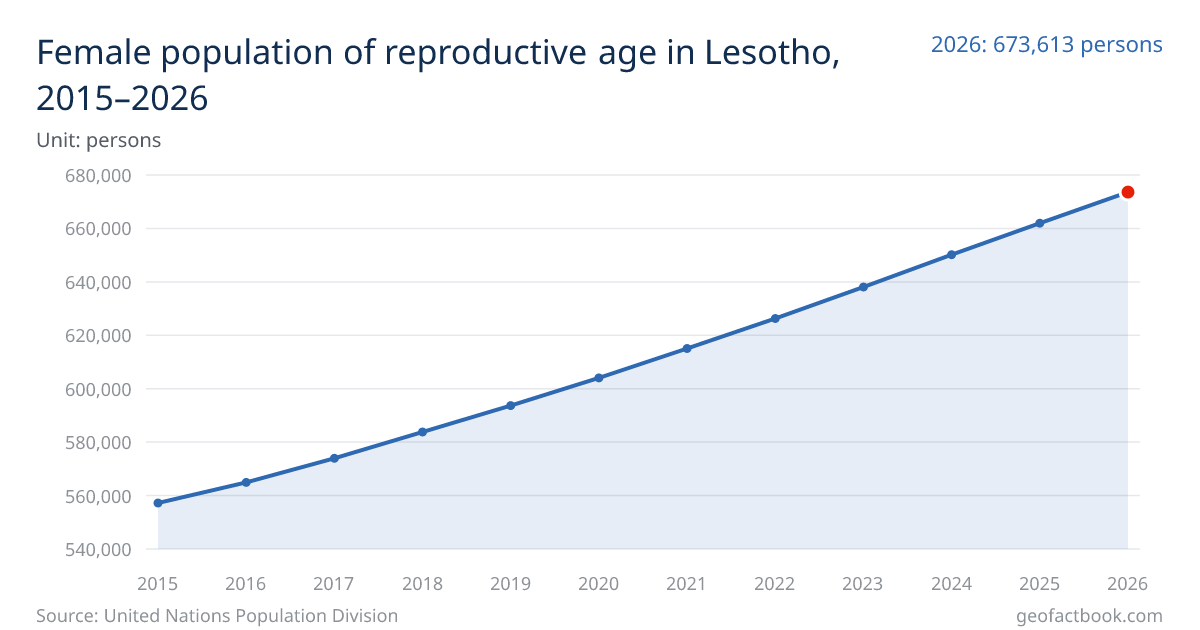
Lesotho's female population of reproductive age in 2026 is 673,613 (estimate), up 1.8% from 2025. It ranks #142 of 236 countries.
The female population of reproductive age is a crucial demographic statistic that influences healthcare, economic growth, and social policies in countries. Understanding this population helps address reproductive health needs and support family planning initiatives.
Estimated value for 2026 (interpolated, no direct source).
Where Lesotho ranks (2026)
#142 of 236- #140
 Puerto Rico709,448.75 persons
- #141
 Republic of Moldova698,079.6 persons
- #142
 Lesotho673,613 persons
- #143
 Gabon652,038.4 persons
- #144
 Bosnia and Herzegovina639,071.55 persons
Female population of reproductive age over timeSome values are estimated based on historical trends
| Year | Value | Change | % Change | Actions |
|---|---|---|---|---|
| 2026 | 673.61K persons | +11.65K persons | +1.76% | |
| 2025 | 661.96K persons | +11.80K persons | +1.81% | |
| 2024 | 650.16K persons | +12.08K persons | +1.89% | |
| 2023 | 638.08K persons | +11.79K persons | +1.88% | |
| 2022 | 626.29K persons | +11.24K persons | +1.83% | |
| 2021 | 615.05K persons | +11.01K persons | +1.82% | |
| 2020 | 604.04K persons | +10.35K persons | +1.74% | |
| 2019 | 593.69K persons | +9.89K persons | +1.69% | |
| 2018 | 583.80K persons | +9.85K persons | +1.72% | |
| 2017 | 573.94K persons | +9.01K persons | +1.59% | |
| 2016 | 564.93K persons | +7.71K persons | +1.38% | |
| 2015 | 557.22K persons | — | — |
Female population of reproductive age in Lesotho, 2015–2026: chart
Cite this page
Geo Factbook. (n.d.). Lesotho: Female population of reproductive age. Retrieved November 28, 2026, from https://geofactbook.com/countries/lesotho/female-population-of-reproductive-age
The figures on this page come from United Nations Population Division. For academic work, cite the original source as well.
Frequently Asked Questions About Lesotho Female population of reproductive age
What is Lesotho's female population of reproductive age in 2026?▾
Lesotho's female population of reproductive age is 673,613 in 2026 (estimate), according to United Nations Population Division.
Is Lesotho's female population of reproductive age increasing or decreasing?▾
Lesotho's female population of reproductive age rose by 1.8% from 2025 (661,960) to 2026 (673,613). Over the past decade (2016–2026) it rose by 19.2%.
How does Lesotho rank for female population of reproductive age?▾
In 2026, Lesotho has the 142nd highest female population of reproductive age out of 236 countries with data.
What was Lesotho's female population of reproductive age in 2015?▾
In 2015, Lesotho's female population of reproductive age was 557,222. By 2026 it rose by 20.9%.
Explore additional statistical insights
Population living in slums in Lesotho
This statistic measures the percentage of a country's population living in slums, highlighting urban poverty and living conditions. Understanding slum populations is crucial for addressing housing challenges and improving the quality of life.
Labor Force in Lesotho
Labor force participation rate measures the active workforce in each country. Explore rankings, compare nations, and view historical trends.
Life expectancy at birth in Lesotho
Life expectancy at birth measures the average years a newborn is expected to live, reflecting a country's health standards and quality of life. This vital statistic highlights disparities in healthcare and living conditions across nations, making it essential for global health assessments.
Human Development Index in Lesotho
The Human Development Index combines indicators of health, education, and income to assess development levels.
Egg Consumption per Capita in Lesotho
Egg consumption per capita measures the average number of eggs consumed annually by individuals in a country.
Population density in Lesotho
Population density measures how many people live per square kilometer in a country, highlighting urbanization and resource distribution. Understanding this statistic is crucial for assessing living conditions, infrastructure needs, and environmental impact.