
Jersey Rule of Law Index by Country 2026: 95.85 %
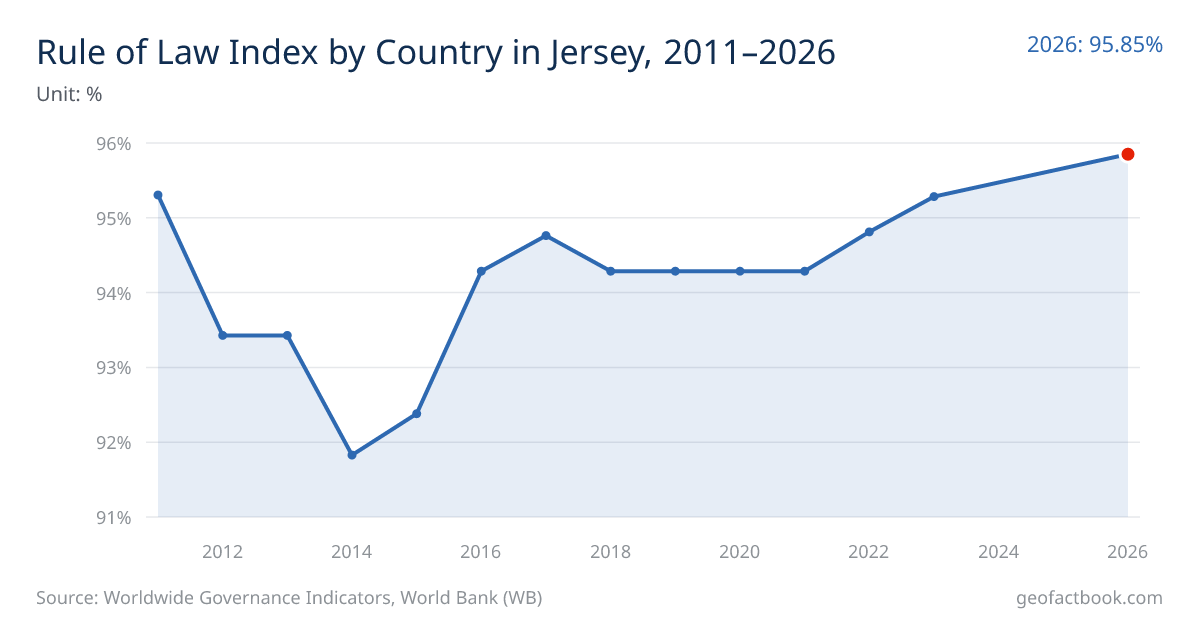
Jersey's rule of law index by country in 2026 is 95.85 % (estimate), up 0.6% from 2023. It ranks #10 of 209 countries.
Compare countries by Rule of Law percentile rank, reflecting confidence in laws, courts, police, property rights, and protection from crime and violence.
Estimated value for 2026 (interpolated, no direct source).
Where Jersey ranks (2026)
#10 of 209




Rule of Law Index by Country over timeSome values are estimated based on historical trends
| Year | Value | Change | % Change | Actions |
|---|---|---|---|---|
| 2026 | 95.85 % | — | — | |
| 2025 | — | — | — | |
| 2024 | — | — | — | |
| 2023 | 95.28 % | +0.47 % | +0.50% | |
| 2022 | 94.81 % | +0.53 % | +0.56% | |
| 2021 | 94.29 % | 0 % | 0.00% | |
| 2020 | 94.29 % | 0 % | 0.00% | |
| 2019 | 94.29 % | 0 % | 0.00% | |
| 2018 | 94.29 % | 0.48 % | -0.50% | |
| 2017 | 94.76 % | +0.48 % | +0.51% | |
| 2016 | 94.29 % | +1.9 % | +2.06% | |
| 2015 | 92.38 % | +0.55 % | +0.60% | |
| 2014 | 91.83 % | 1.6 % | -1.71% | |
| 2013 | 93.43 % | 0 % | 0.00% | |
| 2012 | 93.43 % | 1.88 % | -1.97% | |
| 2011 | 95.31 % | — | — | |
| 2010 | — | — | — | |
| 2009 | — | — | — | |
| 2008 | — | — | — | |
| 2007 | — | — | — | |
| 2006 | — | — | — | |
| 2005 | — | — | — | |
| 2004 | — | — | — | |
| 2003 | — | — | — | |
| 2002 | — | — | — | |
| 2001 | — | — | — | |
| 2000 | — | — | — | |
| 1999 | — | — | — | |
| 1998 | — | — | — | |
| 1997 | — | — | — | |
| 1996 | — | — | — |
Rule of Law Index by Country in Jersey, 2011–2026: chart
Cite this page
Geo Factbook. (n.d.). Jersey: Rule of Law Index by Country. Retrieved November 28, 2026, from https://geofactbook.com/countries/jersey/rule-of-law-index-by-country
The figures on this page come from Worldwide Governance Indicators, World Bank (WB). For academic work, cite the original source as well.
Frequently Asked Questions About Jersey Rule of Law Index by Country
What is Jersey's rule of law index by country in 2026?▾
Jersey's rule of law index by country is 95.85 % in 2026 (estimate), according to Worldwide Governance Indicators, World Bank (WB).
Is Jersey's rule of law index by country increasing or decreasing?▾
Jersey's rule of law index by country rose by 0.6% from 2023 (95.28 %) to 2026 (95.85 %). Over the past decade (2016–2026) it rose by 1.7%.
How does Jersey rank for rule of law index by country?▾
In 2026, Jersey has the 10th highest rule of law index by country out of 209 countries with data.
What was Jersey's rule of law index by country in 2011?▾
In 2011, Jersey's rule of law index by country was 95.31 %. By 2026 it rose by 0.6%.
Explore additional statistical insights
Annual Forest Area Change Rate in Jersey
Annual forest area change rate indicates how quickly a country's forests are expanding or shrinking each year.
Global Average Sex Ratio at Birth in Jersey
Explore the global average sex ratio at birth, highlighting the natural baseline in different countries.
Median age of population in Jersey
The median age of a population is a key demographic indicator, reflecting the age distribution within a country. Understanding median age helps assess economic development, healthcare needs, and social dynamics. Countries with a higher median age may face challenges related to aging populations, while younger populations often indicate growth potential.
Red List Index Score in Jersey
The Red List Index Score indicates the overall extinction risk of species within a country based on the IUCN Red List categories.
Percentage of land area by degree of urbanization in Jersey
Explore the percentage of land area by degree of urbanization, highlighting how urban development shapes countries' landscapes and influences economic growth. Understanding this statistic reveals the balance between urban and rural spaces, essential for sustainable planning.
Percentage of population by degree of urbanization in Jersey
Explore the percentage of population by degree of urbanization across countries, highlighting the shift towards urban living and its impact on economic growth and development. Understanding these trends is crucial for addressing urban planning and resource allocation.