
Jamaica Internet Usage Rate by Country (% of Population) 2023: 89.47 %
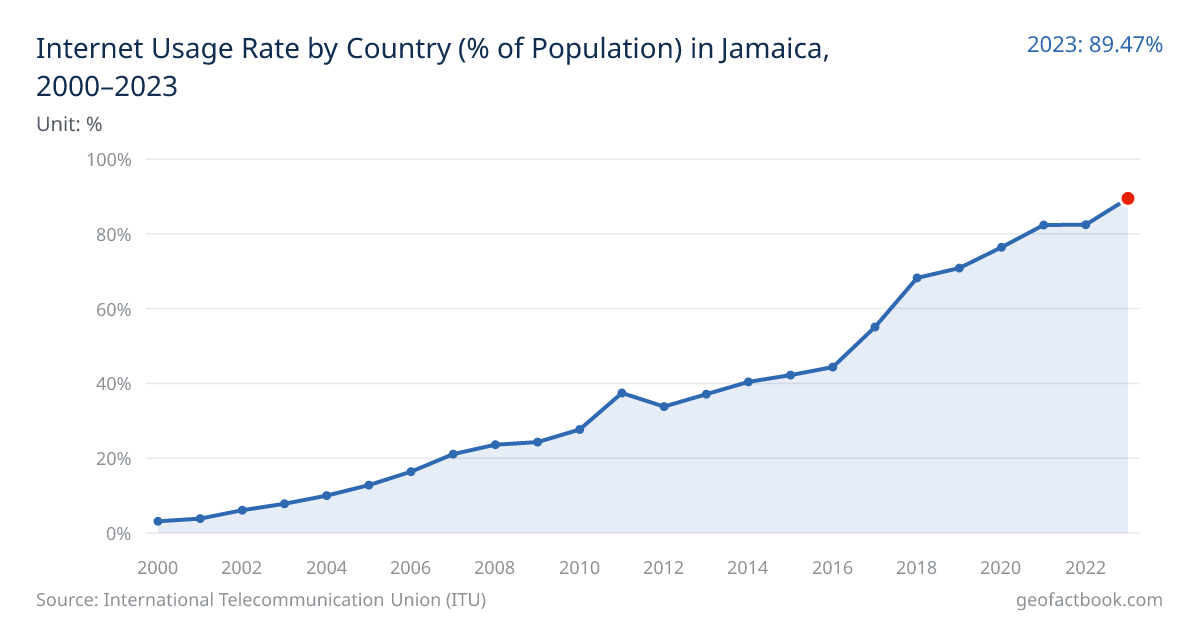
Jamaica's internet usage rate by country (% of population) in 2023 is 89.47 %, up 8.5% from 2022.
Discover the internet usage rate by country, showcasing the percentage of the population online. This statistic highlights digital accessibility and connectivity trends globally, emphasizing the importance of internet access in today's world.
Internet Usage Rate by Country (% of Population) over time
| Year | Value | Change | % Change | Actions |
|---|---|---|---|---|
| 2024 | — | — | — | |
| 2023 | 89.47 % | +7.03 % | +8.52% | |
| 2022 | 82.45 % | +0.08 % | +0.10% | |
| 2021 | 82.36 % | +5.98 % | +7.82% | |
| 2020 | 76.38 % | +5.54 % | +7.82% | |
| 2019 | 70.84 % | +2.63 % | +3.85% | |
| 2018 | 68.21 % | +13.14 % | +23.86% | |
| 2017 | 55.07 % | +10.71 % | +24.13% | |
| 2016 | 44.37 % | +2.15 % | +5.08% | |
| 2015 | 42.22 % | +1.82 % | +4.50% | |
| 2014 | 40.4 % | +3.3 % | +8.90% | |
| 2013 | 37.1 % | +3.31 % | +9.80% | |
| 2012 | 33.79 % | 3.65 % | -9.75% | |
| 2011 | 37.44 % | +9.77 % | +35.30% | |
| 2010 | 27.67 % | +3.37 % | +13.87% | |
| 2009 | 24.3 % | +0.7 % | +2.97% | |
| 2008 | 23.6 % | +2.5 % | +11.85% | |
| 2007 | 21.1 % | +4.7 % | +28.66% | |
| 2006 | 16.4 % | +3.6 % | +28.12% | |
| 2005 | 12.8 % | +2.8 % | +28.00% | |
| 2004 | 10 % | +2.2 % | +28.21% | |
| 2003 | 7.8 % | +1.7 % | +27.87% | |
| 2002 | 6.1 % | +2.24 % | +57.91% | |
| 2001 | 3.86 % | +0.75 % | +23.98% | |
| 2000 | 3.12 % | — | — |
Internet Usage Rate by Country (% of Population) in Jamaica, 2000–2023: chart
Cite this page
Geo Factbook. (n.d.). Jamaica: Internet Usage Rate by Country (% of Population). Retrieved November 29, 2026, from https://geofactbook.com/countries/jamaica/internet-usage-rate-by-country-percentage-of-population
The figures on this page come from International Telecommunication Union (ITU). For academic work, cite the original source as well.
Frequently Asked Questions About Jamaica Internet Usage Rate by Country (% of Population)
What is Jamaica's internet usage rate by country (% of population) in 2023?▾
Jamaica's internet usage rate by country (% of population) is 89.47 % in 2023, according to International Telecommunication Union (ITU).
Is Jamaica's internet usage rate by country (% of population) increasing or decreasing?▾
Jamaica's internet usage rate by country (% of population) rose by 8.5% from 2022 (82.45 %) to 2023 (89.47 %). Over the past decade (2013–2023) it rose by 141.2%.
What was Jamaica's internet usage rate by country (% of population) in 2000?▾
In 2000, Jamaica's internet usage rate by country (% of population) was 3.12 %. By 2023 it rose by 2771.6%.
Explore additional statistical insights
Waterways in Jamaica
Waterways data highlights the extent of navigable routes in each country. Explore rankings, compare nations, and view interactive maps.
AI Preparedness Index in Jamaica
The IMF's AI Preparedness Index scores how ready a country is to adopt artificial intelligence, on a scale from 0 to 1 (higher is better prepared). It combines four areas: digital infrastructure, human capital and labour market policies, innovation and economic integration, and regulation and ethics. It measures readiness, not how many jobs AI has replaced or could affect.
Press Freedom Index Score in Jamaica
The Press Freedom Index Score measures the level of media freedom in countries worldwide. A higher score indicates stronger press independence, essential for democracy and transparency. Understanding these scores helps highlight the importance of free expression in society.
Internet Penetration Rate (%) in Jamaica
The Internet Penetration Rate indicates the percentage of the population with internet access, crucial for digital public service access.
Internet Users (% of Population) in Jamaica
Explore Internet Users worldwide, compare usage rates by country, and visualize trends with interactive maps and rankings.
Total net-migration in Jamaica
Total net-migration measures the difference between the number of immigrants and emigrants in a country, reflecting population shifts and economic opportunities. Understanding this statistic is crucial for analyzing demographic trends and policy impacts in nations worldwide.