
Greece Hospital Beds per Capita 2022: 4.27 beds per 1,000
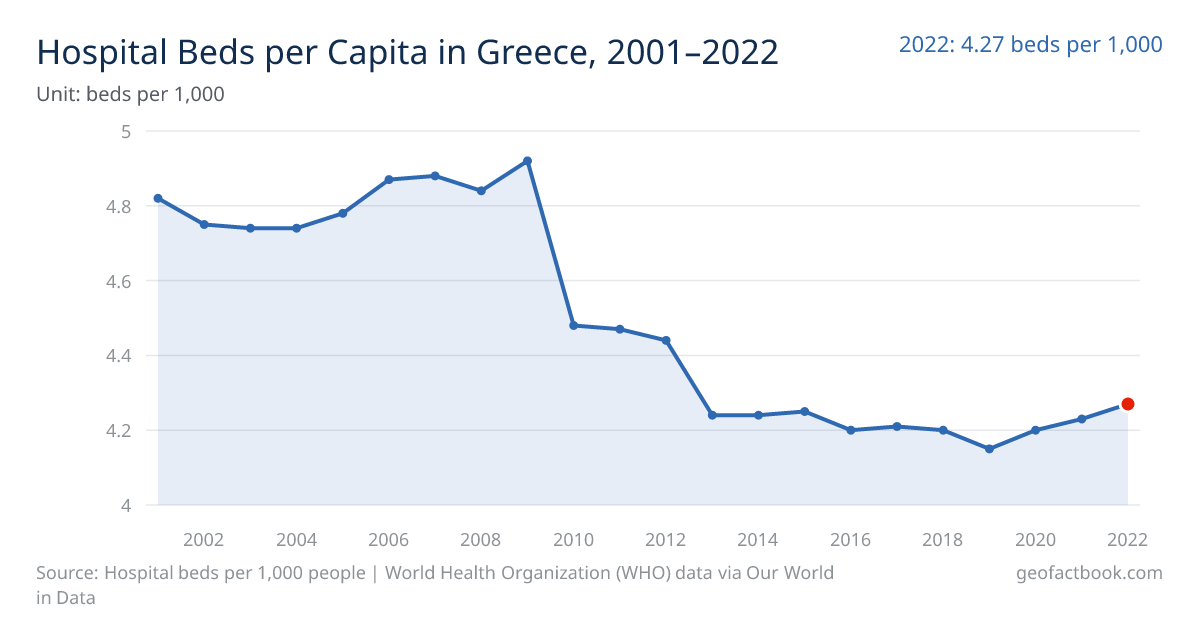
Greece's hospital beds per capita in 2022 is 4.27 beds per 1,000, up 0.9% from 2021. It ranks #29 of 111 countries.
Hospital beds per capita highlights healthcare infrastructure by showing available hospital beds per 1,000 people globally.
Source (2022): Hospital beds per 1,000 people | Our World in Data
Where Greece ranks (2022)
#29 of 111- #27
 Switzerland4.41 beds per 1,000
- #28
 Cuba4.32 beds per 1,000
- #29
 Greece4.27 beds per 1,000
- #30
 Tajikistan4.22 beds per 1,000
- #31
 Armenia4.2 beds per 1,000
Hospital Beds per Capita over time
| Year | Value | Change | % Change | Actions |
|---|---|---|---|---|
| 2022 | 4.27 beds per 1,000 | +0.04 beds per 1,000 | +0.95% | |
| 2021 | 4.23 beds per 1,000 | +0.03 beds per 1,000 | +0.71% | |
| 2020 | 4.2 beds per 1,000 | +0.05 beds per 1,000 | +1.20% | |
| 2019 | 4.15 beds per 1,000 | 0.05 beds per 1,000 | -1.19% | |
| 2018 | 4.2 beds per 1,000 | 0.01 beds per 1,000 | -0.24% | |
| 2017 | 4.21 beds per 1,000 | +0.01 beds per 1,000 | +0.24% | |
| 2016 | 4.2 beds per 1,000 | 0.05 beds per 1,000 | -1.18% | |
| 2015 | 4.25 beds per 1,000 | +0.01 beds per 1,000 | +0.24% | |
| 2014 | 4.24 beds per 1,000 | 0 beds per 1,000 | 0.00% | |
| 2013 | 4.24 beds per 1,000 | 0.2 beds per 1,000 | -4.50% | |
| 2012 | 4.44 beds per 1,000 | 0.03 beds per 1,000 | -0.67% | |
| 2011 | 4.47 beds per 1,000 | 0.01 beds per 1,000 | -0.22% | |
| 2010 | 4.48 beds per 1,000 | 0.44 beds per 1,000 | -8.94% | |
| 2009 | 4.92 beds per 1,000 | +0.08 beds per 1,000 | +1.65% | |
| 2008 | 4.84 beds per 1,000 | 0.04 beds per 1,000 | -0.82% | |
| 2007 | 4.88 beds per 1,000 | +0.01 beds per 1,000 | +0.21% | |
| 2006 | 4.87 beds per 1,000 | +0.09 beds per 1,000 | +1.88% | |
| 2005 | 4.78 beds per 1,000 | +0.04 beds per 1,000 | +0.84% | |
| 2004 | 4.74 beds per 1,000 | 0 beds per 1,000 | 0.00% | |
| 2003 | 4.74 beds per 1,000 | 0.01 beds per 1,000 | -0.21% | |
| 2002 | 4.75 beds per 1,000 | 0.07 beds per 1,000 | -1.45% | |
| 2001 | 4.82 beds per 1,000 | — | — |
Hospital Beds per Capita in Greece, 2001–2022: chart
Cite this page
Geo Factbook. (n.d.). Greece: Hospital Beds per Capita. Retrieved November 27, 2026, from https://geofactbook.com/countries/greece/hospital-beds-per-capita
The figures on this page come from Hospital beds per 1,000 people | World Health Organization (WHO) data via Our World in Data. For academic work, cite the original source as well.
Frequently Asked Questions About Greece Hospital Beds per Capita
What is Greece's hospital beds per capita in 2022?▾
Greece's hospital beds per capita is 4.27 beds per 1,000 in 2022, according to Hospital beds per 1,000 people | World Health Organization (WHO) data via Our World in Data.
Is Greece's hospital beds per capita increasing or decreasing?▾
Greece's hospital beds per capita rose by 0.9% from 2021 (4.23 beds per 1,000) to 2022 (4.27 beds per 1,000). Over the past decade (2012–2022) it fell by 3.8%.
How does Greece rank for hospital beds per capita?▾
In 2022, Greece has the 29th highest hospital beds per capita out of 111 countries with data.
What was Greece's hospital beds per capita in 2001?▾
In 2001, Greece's hospital beds per capita was 4.82 beds per 1,000. By 2022 it fell by 11.4%.
Explore additional statistical insights
Low Birth Weight Prevalence in Greece
Low birth weight prevalence shows the percentage of newborns weighing less than 2,500 grams at birth.
Breast Cancer Mortality Rate in Greece
Breast cancer mortality rate measures deaths per 100,000 women; indicates healthcare effectiveness.
Health Care Spending per Capita in Greece
Health care spending per capita measures the average health expenditure per person in a country, highlighting affordability.
Highest Male Life Expectancy in Greece
Discover countries where males live the longest, with life expectancy surpassing global averages significantly.
Health Coverage Index Score in Greece
Health Coverage Index Score assesses a country's capacity to provide essential health services to its population.
Physicians per 1,000 People in Greece
The total number of doctors in each country reflects healthcare workforce size and capacity to serve the population.