
North Rhine-Westphalia Population Density by Year (2015–2024)
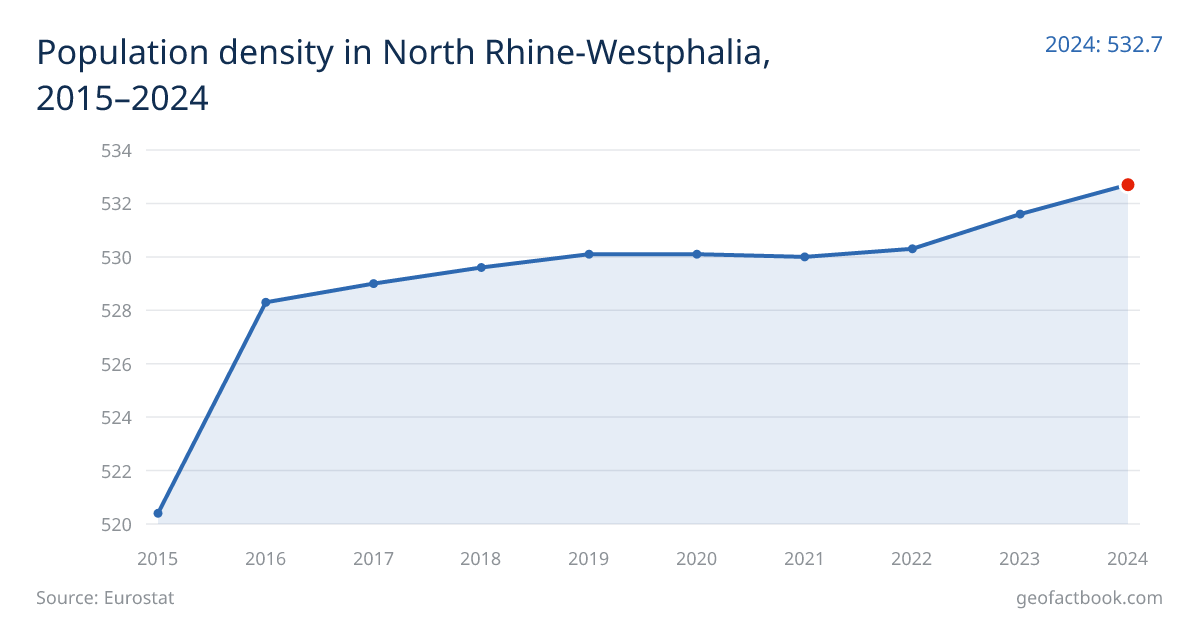
North Rhine-Westphalia's population density was 533 per km² in 2024, the 4th highest of any state. Since 2015 (520 per km²) it changed by +2.4%. It has ranked 4th in both 2015 and 2024.
Population density in North Rhine-Westphalia by year
| Year | Population density | Change | Rank among states |
|---|---|---|---|
| 2024 | 533 per km² | +0.2% | 4 of 16 |
| 2023 | 532 per km² | +0.2% | 4 of 16 |
| 2022 | 530 per km² | +0.1% | 4 of 16 |
| 2021 | 530 per km² | ±0.0% | 4 of 16 |
| 2020 | 530 per km² | ±0.0% | 4 of 16 |
| 2019 | 530 per km² | +0.1% | 4 of 16 |
| 2018 | 530 per km² | +0.1% | 4 of 16 |
| 2017 | 529 per km² | +0.1% | 4 of 16 |
| 2016 | 528 per km² | +1.5% | 4 of 16 |
| 2015 | 520 per km² | — | 4 of 16 |
Eurostat, Population density by NUTS 3 region (demo_r_d3dens). Unit: people per km². Rank 1 is the highest value that year; change is from the previous year shown.
Population density in North Rhine-Westphalia, 2015–2024: chart
Frequently Asked Questions About North Rhine-Westphalia population density
What is the population density of North Rhine-Westphalia?▾
North Rhine-Westphalia's population density was 533 per km² in 2024, according to Eurostat (Population density by NUTS 3 region (demo_r_d3dens)).
Where does North Rhine-Westphalia rank among German states in population density?▾
In 2024, North Rhine-Westphalia had the 4th highest population density of any state: 4th of 16.
How has North Rhine-Westphalia's population density changed since 2015?▾
It went from 520 per km² in 2015 to 533 per km² in 2024 (+2.4%). The highest value in that period was 533 per km² in 2024.
More about North Rhine-Westphalia
Cite this page
Geo Factbook. (n.d.). North Rhine-Westphalia Population Density by Year (2015–2024). Retrieved November 28, 2026, from https://geofactbook.com/countries/germany/states/north-rhine-westphalia/population-density
The figures on this page come from Eurostat. For academic work, cite the original source as well.