
North Rhine-Westphalia Median Age by Year (2015–2025)
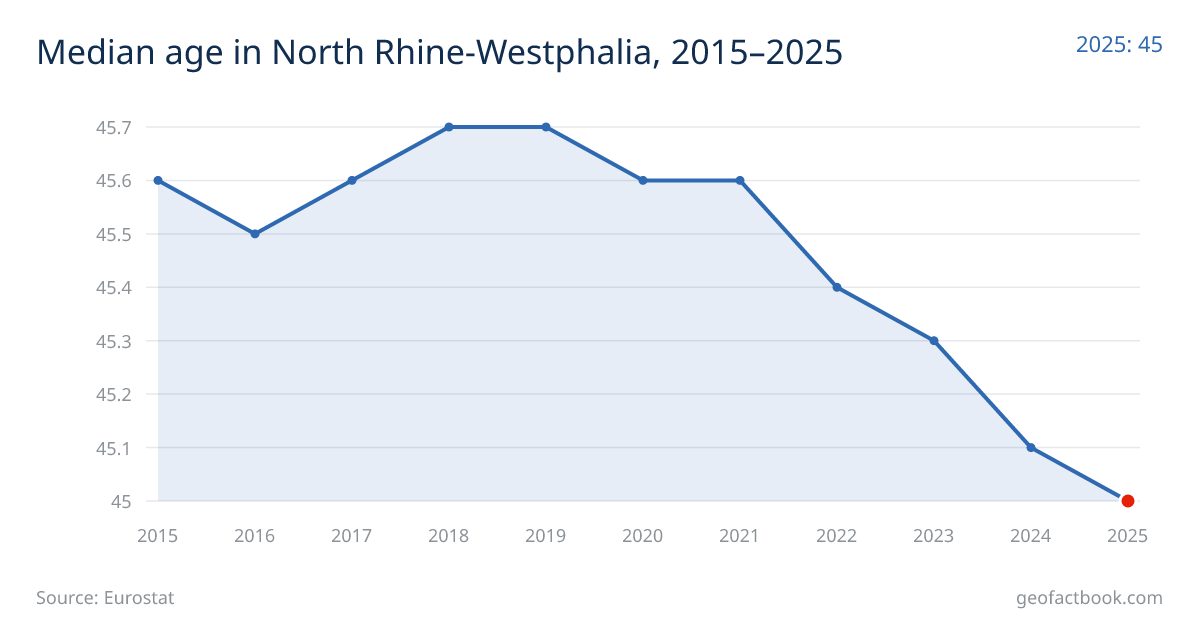
North Rhine-Westphalia's median age was 45.0 years in 2025, the 7th lowest of any state. Since 2015 (45.6 years) it changed by −1.3%. The highest value in this period was 45.7 years in 2019. It has ranked 10th in both 2015 and 2025.
Median age in North Rhine-Westphalia by year
| Year | Median age | Change | Rank among states |
|---|---|---|---|
| 2025 | 45.0 years | −0.2% | 10 of 16 |
| 2024 | 45.1 years | −0.4% | 10 of 16 |
| 2023 | 45.3 years | −0.2% | 10 of 16 |
| 2022 | 45.4 years | −0.4% | 10 of 16 |
| 2021 | 45.6 years | ±0.0% | 10 of 16 |
| 2020 | 45.6 years | −0.2% | 10 of 16 |
| 2019 | 45.7 years | ±0.0% | 10 of 16 |
| 2018 | 45.7 years | +0.2% | 10 of 16 |
| 2017 | 45.6 years | +0.2% | 10 of 16 |
| 2016 | 45.5 years | −0.2% | 10 of 16 |
| 2015 | 45.6 years | — | 10 of 16 |
Eurostat, Population structure indicators by NUTS 2 region, median age (demo_r_pjanind2). Unit: years. Rank 1 is the highest value that year; change is from the previous year shown.
Median age in North Rhine-Westphalia, 2015–2025: chart
Frequently Asked Questions About North Rhine-Westphalia median age
What is the median age of North Rhine-Westphalia?▾
North Rhine-Westphalia's median age was 45.0 years in 2025, according to Eurostat (Population structure indicators by NUTS 2 region, median age (demo_r_pjanind2)).
Where does North Rhine-Westphalia rank among German states in median age?▾
In 2025, North Rhine-Westphalia had the 7th lowest median age of any state: 10th of 16.
How has North Rhine-Westphalia's median age changed since 2015?▾
It went from 45.6 years in 2015 to 45.0 years in 2025 (−1.3%). The highest value in that period was 45.7 years in 2019.
More about North Rhine-Westphalia
Cite this page
Geo Factbook. (n.d.). North Rhine-Westphalia Median Age by Year (2015–2025). Retrieved November 28, 2026, from https://geofactbook.com/countries/germany/states/north-rhine-westphalia/median-age
The figures on this page come from Eurostat. For academic work, cite the original source as well.