
Fiji Total Armed Forces Personnel (PPP) 2020: 4,000
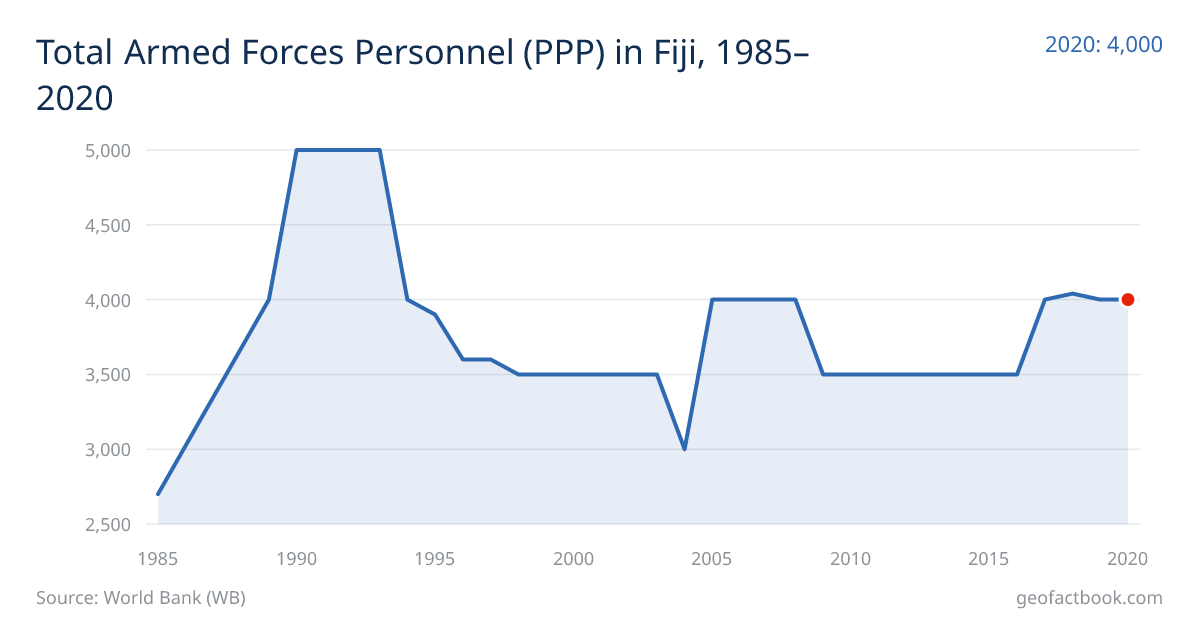
Fiji's total armed forces personnel (ppp) in 2020 is 4,000, unchanged from 2019. It ranks #148 of 170 countries.
Explore total armed forces personnel across 266+ countries. Compare military size, view rankings, and analyze historical trends on our interactive map.
Where Fiji ranks (2020)
#148 of 170- #145
 Republic of Moldova6,000
- #147
 Trinidad and Tobago5,000
- #148
 Fiji4,000
- #148
 Gambia4,000
- #148
 Guinea-Bissau4,000
Total Armed Forces Personnel (PPP) over time
| Year | Value | Change | % Change | Actions |
|---|---|---|---|---|
| 2020 | 4.00K | 0 | 0.00% | |
| 2019 | 4.00K | 40 | -0.99% | |
| 2018 | 4.04K | +40 | +1.00% | |
| 2017 | 4.00K | +500 | +14.29% | |
| 2016 | 3.50K | 0 | 0.00% | |
| 2015 | 3.50K | 0 | 0.00% | |
| 2014 | 3.50K | 0 | 0.00% | |
| 2013 | 3.50K | 0 | 0.00% | |
| 2012 | 3.50K | 0 | 0.00% | |
| 2011 | 3.50K | 0 | 0.00% | |
| 2010 | 3.50K | 0 | 0.00% | |
| 2009 | 3.50K | 500 | -12.50% | |
| 2008 | 4.00K | 0 | 0.00% | |
| 2007 | 4.00K | 0 | 0.00% | |
| 2006 | 4.00K | 0 | 0.00% | |
| 2005 | 4.00K | +1.00K | +33.33% | |
| 2004 | 3.00K | 500 | -14.29% | |
| 2003 | 3.50K | 0 | 0.00% | |
| 2002 | 3.50K | 0 | 0.00% | |
| 2001 | 3.50K | 0 | 0.00% | |
| 2000 | 3.50K | 0 | 0.00% | |
| 1999 | 3.50K | 0 | 0.00% | |
| 1998 | 3.50K | 100 | -2.78% | |
| 1997 | 3.60K | 0 | 0.00% | |
| 1996 | 3.60K | 300 | -7.69% | |
| 1995 | 3.90K | 100 | -2.50% | |
| 1994 | 4.00K | 1.00K | -20.00% | |
| 1993 | 5.00K | 0 | 0.00% | |
| 1992 | 5.00K | 0 | 0.00% | |
| 1991 | 5.00K | 0 | 0.00% | |
| 1990 | 5.00K | +1.00K | +25.00% | |
| 1989 | 4.00K | +1.30K | +48.15% | |
| 1985 | 2.70K | — | — |
Total Armed Forces Personnel (PPP) in Fiji, 1985–2020: chart
Cite this page
Geo Factbook. (n.d.). Fiji: Total Armed Forces Personnel (PPP). Retrieved November 27, 2026, from https://geofactbook.com/countries/fiji/armed-forces-personnel-total
The figures on this page come from World Bank (WB). For academic work, cite the original source as well.
Frequently Asked Questions About Fiji Total Armed Forces Personnel (PPP)
What is Fiji's total armed forces personnel (ppp) in 2020?▾
Fiji's total armed forces personnel (ppp) is 4,000 in 2020, according to World Bank (WB).
Is Fiji's total armed forces personnel (ppp) increasing or decreasing?▾
Fiji's total armed forces personnel (ppp) was essentially unchanged from 2019 (4,000) to 2020 (4,000). Over the past decade (2010–2020) it rose by 14.3%.
How does Fiji rank for total armed forces personnel (ppp)?▾
In 2020, Fiji has the 148th highest total armed forces personnel (ppp) out of 170 countries with data.
What was Fiji's total armed forces personnel (ppp) in 1985?▾
In 1985, Fiji's total armed forces personnel (ppp) was 2,700. By 2020 it rose by 48.1%.
Explore additional statistical insights
Military Expenditures (% of GDP) in Fiji
Military Expenditures as a percentage of GDP highlights national defense spending. Compare countries, explore rankings, and view trends.
Carbon Intensity of GDP in Fiji
Carbon intensity of GDP measures CO2 emissions per unit of GDP, indicating economic efficiency and environmental impact.
Median age of population in Fiji
The median age of a population is a key demographic indicator, reflecting the age distribution within a country. Understanding median age helps assess economic development, healthcare needs, and social dynamics. Countries with a higher median age may face challenges related to aging populations, while younger populations often indicate growth potential.
Capture Fisheries Production in Fiji
Capture fisheries production measures the total fish catch in a country annually, indicating its fishing industry's size and activity.
Urban Informal Employment Share in Fiji
Urban informal employment share indicates the percentage of workers in informal jobs within urban areas.
Percentage of population by degree of urbanization in Fiji
Explore the percentage of population by degree of urbanization across countries, highlighting the shift towards urban living and its impact on economic growth and development. Understanding these trends is crucial for addressing urban planning and resource allocation.