
Europe, Northern America, Australia, and New Zealand Female population of reproductive age 2026: 254.51 Million
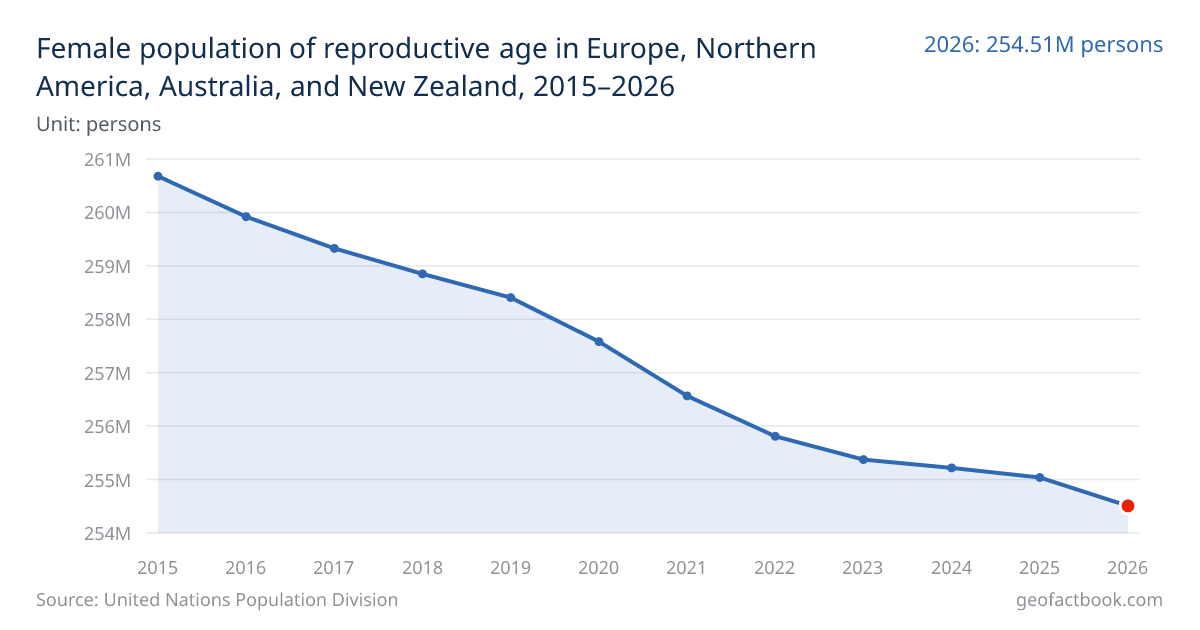
Europe, Northern America, Australia, and New Zealand's female population of reproductive age in 2026 is 254.51 Million (estimate), down 0.2% from 2025.
The female population of reproductive age is a crucial demographic statistic that influences healthcare, economic growth, and social policies in countries. Understanding this population helps address reproductive health needs and support family planning initiatives.
Estimated value for 2026 (interpolated, no direct source).
More about Europe, Northern America, Australia, and New Zealand
- Percentage of population by degree of urbanization73.87%
- Total population1.17B persons
- Under-five mortality rate4.41 per live births
Female population of reproductive age over timeSome values are estimated based on historical trends
| Year | Value | Change | % Change | Actions |
|---|---|---|---|---|
| 2026 | 254.51M persons | 530.23K persons | -0.21% | |
| 2025 | 255.04M persons | 181.13K persons | -0.07% | |
| 2024 | 255.22M persons | 155.11K persons | -0.06% | |
| 2023 | 255.37M persons | 435.70K persons | -0.17% | |
| 2022 | 255.81M persons | 755.20K persons | -0.29% | |
| 2021 | 256.57M persons | 1.02M persons | -0.39% | |
| 2020 | 257.58M persons | 824.36K persons | -0.32% | |
| 2019 | 258.41M persons | 443.72K persons | -0.17% | |
| 2018 | 258.85M persons | 477.10K persons | -0.18% | |
| 2017 | 259.33M persons | 592.39K persons | -0.23% | |
| 2016 | 259.92M persons | 758.62K persons | -0.29% | |
| 2015 | 260.68M persons | — | — |
Female population of reproductive age in Europe, Northern America, Australia, and New Zealand, 2015–2026: chart
Cite this page
Geo Factbook. (n.d.). Europe, Northern America, Australia, and New Zealand: Female population of reproductive age. Retrieved November 29, 2026, from https://geofactbook.com/countries/europe-northern-america-australia-and-new-zealand/female-population-of-reproductive-age
The figures on this page come from United Nations Population Division. For academic work, cite the original source as well.
Frequently Asked Questions About Europe, Northern America, Australia, and New Zealand Female population of reproductive age
What is Europe, Northern America, Australia, and New Zealand's female population of reproductive age in 2026?▾
Europe, Northern America, Australia, and New Zealand's female population of reproductive age is 254.51 Million in 2026 (estimate), according to United Nations Population Division.
Is Europe, Northern America, Australia, and New Zealand's female population of reproductive age increasing or decreasing?▾
Europe, Northern America, Australia, and New Zealand's female population of reproductive age fell by 0.2% from 2025 (255.04 Million) to 2026 (254.51 Million). Over the past decade (2016–2026) it fell by 2.1%.
What was Europe, Northern America, Australia, and New Zealand's female population of reproductive age in 2015?▾
In 2015, Europe, Northern America, Australia, and New Zealand's female population of reproductive age was 260.68 Million. By 2026 it fell by 2.4%.
Explore additional statistical insights
Contraceptive Prevalence Rate in Europe, Northern America, Australia, and New Zealand
Contraceptive Prevalence Rate indicates the percentage of women using contraception. Explore global rankings, compare countries, and view trends.
Total fertility rate in Europe, Northern America, Australia, and New Zealand
The total fertility rate measures the average number of children a woman is expected to have during her lifetime, reflecting population growth and demographic trends. Understanding this statistic is crucial for analyzing economic development, healthcare needs, and societal changes across countries.
Death Rate (%) in Europe, Northern America, Australia, and New Zealand
Explore death rate statistics across countries. Compare rates, view historical trends, and interact with dynamic maps for deeper insights.
Major Urban Areas Population in Europe, Northern America, Australia, and New Zealand
Explore population figures for major urban areas worldwide. Compare cities, view rankings, and interact with detailed maps.
Education Expenditure (% of GDP) in Europe, Northern America, Australia, and New Zealand
Education expenditure measures the percentage of GDP spent on education. Compare countries and explore interactive rankings and trends.
Life expectancy at birth in Europe, Northern America, Australia, and New Zealand
Life expectancy at birth measures the average years a newborn is expected to live, reflecting a country's health standards and quality of life. This vital statistic highlights disparities in healthcare and living conditions across nations, making it essential for global health assessments.