
Equatorial Guinea Urban Population Share 2050 2025: 71.58 %
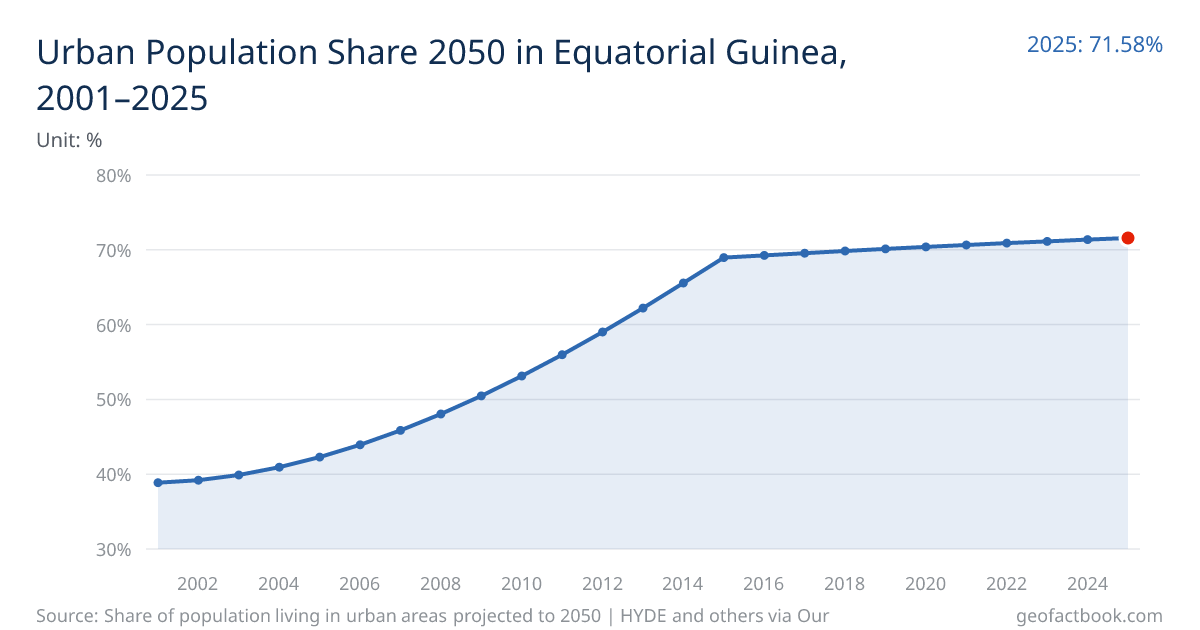
Equatorial Guinea's urban population share 2050 in 2025 is 71.58 %, up 0.3% from 2024. It ranks #96 of 236 countries.
Urban population share by 2050 shows urbanization trends. Discover which countries will be most urbanized.
Source (2025): Share of population living in urban areas projected to 2050 | Our World in Data
Where Equatorial Guinea ranks (2025)
#96 of 236- #94
 Dominican Republic72.52%
- #95
 Syrian Arab Republic72.08%
- #96
 Equatorial Guinea71.58%
- #97
 Bolivia71.56%
- #98
 Angola71.46%
Urban Population Share 2050 over time
| Year | Value | Change | % Change | Actions |
|---|---|---|---|---|
| 2025 | 71.58 % | +0.22 % | +0.31% | |
| 2024 | 71.36 % | +0.23 % | +0.32% | |
| 2023 | 71.13 % | +0.24 % | +0.34% | |
| 2022 | 70.89 % | +0.25 % | +0.35% | |
| 2021 | 70.64 % | +0.26 % | +0.37% | |
| 2020 | 70.39 % | +0.27 % | +0.38% | |
| 2019 | 70.12 % | +0.28 % | +0.40% | |
| 2018 | 69.84 % | +0.29 % | +0.41% | |
| 2017 | 69.55 % | +0.3 % | +0.43% | |
| 2016 | 69.25 % | +0.3 % | +0.44% | |
| 2015 | 68.95 % | +3.39 % | +5.17% | |
| 2014 | 65.56 % | +3.35 % | +5.38% | |
| 2013 | 62.21 % | +3.2 % | +5.42% | |
| 2012 | 59.01 % | +3.04 % | +5.42% | |
| 2011 | 55.97 % | +2.85 % | +5.37% | |
| 2010 | 53.12 % | +2.65 % | +5.25% | |
| 2009 | 50.47 % | +2.43 % | +5.05% | |
| 2008 | 48.04 % | +2.19 % | +4.77% | |
| 2007 | 45.86 % | +1.93 % | +4.39% | |
| 2006 | 43.93 % | +1.65 % | +3.90% | |
| 2005 | 42.28 % | +1.35 % | +3.30% | |
| 2004 | 40.93 % | +1.03 % | +2.59% | |
| 2003 | 39.9 % | +0.7 % | +1.78% | |
| 2002 | 39.2 % | +0.33 % | +0.86% | |
| 2001 | 38.86 % | — | — |
Urban Population Share 2050 in Equatorial Guinea, 2001–2025: chart
Cite this page
Geo Factbook. (n.d.). Equatorial Guinea: Urban Population Share 2050. Retrieved November 29, 2026, from https://geofactbook.com/countries/equatorial-guinea/urban-population-share-2050
The figures on this page come from Share of population living in urban areas projected to 2050 | HYDE and others via Our World in Data. For academic work, cite the original source as well.
Frequently Asked Questions About Equatorial Guinea Urban Population Share 2050
What is Equatorial Guinea's urban population share 2050 in 2025?▾
Equatorial Guinea's urban population share 2050 is 71.58 % in 2025, according to Share of population living in urban areas projected to 2050 | HYDE and others via Our World in Data.
Is Equatorial Guinea's urban population share 2050 increasing or decreasing?▾
Equatorial Guinea's urban population share 2050 rose by 0.3% from 2024 (71.36 %) to 2025 (71.58 %). Over the past decade (2015–2025) it rose by 3.8%.
How does Equatorial Guinea rank for urban population share 2050?▾
In 2025, Equatorial Guinea has the 96th highest urban population share 2050 out of 236 countries with data.
What was Equatorial Guinea's urban population share 2050 in 2001?▾
In 2001, Equatorial Guinea's urban population share 2050 was 38.86 %. By 2025 it rose by 84.2%.
Explore additional statistical insights
Education Expenditure (% of GDP) in Equatorial Guinea
Education expenditure measures the percentage of GDP spent on education. Compare countries and explore interactive rankings and trends.
Death Rate (%) in Equatorial Guinea
Explore death rate statistics across countries. Compare rates, view historical trends, and interact with dynamic maps for deeper insights.
Total population in Equatorial Guinea
Discover the latest total population statistics for every country and region worldwide. Explore accurate, up-to-date data on global population growth, density, and demographic trends — sourced from trusted international databases like the UN and World Bank. Perfect for researchers, students, and data enthusiasts looking to understand how the world’s population is changing.
Average Spirits Consumption Per Capita in Equatorial Guinea
Average spirits consumption per capita highlights drinking habits in different countries, measured in liters annually.
Total net-migration in Equatorial Guinea
Total net-migration measures the difference between the number of immigrants and emigrants in a country, reflecting population shifts and economic opportunities. Understanding this statistic is crucial for analyzing demographic trends and policy impacts in nations worldwide.
Population Change in Equatorial Guinea
This statistic measures population change across countries, highlighting shifts in demographics. Understanding these changes is crucial for planning resources, economic growth, and social services.