
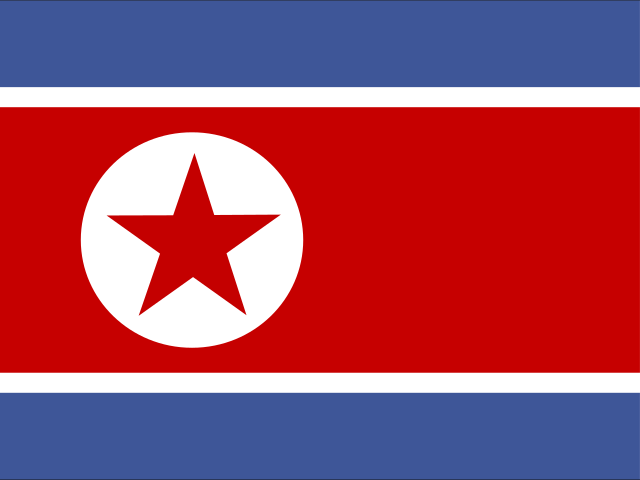
Location
North Korea is in Eastern Asia, northern half of the Korean Peninsula bordering the Korea Bay and the Sea of Japan, between China and South Korea. It shares land borders with China (1,352 km), South Korea (237 km) and Russia (18 km) and has 2,495 km of coastline. The capital is Pyongyang.
North Korea population 2026: 26.64 Million — growth, rank & history →Key Statistics for 2026
Total population
Population Change
Median age of population
Population density
Life expectancy at birth
Agricultural land
Dam capacity per capita
Female population of reproductive age
Percentage of population by degree of urbanization
Population living in slums
Protected Land Area for Adaptation
History
North Korea, officially known as the Democratic People's Republic of Korea (DPRK), has a rich historical narrative that traces back to its ancient origins. The Korean Peninsula has been inhabited since prehistoric times, with archaeological evidence suggesting that complex societies emerged around 3000 BCE. The first historically recorded kingdom, Gojoseon, was founded around 2333 BCE, according to Korean legend, and it played a crucial role in shaping early Korean identity. Over the centuries, various kingdoms such as Goguryeo, Baekje, and Silla emerged, contributing to the cultural and political landscape of the region. By the 668 AD unification under Silla, the Korean state began to develop its identity, which included the adoption of Buddhism and Confucianism as integral parts of society.
The medieval period saw significant developments in North Korean history, particularly during the Goryeo Dynasty (918-1392), which is noted for its cultural achievements and the establishment of a centralized government. The name "Korea" is derived from Goryeo. This era was marked by advancements in science, technology, and the arts, including the invention of movable metal type printing. Following the Goryeo Dynasty, the Joseon Dynasty (1392-1910) further solidified Confucian ideals within Korean society, influencing everything from governance to social hierarchy. During this period, Korea also faced invasions from Japan and the Manchu, which significantly impacted its geopolitical landscape.
The modern history of North Korea is largely defined by the Japanese occupation from 1910 to 1945, which ended after Japan's defeat in World War II. Following this, the Korean Peninsula was divided along the 38th parallel into two zones of occupation, with the Soviet Union controlling the north and the United States the south. This division culminated in the establishment of the Democratic People's Republic of Korea in 1948 under Kim Il-sung, who became its first leader. The Korean War (1950-1953) erupted shortly afterward, leading to a devastating conflict that solidified the division and led to a military stalemate. The armistice signed in 1953 effectively established the Korean Demilitarized Zone (DMZ), which remains one of the most fortified borders in the world.
In recent decades, North Korea has gained international attention due to its nuclear weapons program and ongoing human rights issues. The nation has been subjected to various sanctions by the United Nations in response to its nuclear tests, particularly in 2006, 2009, and 2016. North Korea's leadership under Kim Jong-un has sparked significant dialogue and tension with other nations, notably during the summits with U.S. President Donald Trump in 2018 and 2019, which sought to address denuclearization but ultimately resulted in limited progress. Today, North Korea remains a subject of global scrutiny, reflecting a complex interplay of historical legacies and contemporary geopolitical challenges.
Geography
North Korea, officially known as the Democratic People's Republic of Korea (DPRK), is located in East Asia on the northern part of the Korean Peninsula. It shares its borders with China to the north and northwest, Russia to the northeast, and South Korea to the south, with the heavily fortified Korean Demilitarized Zone (DMZ) acting as a buffer between the two Koreas. The country has a coastline along the Yellow Sea to the west and the Sea of Japan (East Sea) to the east, giving it a strategic position in Northeast Asia.
The physical geography of North Korea is characterized by mountainous terrain, with approximately 80% of the country comprising rugged mountains and uplands. The Taebaek Mountains run down the eastern side of the country, featuring the highest peak, Mount Paektu, which stands at 2,744 meters (9,003 feet) and is considered a sacred site in Korean culture. The western region is predominantly lowlands, where the P'yŏngan and Hwanghae provinces are situated, featuring fertile plains that support agriculture. Major rivers include the Yalu River, which forms part of the border with China, and the Tumen River, which separates North Korea from Russia.
North Korea experiences a continental climate, characterized by four distinct seasons. Winters are cold and dry, with temperatures often dipping below freezing, while summers are hot and humid, influenced by monsoonal patterns. The transitional seasons of spring and autumn are relatively short but can feature significant weather changes. The average annual precipitation varies, with the eastern regions receiving more rain due to orographic lift from the mountains, while the western regions tend to be drier. Natural disasters, such as typhoons and floods, can occur, particularly during the summer months, impacting agriculture and infrastructure.
The country is endowed with a variety of natural resources, including coal, iron ore, limestone, and magnesite, which are vital to its economy. North Korea's mineral wealth is significant, and it is one of the largest producers of graphite and rare earth elements in the world. However, the environmental characteristics of North Korea are complex, marked by deforestation, soil erosion, and pollution, which pose challenges to sustainable development. The government has implemented measures to address these environmental issues, but the interplay between resource exploitation and ecological preservation remains a critical concern for the nation.
Government
North Korea, officially known as the Democratic People's Republic of Korea (DPRK), operates under a totalitarian regime that is characterized by a centralized government controlled by the Workers' Party of Korea (WPK). The political system is defined by the principles of Juche, or self-reliance, as articulated by its founding leader, Kim Il-sung. The government is heavily influenced by the cult of personality surrounding the Kim dynasty, which has led to a unique blend of Marxist-Leninist ideology and Korean nationalism. Despite the inclusion of the term "democratic" in its official name, North Korea is widely regarded as one of the most repressive states in the world, with no tolerance for political dissent or opposition.
The structure of the North Korean government is divided into three main branches: executive, legislative, and judicial. The executive branch is headed by the Supreme Leader, currently Kim Jong-un, who holds multiple titles including Chairman of the Workers' Party and Chairman of the State Affairs Commission. This concentration of power in the hands of the Supreme Leader is absolute, with significant authority to direct policy and the military. The legislative branch is represented by the Supreme People's Assembly (SPA), which serves as the country's primary legislative body. However, the SPA meets infrequently and acts largely as a rubber-stamp institution for decisions made by the leadership. The judicial branch lacks independence, with courts functioning under the control of the government, and the judiciary is often used to enforce state ideology rather than uphold the rule of law.
Key institutions in North Korea include the WPK, the Korean People's Army (KPA), and the State Security Department, among others. The WPK is the ruling party and plays a central role in all political life, with the military being a critical component of governance, reflecting the country's emphasis on military power. The leadership is marked by a strong dynastic succession that has seen three generations of the Kim family in power since the country's establishment in 1948. The political landscape is characterized by a lack of pluralism, with all political activity controlled by the state and no legal opposition parties allowed.
North Korea's electoral system is nominally based on a system of universal suffrage, but in practice, it is tightly controlled. Citizens are required to vote in elections that typically feature only one candidate per position, all of whom are pre-approved by the government. The elections serve more as a tool for legitimizing the regime than as a genuine democratic process. The political landscape is further complicated by a pervasive surveillance state, where dissent is met with severe repercussions. Overall, North Korea's government reflects an authoritarian model that prioritizes the preservation of the ruling elite over the welfare and freedoms of its citizens.
Economy
The economy of North Korea operates under a centralized planned economic system, characterized by significant state control over production and distribution. As of 2021, North Korea's GDP was estimated to be around $28 billion, reflecting a contracting economy due to various internal and external factors, including international sanctions and the COVID-19 pandemic. The country has long prioritized military spending, which has diverted resources from civilian economic needs. Despite these challenges, the government continues to emphasize self-reliance, known as "Juche," which shapes its economic policies and strategies.
North Korea's major industries include coal mining, metallurgy, machinery, textiles, and agriculture. The country is rich in mineral resources, particularly coal, iron ore, and rare earth elements, which form the backbone of its industrial sector. Agriculture remains vital, with crops such as rice and corn being central to the food supply. However, inefficiencies and natural disasters have plagued the agricultural sector, leading to chronic food shortages and reliance on aid from international organizations. The manufacturing sector is also significant, producing goods ranging from military equipment to consumer products, although much of it operates at a suboptimal capacity.
In terms of trade relationships, North Korea's economic interactions are heavily influenced by geopolitical dynamics. Historically, China has been its largest trading partner, accounting for approximately 90% of the country’s total trade. Exports mainly consist of minerals, textiles, and seafood, while imports include machinery, fuel, and foodstuffs. Sanctions imposed by the United Nations and other countries have severely restricted North Korea's trade capabilities, leading to increased isolation and economic hardship. Despite these hurdles, there are opportunities for limited economic engagement, particularly in sectors like tourism and agriculture, which the government has begun to explore cautiously.
North Korea faces numerous economic challenges, including a lack of foreign investment, widespread poverty, and deteriorating infrastructure. Additionally, the country grapples with the effects of sanctions that have targeted its key industries and financial systems. However, there are potential opportunities for economic reform and growth, particularly if the regime were to embrace more market-oriented reforms and improve relations with the international community. Efforts to enhance agricultural productivity and develop tourism could serve as avenues for economic improvement, but such initiatives would require significant changes in policy and a shift towards greater openness.
Culture
North Korea, officially known as the Democratic People's Republic of Korea (DPRK), has a unique cultural landscape shaped by its history and ideology. The official language is Korean, which is spoken by the vast majority of the population. The country is predominantly ethnically homogeneous, with Koreans making up about 99.9% of the population. Religion in North Korea is tightly controlled, with the state promoting a form of atheism. However, traditional beliefs, such as shamanism, and some Buddhist practices persist, albeit in a limited and often suppressed manner. The cult of personality surrounding the Kim family has also led to the elevation of Juche, an ideology centered on self-reliance, which influences cultural expressions.
Cultural traditions in North Korea are deeply intertwined with the state’s political framework. Significant events and festivals, such as the Day of the Sun (April 15, celebrating Kim Il-sung's birthday) and the Day of the Foundation of the Republic (September 9), involve elaborate parades and performances that showcase the nation’s military strength and ideological commitment. Traditional customs, such as Chuseok (harvest festival) and Seollal (Lunar New Year), are celebrated, but often adapted to align with state narratives. Family gatherings during these occasions emphasize loyalty to the state and the Kim family, reinforcing the state’s presence in everyday life.
The arts in North Korea are heavily influenced by government policies, with a focus on creating works that glorify the state and its leaders. Traditional Korean music and dance are performed at state-sponsored events, often featuring themes of patriotism and socialism. Notably, the Mass Games, a large-scale gymnastics and artistic festival, exemplify the country’s emphasis on collective expression and national pride. Literature is similarly regulated, with most works serving to promote the state’s ideology. While there are some historical and cultural texts, they are often overshadowed by propaganda that venerates the ruling family.
North Korean cuisine reflects the country's agricultural practices and cultural heritage, emphasizing staples like rice, kimchi, and various vegetable dishes. Meals are typically simple and communal, with a focus on seasonal ingredients. Daily life in North Korea is characterized by a strong communal ethos, with much of the population participating in state-organized activities. While the government promotes a narrative of self-sufficiency and strength, many citizens face challenges related to food security and economic hardship, impacting their daily experiences and cultural expressions.
About This Data
This page displays comprehensive statistical data for North Korea for the year 2026. All data points are sourced from authoritative international organizations and are regularly updated to ensure accuracy and reliability.
Click on any statistic to explore more detailed information, see how North Korea compares with other countries, and view historical trends.
Primary Data Sources
CIA World Factbook
Comprehensive country profiles and demographic statistics from the Central Intelligence Agency
Learn moreUnited Nations Statistics
Global demographic data and population projections from UN agencies and research divisions
Learn moreWorld Bank Open Data
Development indicators and comprehensive population metrics from the World Bank database
Learn moreCompare North Korea with other countries
Side-by-side comparisons across population, GDP, geography, and more.
Frequently Asked Questions About North Korea
Which continent is North Korea in?▾
North Korea is in Asia, in the Eastern Asia subregion according to the UN geoscheme.
What is the population of North Korea in 2026?▾
The population of North Korea in 2026 is approximately 26,643,250 persons.
What is the capital of North Korea?▾
The capital of North Korea is Pyongyang.
What is the total fertility rate in North Korea?▾
The total fertility rate in North Korea is approximately 1.76 children per woman.
What is the life expectancy in North Korea?▾
The life expectancy at birth in North Korea is approximately 76.14 years.
What percentage of North Korea's population lives in urban areas?▾
Approximately 86.47% of North Korea's population lives in urban areas.
What is the population density of North Korea?▾
The population density of North Korea is approximately 221.44 persons per square kilometer.