
Côte d'Ivoire GNI Per Capita (PPP) 2025: $7,750
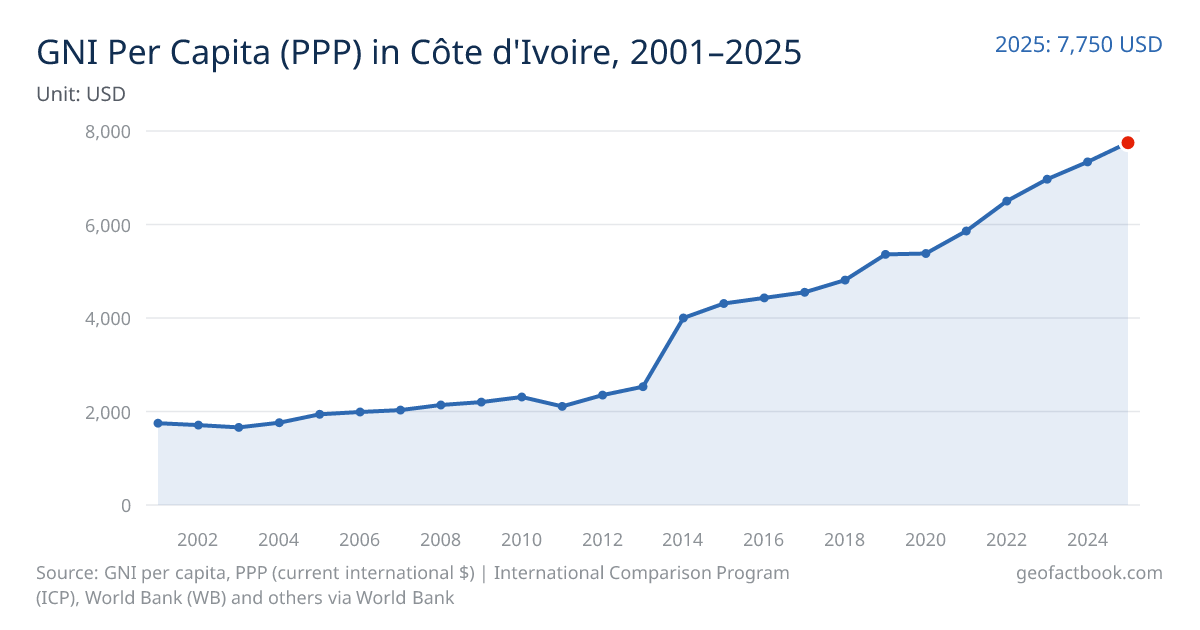
Côte d'Ivoire's gni per capita (ppp) in 2025 is $7,750, up 5.6% from 2024. It ranks #136 of 181 countries.
GNI per capita (PPP) shows the average income earned per person, adjusted for purchasing power.
Source (2025): GNI per capita (PPP)
Where Côte d'Ivoire ranks (2025)
#136 of 181- #134
 Tajikistan8,240 USD
- #135
 Ghana8,080 USD
- #136
 Côte d'Ivoire7,750 USD
- #137
 Mauritania7,640 USD
- #138
 Honduras7,270 USD
GNI Per Capita (PPP) over time
| Year | Value | Change | % Change | Actions |
|---|---|---|---|---|
| 2025 | 7.75K USD | +410 USD | +5.59% | |
| 2024 | 7.34K USD | +370 USD | +5.31% | |
| 2023 | 6.97K USD | +470 USD | +7.23% | |
| 2022 | 6.50K USD | +640 USD | +10.92% | |
| 2021 | 5.86K USD | +480 USD | +8.92% | |
| 2020 | 5.38K USD | +20 USD | +0.37% | |
| 2019 | 5.36K USD | +550 USD | +11.43% | |
| 2018 | 4.81K USD | +260 USD | +5.71% | |
| 2017 | 4.55K USD | +120 USD | +2.71% | |
| 2016 | 4.43K USD | +120 USD | +2.78% | |
| 2015 | 4.31K USD | +310 USD | +7.75% | |
| 2014 | 4.00K USD | +1.47K USD | +58.10% | |
| 2013 | 2.53K USD | +180 USD | +7.66% | |
| 2012 | 2.35K USD | +240 USD | +11.37% | |
| 2011 | 2.11K USD | 200 USD | -8.66% | |
| 2010 | 2.31K USD | +110 USD | +5.00% | |
| 2009 | 2.20K USD | +60 USD | +2.80% | |
| 2008 | 2.14K USD | +110 USD | +5.42% | |
| 2007 | 2.03K USD | +40 USD | +2.01% | |
| 2006 | 1.99K USD | +50 USD | +2.58% | |
| 2005 | 1.94K USD | +180 USD | +10.23% | |
| 2004 | 1.76K USD | +100 USD | +6.02% | |
| 2003 | 1.66K USD | 50 USD | -2.92% | |
| 2002 | 1.71K USD | 40 USD | -2.29% | |
| 2001 | 1.75K USD | — | — |
GNI Per Capita (PPP) in Côte d'Ivoire, 2001–2025: chart
Cite this page
Geo Factbook. (n.d.). Côte d'Ivoire: GNI Per Capita (PPP). Retrieved November 27, 2026, from https://geofactbook.com/countries/cte-divoire/gni-per-capita-ppp
The figures on this page come from GNI per capita, PPP (current international $) | International Comparison Program (ICP), World Bank (WB) and others via World Bank. For academic work, cite the original source as well.
Frequently Asked Questions About Côte d'Ivoire GNI Per Capita (PPP)
What is Côte d'Ivoire's gni per capita (ppp) in 2025?▾
Côte d'Ivoire's gni per capita (ppp) is $7,750 in 2025, according to GNI per capita, PPP (current international $) | International Comparison Program (ICP), World Bank (WB) and others via World Bank.
Is Côte d'Ivoire's gni per capita (ppp) increasing or decreasing?▾
Côte d'Ivoire's gni per capita (ppp) rose by 5.6% from 2024 ($7,340) to 2025 ($7,750). Over the past decade (2015–2025) it rose by 79.8%.
How does Côte d'Ivoire rank for gni per capita (ppp)?▾
In 2025, Côte d'Ivoire has the 136th highest gni per capita (ppp) out of 181 countries with data.
What was Côte d'Ivoire's gni per capita (ppp) in 2001?▾
In 2001, Côte d'Ivoire's gni per capita (ppp) was $1,750. By 2025 it rose by 342.9%.
Explore additional statistical insights
Global Cattle Population in Côte d'Ivoire
Explore the global cattle population; discover the countries with the highest number of cattle and their impact on agriculture.
Total Egg Production in Côte d'Ivoire
Total egg production measures the number of eggs produced annually in each country, indicating agricultural output.
Real GDP Growth Rate (USD) in Côte d'Ivoire
Real GDP Growth Rate measures economic performance. Compare countries and explore interactive rankings and historical trends.
Cereal Production Volume in Côte d'Ivoire
Cereal production volume measures total cereal output in tons. It tracks agricultural productivity across nations.
AI Preparedness Index in Côte d'Ivoire
The IMF's AI Preparedness Index scores how ready a country is to adopt artificial intelligence, on a scale from 0 to 1 (higher is better prepared). It combines four areas: digital infrastructure, human capital and labour market policies, innovation and economic integration, and regulation and ethics. It measures readiness, not how many jobs AI has replaced or could affect.
Average Annual Working Hours in Côte d'Ivoire
Average annual working hours per worker indicates productivity and work-life balance in each country.