
Croatia Press Freedom Index Score 2025: 64.20 points
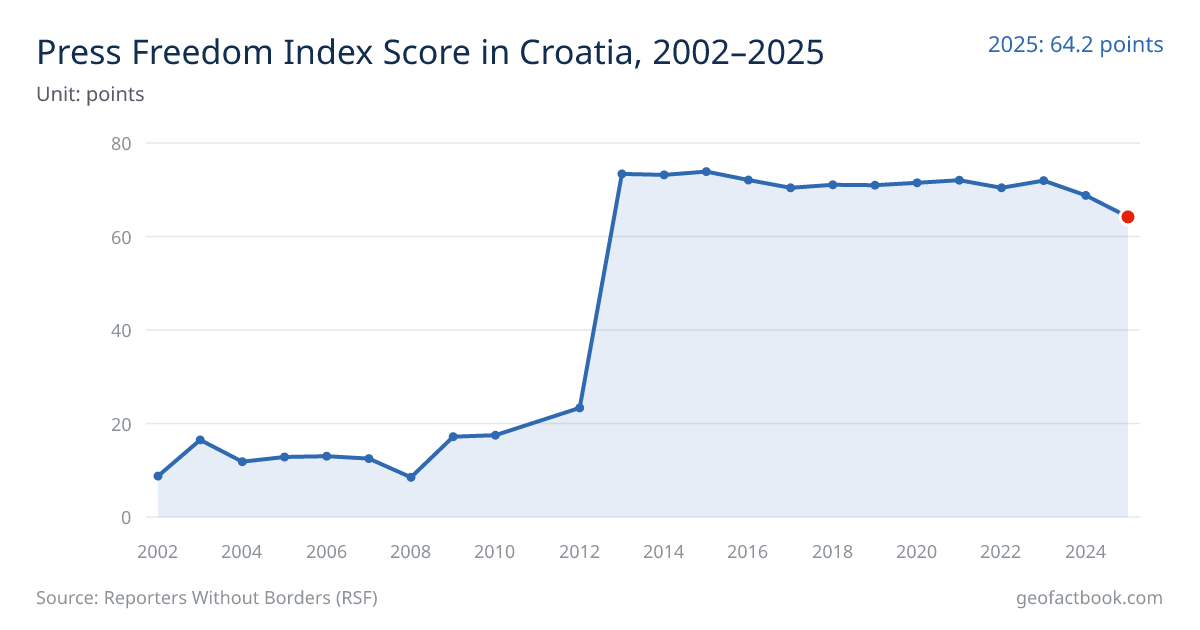
Croatia's press freedom index score in 2025 is 64.20 points, down 6.7% from 2024. It ranks #59 of 178 countries.
The Press Freedom Index Score measures the level of media freedom in countries worldwide. A higher score indicates stronger press independence, essential for democracy and transparency. Understanding these scores helps highlight the importance of free expression in society.
Where Croatia ranks (2025)
#59 of 178- #57
 Gambia65.49 points
- #58
 Uruguay65.18 points
- #59
 Croatia64.2 points
- #60
 South Korea64.06 points
- #61
 Ukraine63.93 points
Press Freedom Index Score over time
| Year | Value | Change | % Change | Actions |
|---|---|---|---|---|
| 2025 | 64.2 points | 4.59 points | -6.67% | |
| 2024 | 68.79 points | 3.16 points | -4.39% | |
| 2023 | 71.95 points | +1.53 points | +2.17% | |
| 2022 | 70.42 points | 1.63 points | -2.26% | |
| 2021 | 72.05 points | +0.56 points | +0.78% | |
| 2020 | 71.49 points | +0.52 points | +0.73% | |
| 2019 | 70.97 points | 0.09 points | -0.13% | |
| 2018 | 71.06 points | +0.65 points | +0.92% | |
| 2017 | 70.41 points | 1.68 points | -2.33% | |
| 2016 | 72.09 points | 1.79 points | -2.42% | |
| 2015 | 73.88 points | +0.7 points | +0.96% | |
| 2014 | 73.18 points | 0.21 points | -0.29% | |
| 2013 | 73.39 points | +50.06 points | +214.57% | |
| 2012 | 23.33 points | +5.83 points | +33.31% | |
| 2010 | 17.5 points | +0.33 points | +1.94% | |
| 2009 | 17.17 points | +8.67 points | +101.96% | |
| 2008 | 8.5 points | 4 points | -32.00% | |
| 2007 | 12.5 points | 0.5 points | -3.85% | |
| 2006 | 13 points | +0.17 points | +1.33% | |
| 2005 | 12.83 points | +1 points | +8.45% | |
| 2004 | 11.83 points | 4.67 points | -28.30% | |
| 2003 | 16.5 points | +7.75 points | +88.57% | |
| 2002 | 8.75 points | — | — |
Press Freedom Index Score in Croatia, 2002–2025: chart
Cite this page
Geo Factbook. (n.d.). Croatia: Press Freedom Index Score. Retrieved November 27, 2026, from https://geofactbook.com/countries/croatia/press-freedom-index-score
The figures on this page come from Reporters Without Borders (RSF). For academic work, cite the original source as well.
Frequently Asked Questions About Croatia Press Freedom Index Score
What is Croatia's press freedom index score in 2025?▾
Croatia's press freedom index score is 64.20 points in 2025, according to Reporters Without Borders (RSF).
Is Croatia's press freedom index score increasing or decreasing?▾
Croatia's press freedom index score fell by 6.7% from 2024 (68.79 points) to 2025 (64.20 points). Over the past decade (2015–2025) it fell by 13.1%.
How does Croatia rank for press freedom index score?▾
In 2025, Croatia has the 59th highest press freedom index score out of 178 countries with data.
What was Croatia's press freedom index score in 2002?▾
In 2002, Croatia's press freedom index score was 8.75 points. By 2025 it rose by 633.7%.
Explore additional statistical insights
Annual Scholarly AI Publications in Croatia
Annual scholarly AI publications quantify research output. High numbers indicate active research and innovation in AI fields.
Internet Penetration Rate (%) in Croatia
The Internet Penetration Rate indicates the percentage of the population with internet access, crucial for digital public service access.
Broadband Internet Penetration in Croatia
Broadband internet penetration measures the percentage of the population with access to high-speed internet.
Internet Users (% of Population) in Croatia
Explore Internet Users worldwide, compare usage rates by country, and visualize trends with interactive maps and rankings.
Internet Usage Rate by Country (% of Population) in Croatia
Discover the internet usage rate by country, showcasing the percentage of the population online. This statistic highlights digital accessibility and connectivity trends globally, emphasizing the importance of internet access in today's world.
Dam capacity per capita in Croatia
Dam capacity per capita measures the amount of water storage available for each individual in a country, expressed in cubic meters. This statistic highlights water resource management and its impact on sustainability and development. Understanding dam capacity is crucial for addressing water security and supporting agriculture, industry, and communities.