
Comoros Percentage of land area by degree of urbanization 2026: 16.22 %
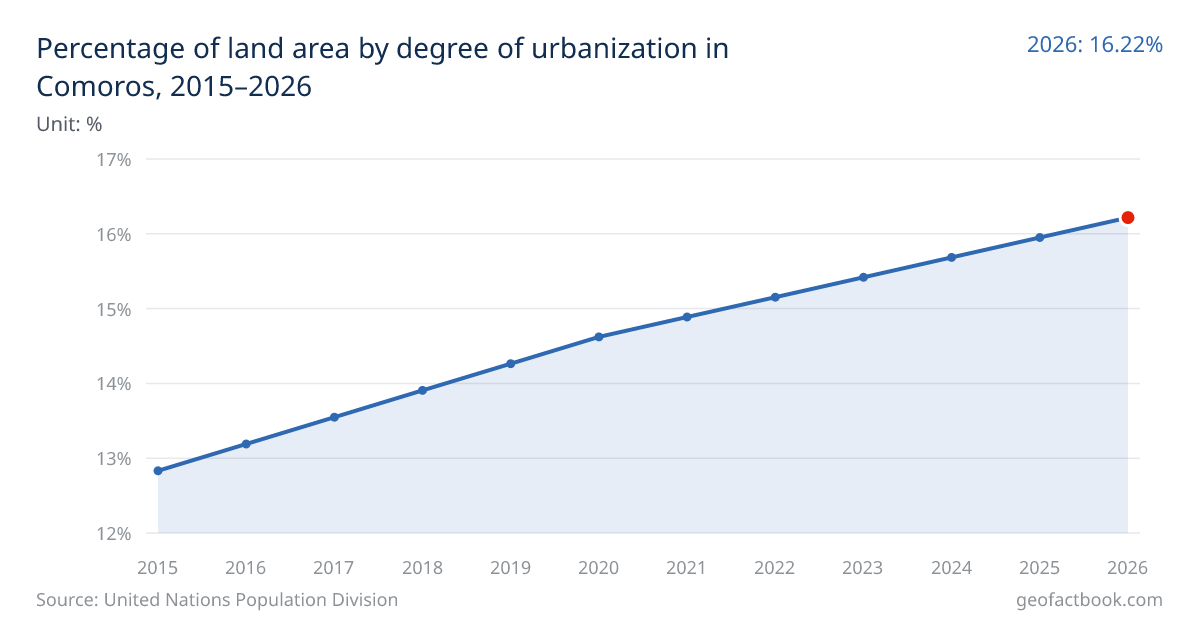
Comoros's percentage of land area by degree of urbanization in 2026 is 16.22 % (estimate), up 1.7% from 2025. It ranks #46 of 237 countries.
Explore the percentage of land area by degree of urbanization, highlighting how urban development shapes countries' landscapes and influences economic growth. Understanding this statistic reveals the balance between urban and rural spaces, essential for sustainable planning.
Estimated value for 2026 (interpolated, no direct source).
Where Comoros ranks (2026)
#46 of 237- #44
 Martinique17.41%
- #45
 Guadeloupe16.36%
- #46
 Comoros16.22%
- #47
 United States Virgin Islands15.89%
- #48
 American Samoa15.78%
Percentage of land area by degree of urbanization over timeSome values are estimated based on historical trends
| Year | Value | Change | % Change | Actions |
|---|---|---|---|---|
| 2026 | 16.22 % | +0.27 % | +1.67% | |
| 2025 | 15.95 % | +0.27 % | +1.70% | |
| 2024 | 15.69 % | +0.27 % | +1.73% | |
| 2023 | 15.42 % | +0.27 % | +1.76% | |
| 2022 | 15.15 % | +0.27 % | +1.78% | |
| 2021 | 14.89 % | +0.27 % | +1.82% | |
| 2020 | 14.62 % | +0.36 % | +2.51% | |
| 2019 | 14.26 % | +0.36 % | +2.57% | |
| 2018 | 13.91 % | +0.36 % | +2.64% | |
| 2017 | 13.55 % | +0.36 % | +2.71% | |
| 2016 | 13.19 % | +0.36 % | +2.79% | |
| 2015 | 12.83 % | — | — |
Percentage of land area by degree of urbanization in Comoros, 2015–2026: chart
Cite this page
Geo Factbook. (n.d.). Comoros: Percentage of land area by degree of urbanization. Retrieved November 29, 2026, from https://geofactbook.com/countries/comoros/percentage-of-land-area-by-degree-of-urbanization
The figures on this page come from United Nations Population Division. For academic work, cite the original source as well.
Frequently Asked Questions About Comoros Percentage of land area by degree of urbanization
What is Comoros's percentage of land area by degree of urbanization in 2026?▾
Comoros's percentage of land area by degree of urbanization is 16.22 % in 2026 (estimate), according to United Nations Population Division.
Is Comoros's percentage of land area by degree of urbanization increasing or decreasing?▾
Comoros's percentage of land area by degree of urbanization rose by 1.7% from 2025 (15.95 %) to 2026 (16.22 %). Over the past decade (2016–2026) it rose by 22.9%.
How does Comoros rank for percentage of land area by degree of urbanization?▾
In 2026, Comoros has the 46th highest percentage of land area by degree of urbanization out of 237 countries with data.
What was Comoros's percentage of land area by degree of urbanization in 2015?▾
In 2015, Comoros's percentage of land area by degree of urbanization was 12.83 %. By 2026 it rose by 26.4%.
Explore additional statistical insights
Infrastructure Resilience Score in Comoros
Infrastructure Resilience Score evaluates a country's ability to withstand and recover from disasters.
Banana Yield Per Hectare in Comoros
Compare the efficiency of banana production by examining yield per hectare across different countries.
Arable Land Per Person in Comoros
Arable land per person measures the amount of farmable land available to each individual in a country.
AI Preparedness Index in Comoros
The IMF's AI Preparedness Index scores how ready a country is to adopt artificial intelligence, on a scale from 0 to 1 (higher is better prepared). It combines four areas: digital infrastructure, human capital and labour market policies, innovation and economic integration, and regulation and ethics. It measures readiness, not how many jobs AI has replaced or could affect.
Total Natural Resource Rents in Comoros
Total natural resource rents indicate the value derived from natural resources as a percentage of GDP.
Median age of population in Comoros
The median age of a population is a key demographic indicator, reflecting the age distribution within a country. Understanding median age helps assess economic development, healthcare needs, and social dynamics. Countries with a higher median age may face challenges related to aging populations, while younger populations often indicate growth potential.