
Tibet in Numbers
Population, economy, income, urbanization and births in Tibet, how it ranks among the 31 provincial-level regions, and which countries it is comparable to. Every number shows its official source and year.
Population
#31 of 313.70 million
lowest in China · full ranking
2024 · National Bureau of Statistics of China, China Statistical Yearbook, population at year-end by region
GDP
#31 of 31$38.4 billion
lowest in China · full ranking
2024 · National Bureau of Statistics of China, China Statistical Yearbook, gross regional product, converted from yuan at the year's average exchange rate (World Bank PA.NUS.FCRF)
GDP per capita
#21 of 31$10,453
11th lowest in China · full ranking
2024 · National Bureau of Statistics of China, China Statistical Yearbook, per capita gross regional product, converted from yuan at the year's average exchange rate (World Bank PA.NUS.FCRF)
Disposable income per capita
#23 of 31$4,357
9th lowest in China · full ranking
2024 · National Bureau of Statistics of China, China Statistical Yearbook, per capita disposable income of residents, converted from yuan at the year's average exchange rate (World Bank PA.NUS.FCRF)
Urban population
#31 of 3139.7%
lowest in China · full ranking
2024 · National Bureau of Statistics of China, China Statistical Yearbook, share of urban population by region
Services share of GDP
#14 of 3154.3%
14th highest in China · full ranking
2024 · National Bureau of Statistics of China, China Statistical Yearbook, tertiary industry value added divided by gross regional product
If Tibet were a country
Population like
🇪🇷 EritreaTibet has about as many people as Eritrea: 3.70 million vs 3.61 million.
Tibet vs Eritrea →Economy like
🇧🇳 Brunei DarussalamTibet's economy is roughly the size of Brunei Darussalam's: $38.4 billion vs about $38.6 billion.
Tibet vs Brunei Darussalam →Country figures are 2025 estimates from Gapminder. Country GDP is measured in international dollars (purchasing power parity), while province GDP is in current prices, so treat the economy match as a rough size comparison.
More about Tibet
Birth rate
#1 of 3113.9 per 1,000
highest in China · full ranking
2024 · National Bureau of Statistics of China, China Statistical Yearbook, birth rate by region
Death rate
#30 of 315.4 per 1,000
2nd lowest in China · full ranking
2024 · National Bureau of Statistics of China, China Statistical Yearbook, death rate by region
How Tibet ranks
- Tibet has the lowest population among the 31 provincial-level regions (3.70 million in 2024). See the ranking
- Tibet has the lowest GDP among the 31 provincial-level regions ($38.4 billion in 2024). See the ranking
- Tibet has the 11th lowest GDP per person among the 31 provincial-level regions ($10,453 in 2024). See the ranking
- Tibet has the 9th lowest disposable income per person among the 31 provincial-level regions ($4,357 in 2024). See the ranking
- Tibet has the lowest share of people in cities among the 31 provincial-level regions (39.7% in 2024). See the ranking
- Tibet has the 14th highest services share of the economy among the 31 provincial-level regions (54.3% in 2024). See the ranking
- Tibet has the highest birth rate among the 31 provincial-level regions (13.9 per 1,000 in 2024). See the ranking
- Tibet has the 2nd lowest death rate among the 31 provincial-level regions (5.4 per 1,000 in 2024). See the ranking
Frequently Asked Questions About Tibet
What is the population of Tibet?▾
Tibet had 3.70 million people in 2024, the lowest of the 31 provincial-level regions. Source: National Bureau of Statistics of China.
What is the GDP of Tibet?▾
Tibet's GDP was $38.4 billion in 2024 (current dollars), the lowest in China. Source: National Bureau of Statistics of China.
Which country has a similar population to Tibet?▾
Tibet has about as many people as Eritrea: 3.70 million vs 3.61 million.
Where is Tibet?
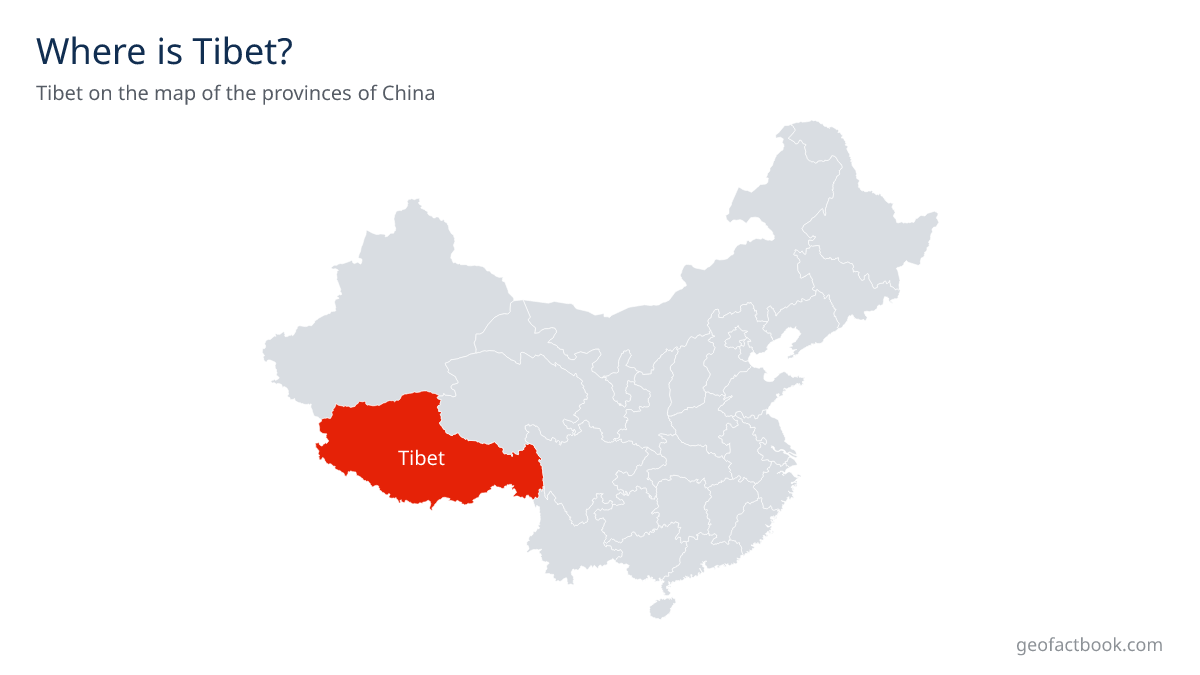
Compare Tibet with another province
Explore More
Cite this page
Geo Factbook. (n.d.). Tibet in Numbers. Retrieved November 27, 2026, from https://geofactbook.com/countries/china/provinces/tibet
The figures on this page come from National Bureau of Statistics of China. For academic work, cite the original source as well.