
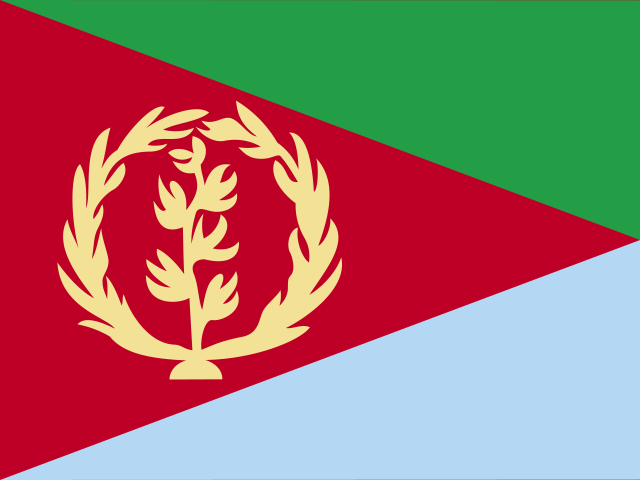
Location
Eritrea is in Eastern Africa, bordering the Red Sea, between Djibouti and Sudan. It shares land borders with Ethiopia (1,033 km), Sudan (682 km) and Djibouti (125 km) and has 2,234 km of coastline. The capital is Asmara.
Eritrea population 2026: 3.68 Million — growth, rank & history →Key Statistics for 2026
Total population
Population Change
Median age of population
Population density
Life expectancy at birth
Agricultural land
Dam capacity per capita
Female population of reproductive age
Health Care Spending per Capita
Length of paid parental leave for mother
Percentage of population by degree of urbanization
History
Eritrea's history traces back to ancient times, with archaeological findings indicating that the region has been inhabited since the Middle Stone Age. The territory was part of the ancient Kingdom of Aksum, which emerged around the 1st century CE. Aksum became a significant trading empire that controlled trade routes across the Red Sea and established one of the earliest Christian states in the world. As a result, Eritrea's early history is marked by cultural exchanges and the spread of Christianity, which persisted through centuries, influencing the region's social and political structures.
During the medieval period, Eritrea saw the rise of various kingdoms and the influence of Islamic sultanates. The establishment of the Kingdom of Medri Bahri in the 13th century marked a significant development, as it unified various ethnic groups and fostered trade with neighboring regions. This period also witnessed the gradual Islamization of the coastal regions, alongside the persistence of Christian communities in the highlands. The interactions between these two faiths contributed to a rich tapestry of cultural and social dynamics that characterized Eritrea's medieval landscape.
The modern history of Eritrea began with the Italian colonization in the late 19th century, which lasted until World War II. In 1941, British forces liberated Eritrea from Italian control, leading to a brief period of British administration. Following World War II, Eritrea was federated with Ethiopia in 1952, but this federation was dissolved by the Ethiopian Emperor Haile Selassie in 1962, leading to a protracted war for independence. Eritrea's struggle culminated in victory in 1991, when the Eritrean People's Liberation Front (EPLF) overthrew the Ethiopian government, and Eritrea formally achieved independence in 1993.
In recent history, Eritrea has been characterized by its ongoing tensions with Ethiopia, particularly following the border conflict from 1998 to 2000. The peace agreement signed in 2018 marked a historic reconciliation, ending nearly two decades of hostility. Today, Eritrea's historical significance lies in its strategic location along the Red Sea, its diverse cultural heritage, and its ongoing efforts to navigate post-independence challenges, including economic development and human rights issues. Understanding Eritrea's complex history is essential for grasping its contemporary political landscape and regional dynamics.
Geography
Eritrea is located in the Horn of Africa, bordered by the Red Sea to the east, Sudan to the west, and Ethiopia to the south. The country covers an area of approximately 117,600 square kilometers (45,406 square miles) and has a coastline stretching over 1,000 kilometers (620 miles). Eritrea shares borders with Ethiopia to the south, and Sudan to the west, which has historically influenced its geopolitical landscape. The country's strategic location along the Red Sea provides access to vital shipping routes, enhancing its significance in regional trade.
The physical features of Eritrea are diverse, encompassing mountains, plateaus, and coastal plains. The central highlands, characterized by the Asmera Mountains, rise dramatically from the low-lying coastal areas. The highest peak is Mount Soira, which reaches an elevation of 3,018 meters (9,869 feet). The terrain transitions from arid coastal regions to fertile highlands, with several rivers, including the Barka and Gash, flowing through the country, although many are seasonal and dependent on rainfall. The country's notable topography contributes to a variety of ecosystems and biodiversity.
Eritrea experiences a range of climatic conditions, primarily influenced by its elevation and proximity to the Red Sea. The coastal areas generally have a hot desert climate, while the highlands enjoy a more temperate climate, with cooler temperatures and seasonal rainfall. The country has two main seasons: the dry season from May to September and the wet season from October to April. Annual precipitation varies significantly, with the highlands receiving more rainfall, making them suitable for agriculture.
The natural resources of Eritrea include minerals such as gold, copper, and zinc, which are significant to its economy. Additionally, the country has potential reserves of oil and natural gas, although these have yet to be fully explored. The environmental characteristics of Eritrea are marked by its unique biodiversity, with various endemic species. However, the country faces challenges such as deforestation, soil erosion, and water scarcity, which impact its ecological balance and agricultural productivity.
Government
Eritrea is a single-party state governed by the People's Front for Democracy and Justice (PFDJ), which has been in power since the country's independence from Ethiopia in 1993. The political system is characterized by a lack of pluralism, as the PFDJ is the only legal political party. This structure has led to a highly centralized government where decision-making is concentrated in the hands of a few leaders, primarily President Isaias Afwerki, who has held power since independence. The country does not have a constitution in effect, as the implementation of the 1997 constitution has been postponed indefinitely.
The government of Eritrea is structured into three branches: executive, legislative, and judicial. The executive branch is led by the President, who is both the head of state and government, and is supported by a Council of Ministers. The legislative branch, known as the National Assembly, is nominally responsible for enacting laws, although its actual power is limited as it has not convened since 2002. The judicial branch is overseen by the Supreme Court, which operates under the authority of the executive. The judiciary lacks independence and is often subject to political influence, which raises concerns about the rule of law and human rights.
Key institutions in Eritrea include the National Assembly, the Council of Ministers, and various ministries that manage specific sectors such as education, health, and defense. However, the political landscape is dominated by President Isaias Afwerki and his close associates, who control the state apparatus. The lack of institutional checks and balances has led to significant criticism from international watchdogs regarding human rights violations and restrictions on freedom of expression.
Eritrea's electoral system is unique, as there have been no national elections since 1993, when the country gained independence. The planned parliamentary elections were postponed indefinitely, and the political environment is characterized by repression of dissent and a lack of competitive political processes. As a result, the political landscape remains tightly controlled, with limited opportunities for political participation or opposition. This has led to widespread criticism from international human rights organizations and has contributed to a significant diaspora of Eritreans seeking asylum abroad.
Economy
The economy of Eritrea is characterized as a mixed economy with a significant state presence. As of the latest estimates, the country's Gross Domestic Product (GDP) stands at approximately $6 billion, reflecting a small but growing economy. Eritrea's economic system has been influenced by its history of conflict and its struggle for independence, leading to a primarily agrarian structure that has gradually incorporated industrial and service sectors. The country has been working towards economic diversification, although it still faces significant challenges in achieving sustainable growth.
Major industries in Eritrea include agriculture, mining, and fishing. The agricultural sector employs a large portion of the workforce, with subsistence farming being predominant. In recent years, the mining industry has emerged as a vital component of the economy, particularly with the discovery of significant mineral resources such as gold, copper, and zinc. The government has prioritized the mining sector as a means to boost economic growth and increase foreign investment. Additionally, the fishing industry, particularly shrimp and fish exports, plays a role in the economy, although it remains underdeveloped compared to other sectors.
Eritrea's trade relationships are primarily oriented towards neighboring countries and select international partners. The nation exports mainly minerals, agricultural products, and livestock, with the mining sector being a key driver of export revenues. Key trading partners include Ethiopia, Sudan, and Djibouti, as well as countries in the European Union and the Middle East. The country imports machinery, food, and fuel, relying on external sources to meet its needs. The balance of trade has been challenging, with imports often exceeding exports, which places pressure on the national economy.
Despite its potential, Eritrea's economy faces numerous challenges, including a lack of infrastructure, limited access to international markets, and the impacts of ongoing political tensions. Additionally, the country grapples with issues such as high unemployment, particularly among youth, and a heavy reliance on the public sector. However, there are opportunities for growth, particularly in the mining sector and potential agricultural advancements. Sustainable economic policies and international cooperation could provide pathways for Eritrea to capitalize on its resources and improve living standards for its population.
Culture
Eritrea is a culturally rich nation located in the Horn of Africa, characterized by its diverse ethnic groups and languages. The country is home to nine recognized ethnic groups, including the Tigrinya, Tigre, Saho, and Bilen, among others. The predominant languages spoken are Tigrinya and Arabic, with English also serving as a significant language for government and education. Religious practices in Eritrea are equally varied, with the population primarily adhering to Christianity and Islam. The Eritrean Orthodox Tewahedo Church plays a vital role in the lives of many Tigrinya Christians, while Islam is predominantly practiced among the Tigre and other ethnic groups, contributing to the nation’s rich cultural tapestry.
The cultural traditions and customs of Eritrea are deeply rooted in its history and diverse ethnic backgrounds. Traditional celebrations often revolve around religious observances, agricultural cycles, and historical events. One of the most significant festivals is Fasika, celebrated by Christians to mark Easter, featuring communal feasts and various cultural performances. Daily life in Eritrea is marked by communal values, with family and community ties playing a crucial role in social interactions. Traditional clothing, such as the colorful habesha kemis worn by women, and the distinctive shamma wrap worn by men, are emblematic of Eritrean identity and cultural pride.
The arts and music of Eritrea reflect its diverse heritage, with traditional music often incorporating unique instruments such as the krar (a lyre) and the kebero (a drum). Eritrean music varies by region and ethnic group, showcasing the country's rich cultural diversity. Notable contemporary musicians, such as Mariachi and Awate, have gained recognition for blending traditional sounds with modern influences. Eritrean literature is also flourishing, with authors exploring themes of identity, exile, and resilience, often drawing from the nation's tumultuous history and cultural heritage.
Cuisine in Eritrea is a vital aspect of daily life, characterized by the use of staple ingredients such as injera (a sourdough flatbread) and various stews known as tsebhi. Meals are typically shared among family and friends, emphasizing communal bonds and hospitality. Coffee ceremonies are an integral part of Eritrean culture, symbolizing friendship and societal connections. The daily life of Eritreans reflects a blend of tradition and modernity, where ancient customs coexist with contemporary practices, creating a vibrant and dynamic cultural landscape that continues to evolve.
About This Data
This page displays comprehensive statistical data for Eritrea for the year 2026. All data points are sourced from authoritative international organizations and are regularly updated to ensure accuracy and reliability.
Click on any statistic to explore more detailed information, see how Eritrea compares with other countries, and view historical trends.
Primary Data Sources
CIA World Factbook
Comprehensive country profiles and demographic statistics from the Central Intelligence Agency
Learn moreUnited Nations Statistics
Global demographic data and population projections from UN agencies and research divisions
Learn moreWorld Bank Open Data
Development indicators and comprehensive population metrics from the World Bank database
Learn moreCompare Eritrea with other countries
Side-by-side comparisons across population, GDP, geography, and more.
Frequently Asked Questions About Eritrea
Which continent is Eritrea in?▾
Eritrea is in Africa, in the Eastern Africa subregion according to the UN geoscheme.
What is the population of Eritrea in 2026?▾
The population of Eritrea in 2026 is 3,678,403 persons.
What is the capital city of Eritrea?▾
The capital city of Eritrea is Asmara.
What is the GDP of Eritrea in 2026?▾
The GDP of Eritrea in 2026 is 4,537,622,742.12 US dollars.
What is the life expectancy in Eritrea?▾
The life expectancy at birth in Eritrea is 72.01 years.
What is the total fertility rate in Eritrea?▾
The total fertility rate in Eritrea is 3.55 children per woman.
What percentage of Eritrea's population lives in urban areas?▾
64.15% of Eritrea's population lives in urban areas.