
Chile Currently married (Percent) 2026: 49.82 %
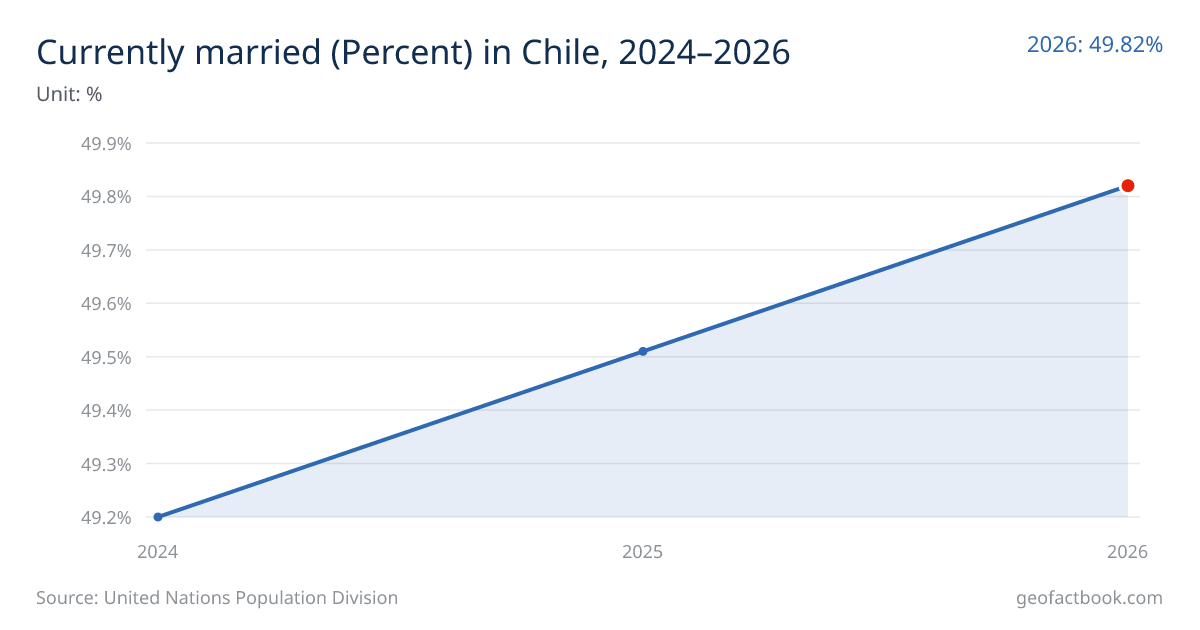
Chile's currently married (percent) in 2026 is 49.82 % (estimate), up 0.6% from 2025. It ranks #166 of 224 countries.
The percentage of currently married individuals by country highlights societal trends in family structure and relationships. Understanding these statistics can provide insights into cultural norms and demographic shifts, influencing policies and social programs.
Estimated value for 2026 (interpolated, no direct source).
Where Chile ranks (2026)
#166 of 224




Currently married (Percent) over timeSome values are estimated based on historical trends
| Year | Value | Change | % Change | Actions |
|---|---|---|---|---|
| 2026 | 49.82 % | +0.31 % | +0.63% | |
| 2025 | 49.51 % | +0.31 % | +0.63% | |
| 2024 | 49.2 % | — | — |
Currently married (Percent) in Chile, 2024–2026: chart
Cite this page
Geo Factbook. (n.d.). Chile: Currently married (Percent). Retrieved November 27, 2026, from https://geofactbook.com/countries/chile/currently-married-percent
The figures on this page come from United Nations Population Division. For academic work, cite the original source as well.
Frequently Asked Questions About Chile Currently married (Percent)
What is Chile's currently married (percent) in 2026?▾
Chile's currently married (percent) is 49.82 % in 2026 (estimate), according to United Nations Population Division.
Is Chile's currently married (percent) increasing or decreasing?▾
Chile's currently married (percent) rose by 0.6% from 2025 (49.51 %) to 2026 (49.82 %).
How does Chile rank for currently married (percent)?▾
In 2026, Chile has the 166th highest currently married (percent) out of 224 countries with data.
What was Chile's currently married (percent) in 2024?▾
In 2024, Chile's currently married (percent) was 49.20 %. By 2026 it rose by 1.3%.
Explore additional statistical insights
Human Capital Index in Chile
The Human Capital Index measures a country's investment in education and health, reflecting its potential for economic growth and productivity. This vital statistic highlights the importance of nurturing human resources for sustainable development.
Physician Density in Chile
Physician density measures healthcare access, showing the number of doctors per square kilometer. Compare countries and explore interactive maps.
Population Change in Chile
This statistic measures population change across countries, highlighting shifts in demographics. Understanding these changes is crucial for planning resources, economic growth, and social services.
Old-Age Dependency Ratio in Chile
Old-age dependency ratio compares the number of elderly dependents to working-age people, affecting economic sustainability.
Total net-migration in Chile
Total net-migration measures the difference between the number of immigrants and emigrants in a country, reflecting population shifts and economic opportunities. Understanding this statistic is crucial for analyzing demographic trends and policy impacts in nations worldwide.
Mean Years of Schooling in Chile
Mean Years of Schooling indicates the average number of years of education received by people aged 25 and older.