
Central African Republic Total fertility rate 2026: 5.80 per woman
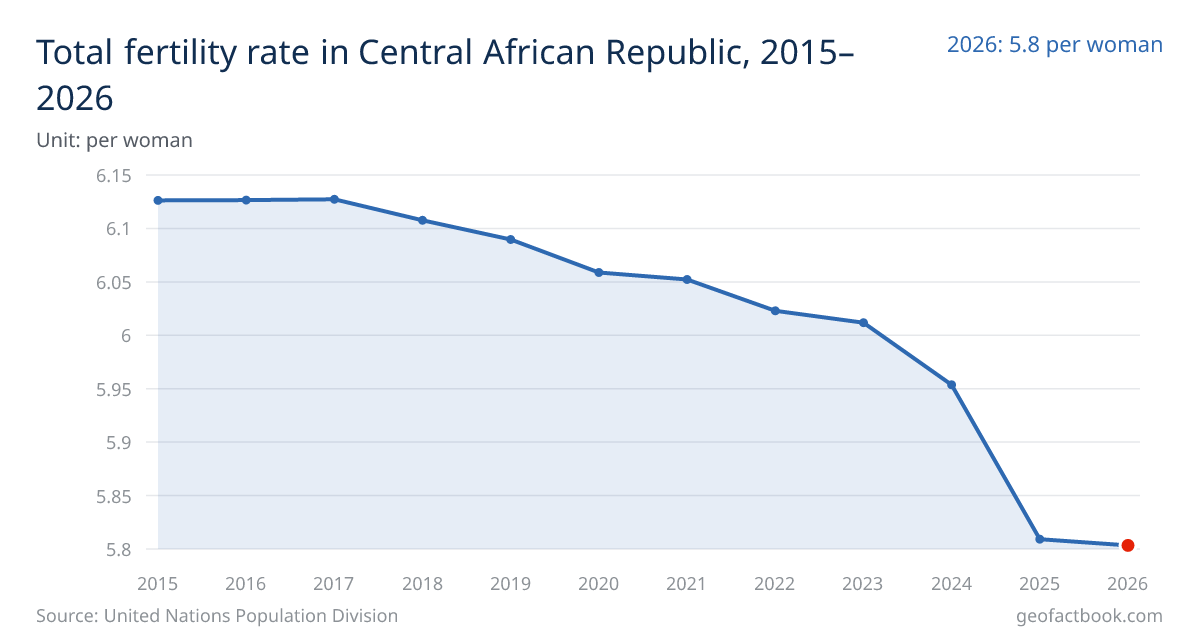
Central African Republic's total fertility rate in 2026 is 5.80 per woman (estimate), down 0.1% from 2025. It ranks #3 of 236 countries.
The total fertility rate measures the average number of children a woman is expected to have during her lifetime, reflecting population growth and demographic trends. Understanding this statistic is crucial for analyzing economic development, healthcare needs, and societal changes across countries.
Estimated value for 2026 (interpolated, no direct source).
Where Central African Republic ranks (2026)
#3 of 236- #1
 Chad5.86 per woman
- #2
 Congo, Democratic Republic of the5.85 per woman
- #3
 Central African Republic5.8 per woman
- #4
 Somalia5.8 per woman
- #5
 Niger5.72 per woman
Total fertility rate over timeSome values are estimated based on historical trends
| Year | Value | Change | % Change | Actions |
|---|---|---|---|---|
| 2026 | 5.8 per woman | 0.01 per woman | -0.10% | |
| 2025 | 5.81 per woman | 0.14 per woman | -2.43% | |
| 2024 | 5.95 per woman | 0.06 per woman | -0.97% | |
| 2023 | 6.01 per woman | 0.01 per woman | -0.19% | |
| 2022 | 6.02 per woman | 0.03 per woman | -0.48% | |
| 2021 | 6.05 per woman | 0.01 per woman | -0.11% | |
| 2020 | 6.06 per woman | 0.03 per woman | -0.51% | |
| 2019 | 6.09 per woman | 0.02 per woman | -0.29% | |
| 2018 | 6.11 per woman | 0.02 per woman | -0.32% | |
| 2017 | 6.13 per woman | +0 per woman | +0.01% | |
| 2016 | 6.13 per woman | +0 per woman | +0.00% | |
| 2015 | 6.13 per woman | — | — |
Total fertility rate in Central African Republic, 2015–2026: chart
Cite this page
Geo Factbook. (n.d.). Central African Republic: Total fertility rate. Retrieved November 27, 2026, from https://geofactbook.com/countries/central-african-republic/total-fertility-rate
The figures on this page come from United Nations Population Division. For academic work, cite the original source as well.
Frequently Asked Questions About Central African Republic Total fertility rate
What is Central African Republic's total fertility rate in 2026?▾
Central African Republic's total fertility rate is 5.80 per woman in 2026 (estimate), according to United Nations Population Division.
Is Central African Republic's total fertility rate increasing or decreasing?▾
Central African Republic's total fertility rate fell by 0.1% from 2025 (5.81 per woman) to 2026 (5.80 per woman). Over the past decade (2016–2026) it fell by 5.3%.
How does Central African Republic rank for total fertility rate?▾
In 2026, Central African Republic has the 3rd highest total fertility rate out of 236 countries with data.
What was Central African Republic's total fertility rate in 2015?▾
In 2015, Central African Republic's total fertility rate was 6.13 per woman. By 2026 it fell by 5.3%.
Explore additional statistical insights
Wine Consumption Per Capita in Central African Republic
Wine consumption per capita measures the average liters of wine consumed by individuals in a country annually.
Mean Years of Schooling in Central African Republic
Mean Years of Schooling indicates the average number of years of education received by people aged 25 and older.
Urban Population Share 2050 in Central African Republic
Urban population share by 2050 shows urbanization trends. Discover which countries will be most urbanized.
Percentage of population by degree of urbanization in Central African Republic
Explore the percentage of population by degree of urbanization across countries, highlighting the shift towards urban living and its impact on economic growth and development. Understanding these trends is crucial for addressing urban planning and resource allocation.
Military Service Age and Obligation in Central African Republic
Military service age and obligation details for 266+ countries. Compare requirements, explore rankings, and view interactive maps.
Life expectancy at birth in Central African Republic
Life expectancy at birth measures the average years a newborn is expected to live, reflecting a country's health standards and quality of life. This vital statistic highlights disparities in healthcare and living conditions across nations, making it essential for global health assessments.