
Central African Republic Human Capital Index 2026: 0.29
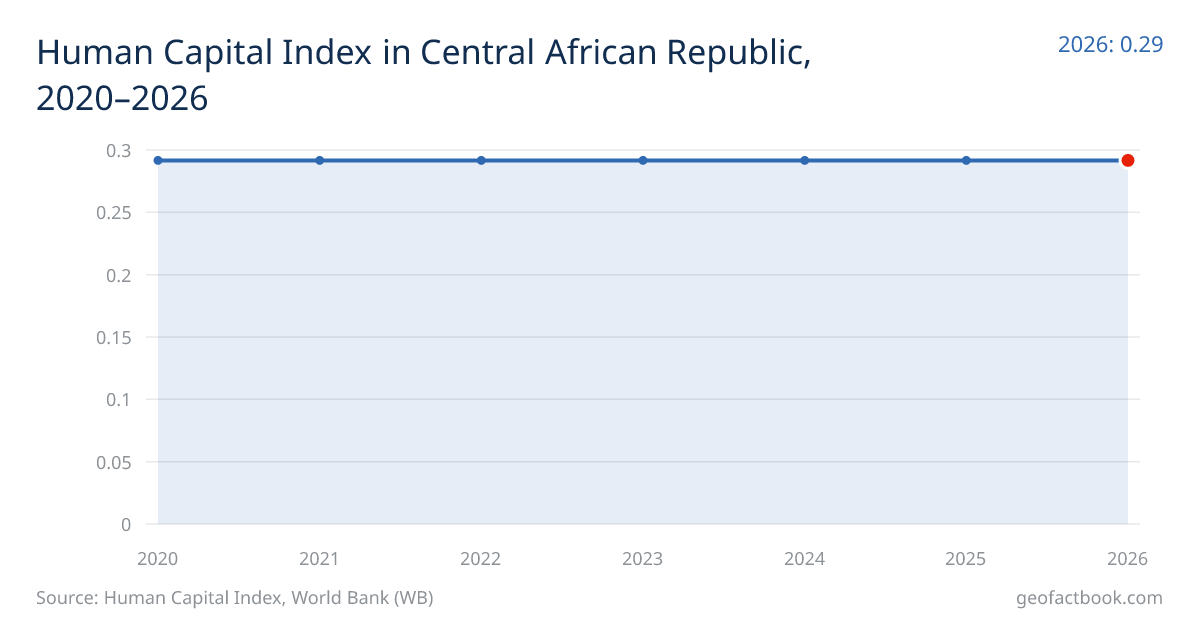
Central African Republic's human capital index in 2026 is 0.29 (estimate), unchanged from 2025. It ranks #174 of 174 countries.
The Human Capital Index measures a country's investment in education and health, reflecting its potential for economic growth and productivity. This vital statistic highlights the importance of nurturing human resources for sustainable development.
Estimated value for 2026 (interpolated, no direct source).
Where Central African Republic ranks (2026)
#174 of 174- #170
 Chad0.31
- #171
 Niger0.31
- #172
 Mali0.31
- #173
 South Sudan0.31
- #174
 Central African Republic0.29
Human Capital Index over timeSome values are estimated based on historical trends
| Year | Value | Change | % Change | Actions |
|---|---|---|---|---|
| 2026 | 0.29 | 0 | 0.00% | |
| 2025 | 0.29 | 0 | 0.00% | |
| 2024 | 0.29 | 0 | 0.00% | |
| 2023 | 0.29 | 0 | 0.00% | |
| 2022 | 0.29 | 0 | 0.00% | |
| 2021 | 0.29 | 0 | 0.00% | |
| 2020 | 0.29 | — | — |
Human Capital Index in Central African Republic, 2020–2026: chart
Cite this page
Geo Factbook. (n.d.). Central African Republic: Human Capital Index. Retrieved November 27, 2026, from https://geofactbook.com/countries/central-african-republic/human-capital-index
The figures on this page come from Human Capital Index, World Bank (WB). For academic work, cite the original source as well.
Frequently Asked Questions About Central African Republic Human Capital Index
What is Central African Republic's human capital index in 2026?▾
Central African Republic's human capital index is 0.29 in 2026 (estimate), according to Human Capital Index, World Bank (WB).
Is Central African Republic's human capital index increasing or decreasing?▾
Central African Republic's human capital index was essentially unchanged from 2025 (0.29) to 2026 (0.29).
How does Central African Republic rank for human capital index?▾
In 2026, Central African Republic has the 174th highest human capital index out of 174 countries with data.
What was Central African Republic's human capital index in 2020?▾
In 2020, Central African Republic's human capital index was 0.29. By 2026 it was essentially unchanged.
Explore additional statistical insights
Total deaths in Central African Republic
Total deaths in countries measure the number of individuals who have passed away within a specific timeframe. This statistic is crucial for understanding health trends, mortality rates, and the impact of various factors on population dynamics.
Crude Birth Rate in Central African Republic
Crude birth rate measures births per 1,000 people. Identify regions with high or low birth rates globally.
Contraceptive Prevalence Rate in Central African Republic
Contraceptive Prevalence Rate indicates the percentage of women using contraception. Explore global rankings, compare countries, and view trends.
Urban Population Share 2050 in Central African Republic
Urban population share by 2050 shows urbanization trends. Discover which countries will be most urbanized.
Total demand for family planning (Percent) in Central African Republic
Total demand for family planning measures the percentage of individuals seeking access to reproductive health services. Understanding this statistic is crucial for addressing global population growth and improving health outcomes.
Total net-migration in Central African Republic
Total net-migration measures the difference between the number of immigrants and emigrants in a country, reflecting population shifts and economic opportunities. Understanding this statistic is crucial for analyzing demographic trends and policy impacts in nations worldwide.