
Bahrain Female population of reproductive age 2026: 373,102
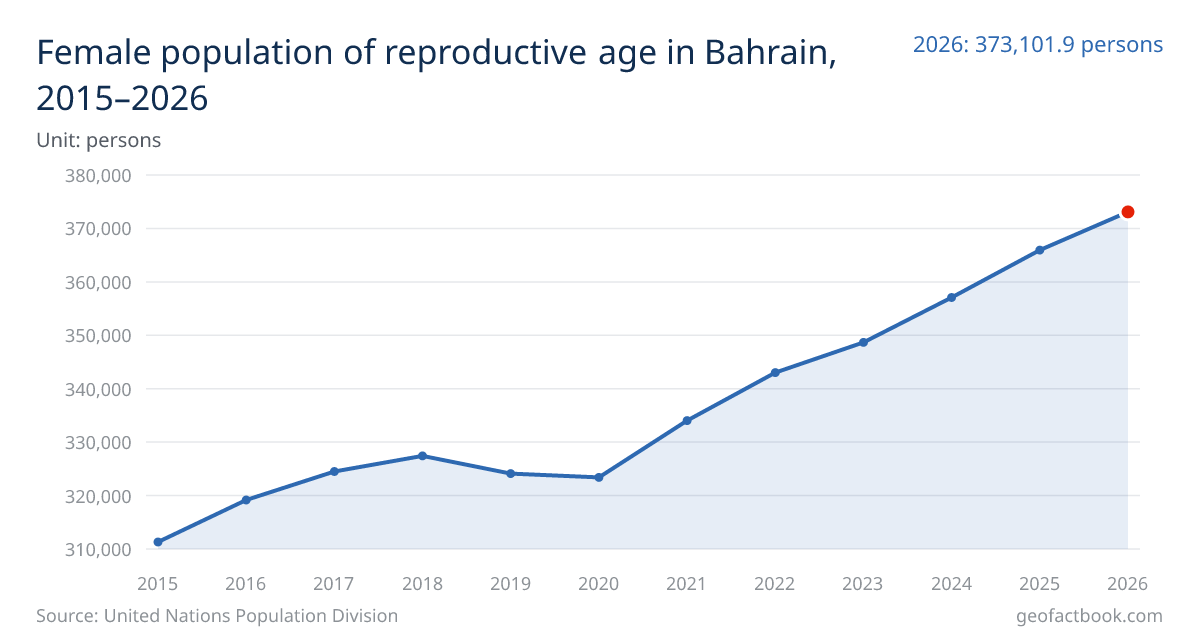
Bahrain's female population of reproductive age in 2026 is 373,102 (estimate), up 2.0% from 2025. It ranks #156 of 236 countries.
The female population of reproductive age is a crucial demographic statistic that influences healthcare, economic growth, and social policies in countries. Understanding this population helps address reproductive health needs and support family planning initiatives.
Estimated value for 2026 (interpolated, no direct source).
Where Bahrain ranks (2026)
#156 of 236- #154
 Latvia381,057.45 persons
- #155
 Timor-Leste378,325.85 persons
- #156
 Bahrain373,101.9 persons
- #157
 Eswatini346,044.35 persons
- #158
 Cyprus337,997.2 persons
Female population of reproductive age over timeSome values are estimated based on historical trends
| Year | Value | Change | % Change | Actions |
|---|---|---|---|---|
| 2026 | 373.10K persons | +7.16K persons | +1.96% | |
| 2025 | 365.94K persons | +8.87K persons | +2.49% | |
| 2024 | 357.06K persons | +8.40K persons | +2.41% | |
| 2023 | 348.66K persons | +5.65K persons | +1.65% | |
| 2022 | 343.01K persons | +8.98K persons | +2.69% | |
| 2021 | 334.03K persons | +10.64K persons | +3.29% | |
| 2020 | 323.39K persons | 722 persons | -0.22% | |
| 2019 | 324.12K persons | 3.31K persons | -1.01% | |
| 2018 | 327.43K persons | +2.93K persons | +0.90% | |
| 2017 | 324.50K persons | +5.33K persons | +1.67% | |
| 2016 | 319.17K persons | +7.86K persons | +2.52% | |
| 2015 | 311.32K persons | — | — |
Female population of reproductive age in Bahrain, 2015–2026: chart
Cite this page
Geo Factbook. (n.d.). Bahrain: Female population of reproductive age. Retrieved November 28, 2026, from https://geofactbook.com/countries/bahrain/female-population-of-reproductive-age
The figures on this page come from United Nations Population Division. For academic work, cite the original source as well.
Frequently Asked Questions About Bahrain Female population of reproductive age
What is Bahrain's female population of reproductive age in 2026?▾
Bahrain's female population of reproductive age is 373,102 in 2026 (estimate), according to United Nations Population Division.
Is Bahrain's female population of reproductive age increasing or decreasing?▾
Bahrain's female population of reproductive age rose by 2.0% from 2025 (365,939) to 2026 (373,102). Over the past decade (2016–2026) it rose by 16.9%.
How does Bahrain rank for female population of reproductive age?▾
In 2026, Bahrain has the 156th highest female population of reproductive age out of 236 countries with data.
What was Bahrain's female population of reproductive age in 2015?▾
In 2015, Bahrain's female population of reproductive age was 311,317. By 2026 it rose by 19.8%.
Explore additional statistical insights
Percentage of population by degree of urbanization in Bahrain
Explore the percentage of population by degree of urbanization across countries, highlighting the shift towards urban living and its impact on economic growth and development. Understanding these trends is crucial for addressing urban planning and resource allocation.
Crude Birth Rate in Bahrain
Crude birth rate measures births per 1,000 people. Identify regions with high or low birth rates globally.
Human Development Index in Bahrain
The Human Development Index combines indicators of health, education, and income to assess development levels.
Median age of population in Bahrain
The median age of a population is a key demographic indicator, reflecting the age distribution within a country. Understanding median age helps assess economic development, healthcare needs, and social dynamics. Countries with a higher median age may face challenges related to aging populations, while younger populations often indicate growth potential.
Population density in Bahrain
Population density measures how many people live per square kilometer in a country, highlighting urbanization and resource distribution. Understanding this statistic is crucial for assessing living conditions, infrastructure needs, and environmental impact.
Total deaths in Bahrain
Total deaths in countries measure the number of individuals who have passed away within a specific timeframe. This statistic is crucial for understanding health trends, mortality rates, and the impact of various factors on population dynamics.