
Argentina Total Armed Forces Personnel (PPP) 2020: 103,000
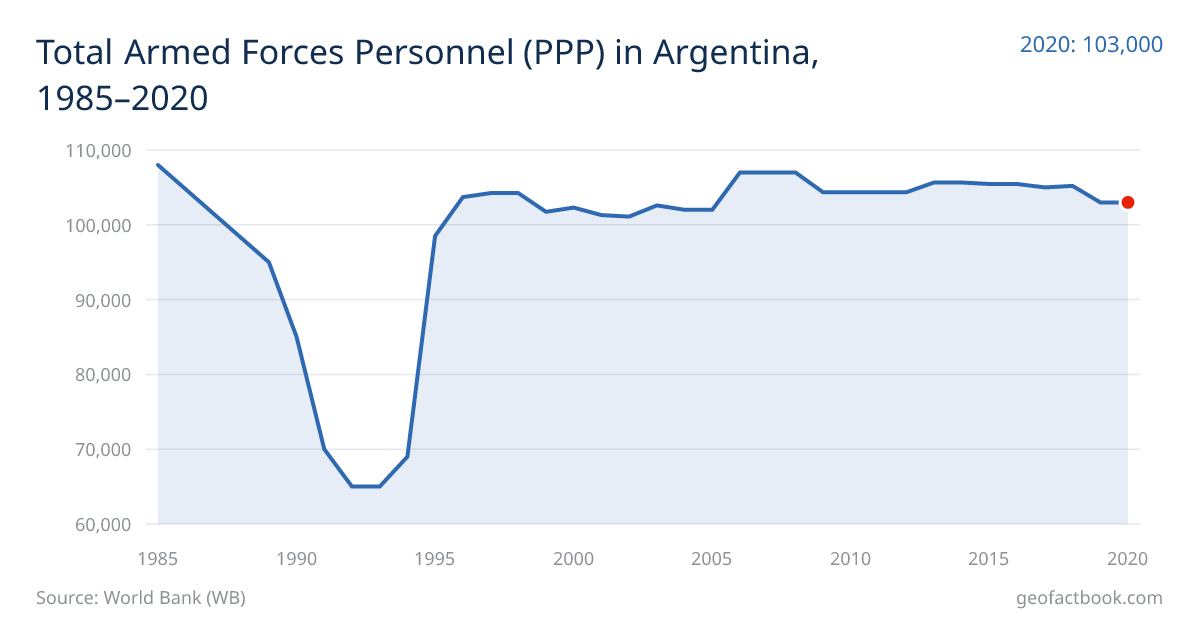
Argentina's total armed forces personnel (ppp) in 2020 is 103,000, unchanged from 2019. It ranks #53 of 170 countries.
Explore total armed forces personnel across 266+ countries. Compare military size, view rankings, and analyze historical trends on our interactive map.
Where Argentina ranks (2020)
#53 of 170- #51
 Chile114,000
- #52
 Nepal112,000
- #53
 Argentina103,000
- #54
 South Africa89,000
- #55
 Azerbaijan82,000
Total Armed Forces Personnel (PPP) over time
| Year | Value | Change | % Change | Actions |
|---|---|---|---|---|
| 2020 | 103.00K | 0 | 0.00% | |
| 2019 | 103.00K | 2.20K | -2.09% | |
| 2018 | 105.20K | +200 | +0.19% | |
| 2017 | 105.00K | 450 | -0.43% | |
| 2016 | 105.45K | 0 | 0.00% | |
| 2015 | 105.45K | 200 | -0.19% | |
| 2014 | 105.65K | 0 | 0.00% | |
| 2013 | 105.65K | +1.30K | +1.25% | |
| 2012 | 104.35K | 0 | 0.00% | |
| 2011 | 104.35K | +10 | +0.01% | |
| 2010 | 104.34K | 0 | 0.00% | |
| 2009 | 104.34K | 2.66K | -2.49% | |
| 2008 | 107.00K | 0 | 0.00% | |
| 2007 | 107.00K | 0 | 0.00% | |
| 2006 | 107.00K | +5.00K | +4.90% | |
| 2005 | 102.00K | 0 | 0.00% | |
| 2004 | 102.00K | 600 | -0.58% | |
| 2003 | 102.60K | +1.50K | +1.48% | |
| 2002 | 101.10K | 200 | -0.20% | |
| 2001 | 101.30K | 1.00K | -0.98% | |
| 2000 | 102.30K | +560 | +0.55% | |
| 1999 | 101.74K | 2.50K | -2.40% | |
| 1998 | 104.24K | 0 | 0.00% | |
| 1997 | 104.24K | +540 | +0.52% | |
| 1996 | 103.70K | +5.20K | +5.28% | |
| 1995 | 98.50K | +29.50K | +42.75% | |
| 1994 | 69.00K | +4.00K | +6.15% | |
| 1993 | 65.00K | 0 | 0.00% | |
| 1992 | 65.00K | 5.00K | -7.14% | |
| 1991 | 70.00K | 15.00K | -17.65% | |
| 1990 | 85.00K | 10.00K | -10.53% | |
| 1989 | 95.00K | 13.00K | -12.04% | |
| 1985 | 108.00K | — | — |
Total Armed Forces Personnel (PPP) in Argentina, 1985–2020: chart
Cite this page
Geo Factbook. (n.d.). Argentina: Total Armed Forces Personnel (PPP). Retrieved November 28, 2026, from https://geofactbook.com/countries/argentina/armed-forces-personnel-total
The figures on this page come from World Bank (WB). For academic work, cite the original source as well.
Frequently Asked Questions About Argentina Total Armed Forces Personnel (PPP)
What is Argentina's total armed forces personnel (ppp) in 2020?▾
Argentina's total armed forces personnel (ppp) is 103,000 in 2020, according to World Bank (WB).
Is Argentina's total armed forces personnel (ppp) increasing or decreasing?▾
Argentina's total armed forces personnel (ppp) was essentially unchanged from 2019 (103,000) to 2020 (103,000). Over the past decade (2010–2020) it fell by 1.3%.
How does Argentina rank for total armed forces personnel (ppp)?▾
In 2020, Argentina has the 53rd highest total armed forces personnel (ppp) out of 170 countries with data.
What was Argentina's total armed forces personnel (ppp) in 1985?▾
In 1985, Argentina's total armed forces personnel (ppp) was 108,000. By 2020 it fell by 4.6%.
Explore additional statistical insights
Military Service Age and Obligation in Argentina
Military service age and obligation details for 266+ countries. Compare requirements, explore rankings, and view interactive maps.
Health Care Spending per Capita in Argentina
Health care spending per capita measures the average health expenditure per person in a country, highlighting affordability.
Gini Index Coefficient in Argentina
Gini Index measures income inequality within a country. Compare rankings, explore trends, and visualize data on our interactive map.
Gross Domestic Product (GDP) by Country in Current US Dollars in Argentina
Discover the Gross Domestic Product (GDP) by country in current US dollars, a key indicator of economic performance. This statistic reveals the financial health and growth potential of nations, making it essential for investors and policymakers.
High-Tech Export Percentage in Argentina
High-tech export percentage indicates a country's focus on advanced technology in its manufacturing exports.
Agricultural land in Argentina
Agricultural land measures the area dedicated to farming and cultivation in countries, impacting food production and sustainability. Understanding this statistic is crucial for assessing agricultural capacity and economic development.