
Algeria Total Armed Forces Personnel (PPP) 2020: 326,000
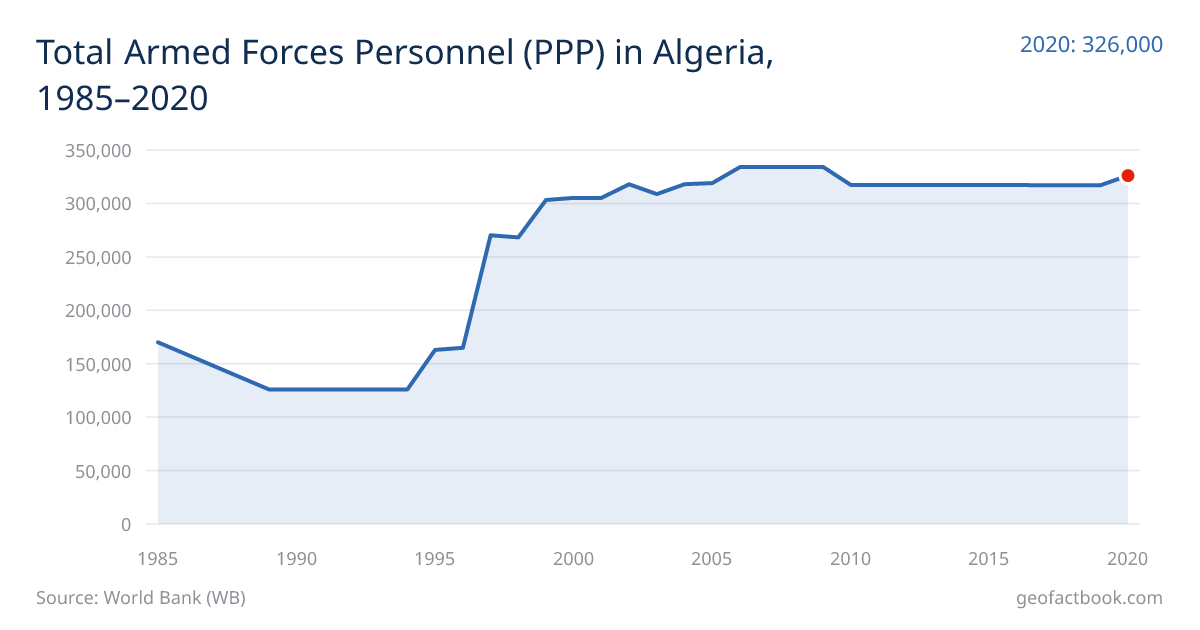
Algeria's total armed forces personnel (ppp) in 2020 is 326,000, up 2.8% from 2019. It ranks #21 of 170 countries.
Explore total armed forces personnel across 266+ countries. Compare military size, view rankings, and analyze historical trends on our interactive map.
Where Algeria ranks (2020)
#21 of 170- #19
 Mexico341,000
- #20
 Italy338,000
- #21
 Algeria326,000
- #22
 Sri Lanka317,000
- #23
 France304,000
Total Armed Forces Personnel (PPP) over time
| Year | Value | Change | % Change | Actions |
|---|---|---|---|---|
| 2020 | 326.00K | +9.00K | +2.84% | |
| 2019 | 317.00K | 0 | 0.00% | |
| 2018 | 317.00K | 0 | 0.00% | |
| 2017 | 317.00K | 200 | -0.06% | |
| 2016 | 317.20K | 0 | 0.00% | |
| 2015 | 317.20K | 0 | 0.00% | |
| 2014 | 317.20K | 0 | 0.00% | |
| 2013 | 317.20K | 0 | 0.00% | |
| 2012 | 317.20K | 0 | 0.00% | |
| 2011 | 317.20K | 0 | 0.00% | |
| 2010 | 317.20K | 17.00K | -5.09% | |
| 2009 | 334.20K | +200 | +0.06% | |
| 2008 | 334.00K | 0 | 0.00% | |
| 2007 | 334.00K | 0 | 0.00% | |
| 2006 | 334.00K | +15.00K | +4.70% | |
| 2005 | 319.00K | +1.00K | +0.31% | |
| 2004 | 318.00K | +9.30K | +3.01% | |
| 2003 | 308.70K | 9.20K | -2.89% | |
| 2002 | 317.90K | +12.70K | +4.16% | |
| 2001 | 305.20K | 0 | 0.00% | |
| 2000 | 305.20K | +2.00K | +0.66% | |
| 1999 | 303.20K | +35.00K | +13.05% | |
| 1998 | 268.20K | 2.00K | -0.74% | |
| 1997 | 270.20K | +105.30K | +63.86% | |
| 1996 | 164.90K | +2.00K | +1.23% | |
| 1995 | 162.90K | +36.90K | +29.29% | |
| 1994 | 126.00K | 0 | 0.00% | |
| 1993 | 126.00K | 0 | 0.00% | |
| 1992 | 126.00K | 0 | 0.00% | |
| 1991 | 126.00K | 0 | 0.00% | |
| 1990 | 126.00K | 0 | 0.00% | |
| 1989 | 126.00K | 44.00K | -25.88% | |
| 1985 | 170.00K | — | — |
Total Armed Forces Personnel (PPP) in Algeria, 1985–2020: chart
Cite this page
Geo Factbook. (n.d.). Algeria: Total Armed Forces Personnel (PPP). Retrieved November 27, 2026, from https://geofactbook.com/countries/algeria/armed-forces-personnel-total
The figures on this page come from World Bank (WB). For academic work, cite the original source as well.
Frequently Asked Questions About Algeria Total Armed Forces Personnel (PPP)
What is Algeria's total armed forces personnel (ppp) in 2020?▾
Algeria's total armed forces personnel (ppp) is 326,000 in 2020, according to World Bank (WB).
Is Algeria's total armed forces personnel (ppp) increasing or decreasing?▾
Algeria's total armed forces personnel (ppp) rose by 2.8% from 2019 (317,000) to 2020 (326,000). Over the past decade (2010–2020) it rose by 2.8%.
How does Algeria rank for total armed forces personnel (ppp)?▾
In 2020, Algeria has the 21st highest total armed forces personnel (ppp) out of 170 countries with data.
What was Algeria's total armed forces personnel (ppp) in 1985?▾
In 1985, Algeria's total armed forces personnel (ppp) was 170,000. By 2020 it rose by 91.8%.
Explore additional statistical insights
Deaths in Armed Conflicts in Algeria
Deaths in armed conflicts highlight the human cost of wars. Track fatalities in countries with ongoing conflicts.
Top Exporting Countries in Algeria
Top exporting countries drive global trade; measure export volume and its impact on international markets.
Orange Yield Per Hectare in Algeria
Examine orange yield per hectare across countries; learn which regions maximize citrus production efficiency.
Diabetes Prevalence (% of Population) in Algeria
Diabetes prevalence measures the percentage of adults aged 20 to 79 affected. Explore country comparisons, rankings, and interactive maps.
Academic Freedom Index in Algeria
Explore the Academic Freedom Index measuring educational liberties globally. Compare countries' scores, view rankings, and analyze historical trends.
Total population in Algeria
Discover the latest total population statistics for every country and region worldwide. Explore accurate, up-to-date data on global population growth, density, and demographic trends — sourced from trusted international databases like the UN and World Bank. Perfect for researchers, students, and data enthusiasts looking to understand how the world’s population is changing.