
AI Preparedness Index 2023
The IMF's AI Preparedness Index scores how ready a country is to adopt artificial intelligence, on a scale from 0 to 1 (higher is better prepared). It combines four areas: digital infrastructure, human capital and labour market policies, innovation and economic integration, and regulation and ethics. It measures readiness, not how many jobs AI has replaced or could affect.
 Singapore
 Central African Republic
Where does your country rank? Pick it to see its position.
Related Economy statistics
More ↓Interactive Map
Complete Data Rankings
Rank | Actions | ||
|---|---|---|---|
1 | Singapore | 0.801 index (0–1) | |
2 |  Denmark | 0.779 index (0–1) | |
3 |  United States | 0.771 index (0–1) | |
4 |  Netherlands | 0.766 index (0–1) | |
5 |  Estonia | 0.764 index (0–1) | |
6 |  Finland | 0.758 index (0–1) | |
7 |  Switzerland | 0.757 index (0–1) | |
8 |  New Zealand | 0.754 index (0–1) | |
9 |  Germany | 0.753 index (0–1) | |
10 |  Sweden | 0.748 index (0–1) | |
11 |  Luxembourg | 0.735 index (0–1) | |
12 |  Japan | 0.733 index (0–1) | |
13 |  United Kingdom | 0.731 index (0–1) | |
14 |  Australia | 0.727 index (0–1) | |
15 |  South Korea | 0.727 index (0–1) | |
16 |  Austria | 0.725 index (0–1) | |
17 |  Israel | 0.725 index (0–1) | |
18 |  Canada | 0.713 index (0–1) | |
19 |  Norway | 0.706 index (0–1) | |
20 |  China, Hong Kong SAR | 0.701 index (0–1) | |
21 |  Iceland | 0.7 index (0–1) | |
22 |  France | 0.698 index (0–1) | |
23 |  Ireland | 0.693 index (0–1) | |
24 |  Belgium | 0.672 index (0–1) | |
25 |  Lithuania | 0.665 index (0–1) | |
26 |  Malta | 0.659 index (0–1) | |
27 |  Spain | 0.648 index (0–1) | |
28 |  Czech Republic | 0.646 index (0–1) | |
29 |  Portugal | 0.646 index (0–1) | |
30 |  China | 0.635 index (0–1) | |
31 |  Slovenia | 0.634 index (0–1) | |
32 |  Cyprus | 0.632 index (0–1) | |
33 |  Latvia | 0.632 index (0–1) | |
34 |  Malaysia | 0.632 index (0–1) | |
35 |  United Arab Emirates | 0.628 index (0–1) | |
36 |  Italy | 0.621 index (0–1) | |
37 |  Poland | 0.597 index (0–1) | |
38 |  Slovakia | 0.592 index (0–1) | |
39 |  Chile | 0.586 index (0–1) | |
40 |  Romania | 0.584 index (0–1) | |
41 |  Croatia | 0.582 index (0–1) | |
42 |  Greece | 0.582 index (0–1) | |
43 |  Bulgaria | 0.577 index (0–1) | |
44 |  Saudi Arabia | 0.577 index (0–1) | |
45 |  Hungary | 0.563 index (0–1) | |
46 |  Russia | 0.559 index (0–1) | |
47 |  Kazakhstan | 0.552 index (0–1) | |
48 |  Uruguay | 0.549 index (0–1) | |
49 |  Costa Rica | 0.54 index (0–1) | |
50 |  Turkey | 0.54 index (0–1) | |
51 |  Serbia | 0.537 index (0–1) | |
52 |  Thailand | 0.536 index (0–1) | |
53 |  Qatar | 0.535 index (0–1) | |
54 |  Oman | 0.533 index (0–1) | |
55 |  Mexico | 0.532 index (0–1) | |
56 |  Seychelles | 0.531 index (0–1) | |
57 |  Georgia | 0.53 index (0–1) | |
58 |  Albania | 0.527 index (0–1) | |
59 |  Mauritius | 0.525 index (0–1) | |
60 |  Indonesia | 0.516 index (0–1) | |
61 |  Bahrain | 0.515 index (0–1) | |
62 |  Ukraine | 0.512 index (0–1) | |
63 |  Barbados | 0.505 index (0–1) | |
64 |  Montenegro | 0.504 index (0–1) | |
65 |  Brazil | 0.501 index (0–1) | |
66 |  Panama | 0.501 index (0–1) | |
67 |  Philippines | 0.498 index (0–1) | |
68 |  South Africa | 0.497 index (0–1) | |
69 |  Brunei Darussalam | 0.495 index (0–1) | |
70 |  Armenia | 0.493 index (0–1) | |
71 |  India | 0.493 index (0–1) | |
72 |  Peru | 0.491 index (0–1) | |
73 |  Colombia | 0.489 index (0–1) | |
74 |  Mongolia | 0.484 index (0–1) | |
75 |  Jordan | 0.483 index (0–1) | |
76 |  North Macedonia | 0.482 index (0–1) | |
77 |  Vietnam | 0.482 index (0–1) | |
78 |  Republic of Moldova | 0.481 index (0–1) | |
79 |  Argentina | 0.474 index (0–1) | |
80 |  Azerbaijan | 0.471 index (0–1) | |
81 |  Belarus | 0.471 index (0–1) | |
82 |  Dominican Republic | 0.469 index (0–1) | |
83 |  Tunisia | 0.465 index (0–1) | |
84 |  Kuwait | 0.461 index (0–1) | |
85 |  Bahamas | 0.458 index (0–1) | |
86 |  Fiji | 0.449 index (0–1) | |
87 |  Kenya | 0.445 index (0–1) | |
88 |  Ecuador | 0.442 index (0–1) | |
89 |  Bhutan | 0.442 index (0–1) | |
90 |  Rwanda | 0.437 index (0–1) | |
91 |  Sri Lanka | 0.436 index (0–1) | |
92 |  Trinidad and Tobago | 0.436 index (0–1) | |
93 |  Jamaica | 0.434 index (0–1) | |
94 |  Cabo Verde | 0.433 index (0–1) | |
95 |  Morocco | 0.429 index (0–1) | |
96 |  Bosnia and Herzegovina | 0.428 index (0–1) | |
97 |  Timor-Leste | 0.428 index (0–1) | |
98 |  Kyrgyzstan | 0.426 index (0–1) | |
99 |  Ghana | 0.425 index (0–1) | |
100 |  Guyana | 0.424 index (0–1) | |
101 |  Belize | 0.423 index (0–1) | |
102 |  Namibia | 0.42 index (0–1) | |
103 |  Lebanon | 0.418 index (0–1) | |
104 |  Suriname | 0.418 index (0–1) | |
105 |  Botswana | 0.413 index (0–1) | |
106 |  Paraguay | 0.41 index (0–1) | |
107 |  Senegal | 0.396 index (0–1) | |
108 |  Egypt | 0.394 index (0–1) | |
109 |  El Salvador | 0.39 index (0–1) | |
110 |  Guatemala | 0.39 index (0–1) | |
111 |  Bangladesh | 0.384 index (0–1) | |
112 |  Iran | 0.378 index (0–1) | |
113 |  Bolivia | 0.377 index (0–1) | |
114 |  Saint Lucia | 0.374 index (0–1) | |
115 |  Zambia | 0.371 index (0–1) | |
116 |  Algeria | 0.37 index (0–1) | |
117 |  Cambodia | 0.37 index (0–1) | |
118 |  Liberia | 0.37 index (0–1) | |
119 |  Pakistan | 0.369 index (0–1) | |
120 |  Côte d'Ivoire | 0.366 index (0–1) | |
121 |  Tajikistan | 0.366 index (0–1) | |
122 |  Benin | 0.363 index (0–1) | |
123 |  Gambia | 0.36 index (0–1) | |
124 |  Lesotho | 0.355 index (0–1) | |
125 |  Uganda | 0.354 index (0–1) | |
126 |  Tanzania | 0.352 index (0–1) | |
127 |  Nepal | 0.351 index (0–1) | |
128 |  Saint Vincent and the Grenadines | 0.342 index (0–1) | |
129 |  Honduras | 0.342 index (0–1) | |
130 |  Cameroon | 0.341 index (0–1) | |
131 |  Malawi | 0.34 index (0–1) | |
132 |  Nigeria | 0.336 index (0–1) | |
133 |  Nicaragua | 0.331 index (0–1) | |
134 |  Laos | 0.33 index (0–1) | |
135 |  Myanmar | 0.327 index (0–1) | |
136 |  Niger | 0.326 index (0–1) | |
137 |  Guinea | 0.324 index (0–1) | |
138 |  Gabon | 0.323 index (0–1) | |
139 |  Djibouti | 0.319 index (0–1) | |
140 |  Togo | 0.316 index (0–1) | |
141 |  Burkina Faso | 0.312 index (0–1) | |
142 |  Eswatini | 0.306 index (0–1) | |
143 |  Madagascar | 0.305 index (0–1) | |
144 |  Zimbabwe | 0.305 index (0–1) | |
145 |  Syrian Arab Republic | 0.298 index (0–1) | |
146 |  Sierra Leone | 0.298 index (0–1) | |
147 |  Mali | 0.296 index (0–1) | |
148 |  Burundi | 0.295 index (0–1) | |
149 |  Papua New Guinea | 0.29 index (0–1) | |
150 |  Congo | 0.277 index (0–1) | |
151 |  Venezuela | 0.275 index (0–1) | |
152 |  Iraq | 0.27 index (0–1) | |
153 |  Haiti | 0.268 index (0–1) | |
154 |  Guinea-Bissau | 0.265 index (0–1) | |
155 |  Angola | 0.26 index (0–1) | |
156 |  Mozambique | 0.257 index (0–1) | |
157 |  Comoros | 0.254 index (0–1) | |
158 |  Ethiopia | 0.254 index (0–1) | |
159 |  Yemen | 0.253 index (0–1) | |
160 |  Congo, Democratic Republic of the | 0.247 index (0–1) | |
161 |  Libya | 0.245 index (0–1) | |
162 |  Chad | 0.234 index (0–1) | |
163 |  Mauritania | 0.233 index (0–1) | |
164 |  Sudan | 0.233 index (0–1) | |
165 | Central African Republic | 0.184 index (0–1) |
- #1Singapore
- #2Denmark
- #3United States
- #4Netherlands
- #5Estonia
- #6Finland
- #7Switzerland
- #8New Zealand
- #9Germany
- #10Sweden
Analysis: These countries represent the highest values in this dataset, showcasing significant scale and impact on global statistics.
- #165Central African Republic
- #164Sudan
- #163Mauritania
- #162Chad
- #161Libya
- #160Congo, Democratic Republic of the
- #159Yemen
- #158Ethiopia
- #157Comoros
- #156Mozambique
Context: These countries or territories have the lowest values, often due to geographic size, administrative status, or specific characteristics.
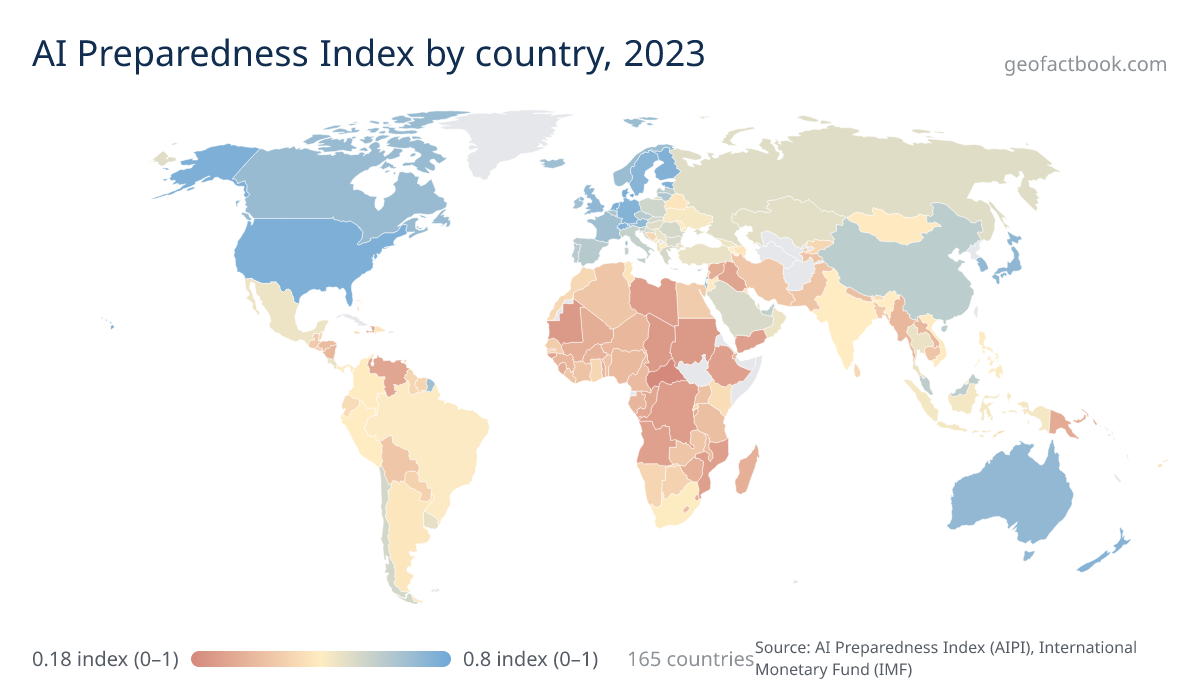
AI Preparedness Index by country, 2023: map image
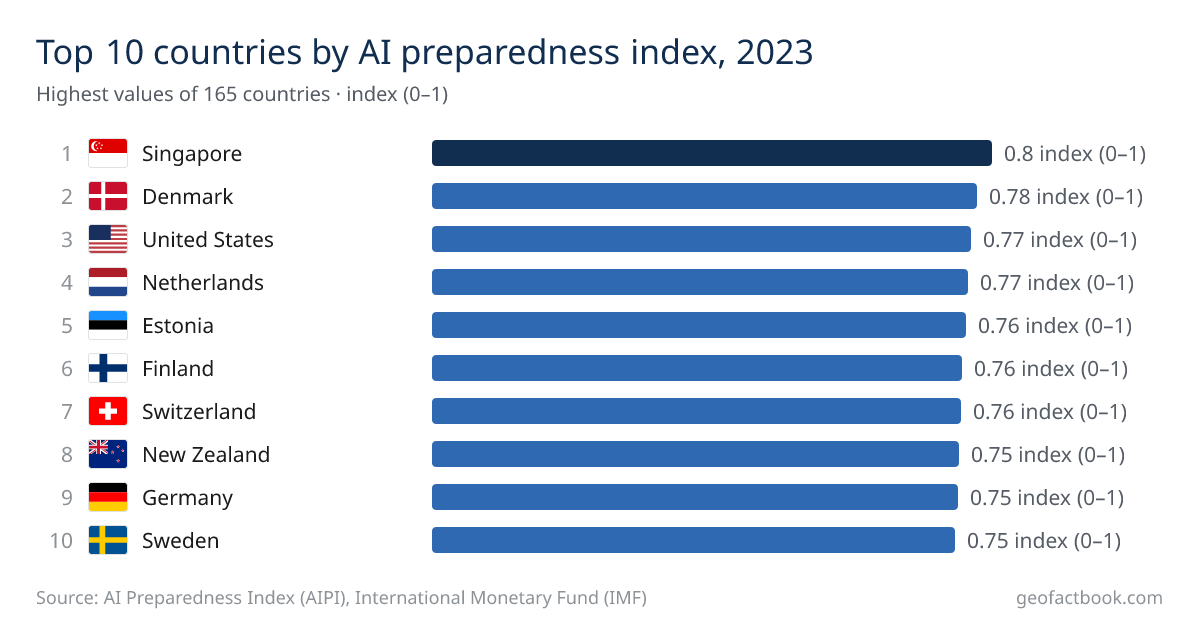
Top 10 countries by AI preparedness index, 2023: chart
Insights by country
Mauritius
Mauritius ranks #59 globally with an AI Preparedness Index value of 0.525 index in 2023. This places it above many regional peers, reflecting a growing commitment to integrating artificial intelligence into various sectors. Key drivers of this index include Mauritius's strategic investments in technology infrastructure and its focus on digital innovation as part of national development plans. Additionally, the government's supportive policies aim to enhance the skills of the workforce in AI-related fields.
United Arab Emirates
The United Arab Emirates ranks #35 globally with an AI Preparedness Index value of 0.628 index in 2023. This positions it above the global average, reflecting a proactive stance in AI development compared to many regional neighbors. Factors contributing to this strong performance include significant government investment in technology and innovation, as well as a strategic focus on becoming a regional tech hub.
Nepal
Nepal ranks #127 globally with an AI Preparedness Index of 0.351 index in 2023. This positions Nepal below many of its South Asian neighbors, reflecting a significant gap in AI readiness compared to countries like India, which is actively investing in technology infrastructure. Key drivers of this low ranking include limited access to digital education and a nascent technology sector, which hinder the country's ability to leverage AI for economic growth.
Lesotho
In 2023, Lesotho ranks #124 globally with an AI Preparedness Index value of 0.355 index (0–1). This positions Lesotho below many of its regional peers, indicating a significant gap in AI readiness compared to countries with more advanced technological infrastructures. Contributing factors include limited investment in digital technology and a small population that restricts the scale of innovation and development in the AI sector.
Philippines
In 2023, the Philippines achieved an AI Preparedness Index value of 0.498 index, ranking #67 out of 165 countries. This positions the Philippines below the regional average for Southeast Asia, indicating challenges in fully leveraging artificial intelligence technologies compared to neighbors like Singapore, which ranks much higher. Key drivers of this index include a growing tech-savvy population and government initiatives aimed at enhancing digital infrastructure, although economic constraints and varying levels of education access remain significant hurdles.
Mexico
In 2023, Mexico achieved a rank of #55 with an AI Preparedness Index value of 0.532 index. This positions Mexico below the regional average for Latin America, indicating room for improvement compared to its neighbors. Key drivers of this index include Mexico's growing tech ecosystem and government initiatives aimed at fostering innovation, although challenges remain in infrastructure and education that may hinder broader AI adoption.
Chad
In 2023, Chad ranks #162 with an AI Preparedness Index value of 0.234 index, placing it among the lowest globally. This score is significantly below the global average, reflecting the country's limited technological infrastructure and investment in digital education. Key drivers of this low ranking include Chad's economic challenges, characterized by a reliance on agriculture and insufficient government policies to promote technology adoption.
Bosnia and Herzegovina
Bosnia and Herzegovina ranks #96 with an AI Preparedness Index value of 0.428 index in 2023. This places the country below the global average, reflecting challenges in its technological infrastructure compared to regional peers. Contributing factors include a developing economy and limited investment in digital education and innovation, which hinder the country's ability to fully leverage artificial intelligence technologies.
Paraguay
In 2023, Paraguay ranks #106 globally with an AI Preparedness Index value of 0.410 index. This places Paraguay below many of its regional neighbors, reflecting challenges in technological infrastructure and investment in digital skills. Factors such as limited access to high-quality education and a nascent tech ecosystem contribute to this ranking, hindering the country's ability to effectively adopt and integrate artificial intelligence solutions.
Egypt
In 2023, Egypt ranks #108 globally in the AI Preparedness Index with a 0.394 index. This position reflects a significant gap compared to top-ranked countries, which often showcase robust technological infrastructure and investment in AI education. Key drivers for Egypt's lower score include limited funding for research and development in artificial intelligence and a rapidly growing population that presents challenges in meeting educational needs in tech fields.
Analysis & Context
In 2023, Singapore leads the AI Preparedness Index with a score of 0.801, highlighting its readiness for artificial intelligence adoption. The global range for this index spans from a minimum of 0.18 to a maximum of 0.80. The average global score is 0.48, providing a benchmark for evaluating countries' preparedness levels.
Key Drivers of AI Preparedness
The top performers in the AI Preparedness Index, such as Singapore, Denmark (0.779), and the United States (0.771), have established themselves as leaders due to their robust digital infrastructure and innovation ecosystems. These countries have heavily invested in high-speed internet access, cloud computing capabilities, and cybersecurity measures, which are crucial for supporting AI technologies. Furthermore, they have vibrant tech industries and policies that encourage innovation, bolstering their positions at the top of the index.
Conversely, countries like the Central African Republic (0.184) and Sudan (0.233) face challenges in these areas. Limited infrastructure and political instability hinder their ability to develop and integrate AI technologies effectively. This stark contrast highlights how significant investment and stable governance are vital to AI readiness.
Human Capital and Policy Influence
Another critical factor influencing AI preparedness is the level of human capital and the presence of labour market policies that foster AI skills. Nations like Estonia (0.764) and Finland (0.758) excel in this domain due to their strong emphasis on education and vocational training in technology and AI-related fields. Their proactive approach to developing a skilled workforce ensures a steady pipeline of talent capable of advancing AI initiatives.
In contrast, countries such as Chad (0.234) and Mozambique (0.257) struggle with educational and economic barriers, limiting their ability to cultivate the necessary human capital. This underscores the importance of strategic educational reforms and investment in workforce development to enhance AI preparedness.
Regulatory Environment and Ethical Standards
The regulatory framework surrounding AI adoption plays a pivotal role in determining a country's preparedness. Countries like Germany (0.753) and Sweden (0.748) have established comprehensive regulations and ethical guidelines that promote responsible AI use while safeguarding privacy and data security. This balanced approach not only accelerates AI integration but also builds public trust in these technologies.
On the other hand, nations such as Libya (0.245) and the Democratic Republic of the Congo (0.247) face regulatory challenges that impede AI development. The absence of clear guidelines and ethical standards can deter investment and innovation, highlighting the necessity for transparent and forward-thinking regulatory policies.
Economic Integration and Innovation
Economic integration and a country's ability to harness global AI advancements are also crucial. Switzerland (0.757) and New Zealand (0.754) benefit from their open economies and strong international collaborations, which facilitate the adoption of cutting-edge AI technologies. These nations actively participate in international AI research and development initiatives, enhancing their competitiveness in the global market.
Meanwhile, countries like Yemen (0.253) and Ethiopia (0.254) face economic isolation and limited access to global AI networks, restricting their ability to leverage international expertise and innovation. This disparity emphasizes the importance of fostering international partnerships and economic policies that support AI integration.
Overall, the AI Preparedness Index of 2023 reveals significant disparities in AI readiness across the globe. While some countries have made substantial progress through strategic investments and policies, others continue to face challenges that require targeted interventions. Understanding these dynamics is essential for nations aiming to improve their AI preparedness and harness the transformative potential of artificial intelligence.
Frequently Asked Questions About AI Preparedness Index in 2023
Which country is the highest on the AI Preparedness Index in 2023?
Singapore is the highest on the AI Preparedness Index in 2023 with a score of 0.8.
What is the lowest score on the AI Preparedness Index in 2023?
The Central African Republic has the lowest score on the AI Preparedness Index in 2023, with a score of 0.18.
What is the average AI Preparedness Index score for countries in 2023?
The average AI Preparedness Index score for countries in 2023 is 0.48.
Which countries are in the top 10 of the AI Preparedness Index in 2023?
The top 10 countries on the AI Preparedness Index in 2023 are Singapore, Denmark, United States, Netherlands, Estonia, Finland, Switzerland, New Zealand, Germany, and Sweden.
How many countries are included in the AI Preparedness Index dataset for 2023?
There are 165 countries included in the AI Preparedness Index dataset for 2023.
What is the median AI Preparedness Index score in 2023?
The median AI Preparedness Index score in 2023 is 0.47.
Data Source
AI Preparedness Index (AIPI), International Monetary Fund (IMF)
IMF AI Preparedness Index, April 2024 release (reference year 2023), from IMF Staff Discussion Note SDN/2024/001 "Gen-AI: Artificial Intelligence and the Future of Work". Downloaded from the IMF DataMapper API.
Visit Data SourceCite this page
Geo Factbook. (n.d.). AI Preparedness Index by Country, 2023. Retrieved November 25, 2026, from https://geofactbook.com/fact/ai-preparedness-index/2023
The figures on this page come from AI Preparedness Index (AIPI), International Monetary Fund (IMF). For academic work, cite the original source as well.
›Embed this ranking on your site
Free to embed with attribution. Shows the top 10 countries and links back to the full ranking.
More Economy Facts
See all Economy facts →AI Investment (% of GDP)
AI investment as a percentage of GDP measures a country's commitment to AI development and innovation, influencing global competitiveness.
Highest: Iran44.35%Gender Pay Gap Percentage
Gender pay gap percentage measures income disparities between men and women across various countries.
Highest: Nigeria26.71%Corporate Tax Rate Trends
Analyze trends in corporate income tax rates over the past decade, identifying patterns and shifts in global economic policies.
Highest: India48.32%You might also like
Total population
FeaturedDiscover the latest total population statistics for every country and region worldwide. Explore accurate, up-to-date data on global population growth, density, and demographic trends — sourced from trusted international databases like the UN and World Bank. Perfect for researchers, students, and data enthusiasts looking to understand how the world’s population is changing.
Highest: India1.48B personsPopulation density
FeaturedPopulation density measures how many people live per square kilometer in a country, highlighting urbanization and resource distribution. Understanding this statistic is crucial for assessing living conditions, infrastructure needs, and environmental impact.
 Highest: Monaco25,822.58 per sq. km
Life expectancy at birth
FeaturedLife expectancy at birth measures the average years a newborn is expected to live, reflecting a country's health standards and quality of life. This vital statistic highlights disparities in healthcare and living conditions across nations, making it essential for global health assessments.
Highest: Monaco89.29 years