
Uruguay Hospital Beds per Capita 2023: 2.44 beds per 1,000
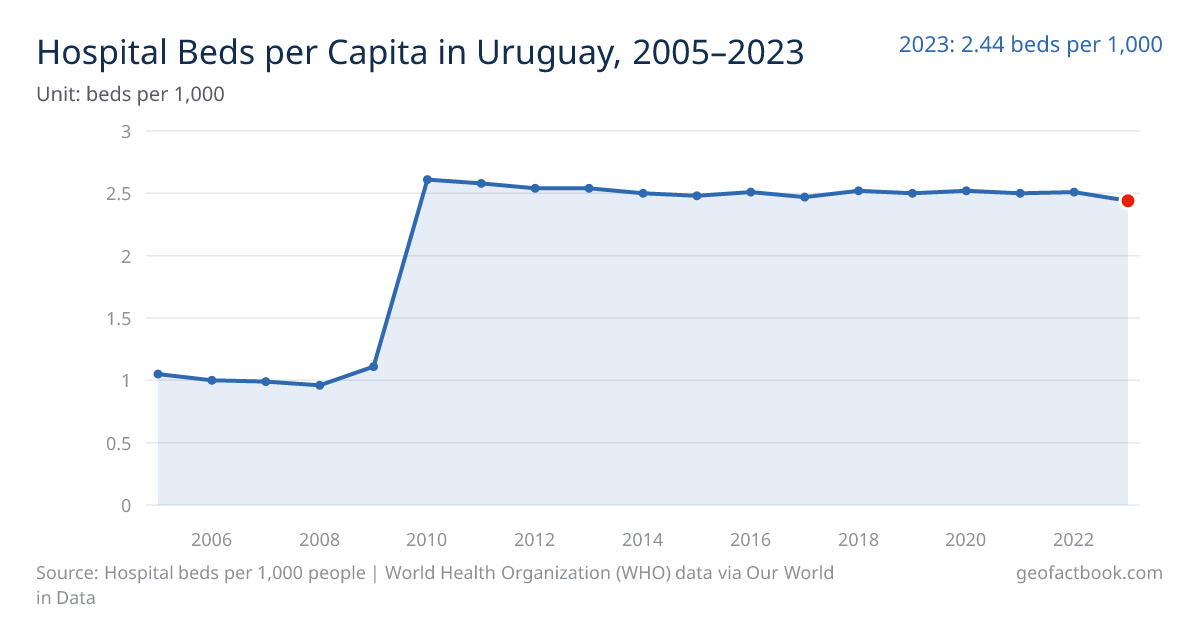
Uruguay's hospital beds per capita in 2023 is 2.44 beds per 1,000, down 2.8% from 2022. It ranks #40 of 73 countries.
Hospital beds per capita highlights healthcare infrastructure by showing available hospital beds per 1,000 people globally.
Source (2023): Hospital beds per 1,000 people | Our World in Data
Where Uruguay ranks (2023)
#40 of 73- #38
 Seychelles2.63 beds per 1,000
- #39
 New Zealand2.51 beds per 1,000
- #40
 Uruguay2.44 beds per 1,000
- #41
 Denmark2.43 beds per 1,000
- #42
 Saudi Arabia2.41 beds per 1,000
Hospital Beds per Capita over time
| Year | Value | Change | % Change | Actions |
|---|---|---|---|---|
| 2023 | 2.44 beds per 1,000 | 0.07 beds per 1,000 | -2.79% | |
| 2022 | 2.51 beds per 1,000 | +0.01 beds per 1,000 | +0.40% | |
| 2021 | 2.5 beds per 1,000 | 0.02 beds per 1,000 | -0.79% | |
| 2020 | 2.52 beds per 1,000 | +0.02 beds per 1,000 | +0.80% | |
| 2019 | 2.5 beds per 1,000 | 0.02 beds per 1,000 | -0.79% | |
| 2018 | 2.52 beds per 1,000 | +0.05 beds per 1,000 | +2.02% | |
| 2017 | 2.47 beds per 1,000 | 0.04 beds per 1,000 | -1.59% | |
| 2016 | 2.51 beds per 1,000 | +0.03 beds per 1,000 | +1.21% | |
| 2015 | 2.48 beds per 1,000 | 0.02 beds per 1,000 | -0.80% | |
| 2014 | 2.5 beds per 1,000 | 0.04 beds per 1,000 | -1.57% | |
| 2013 | 2.54 beds per 1,000 | 0 beds per 1,000 | 0.00% | |
| 2012 | 2.54 beds per 1,000 | 0.04 beds per 1,000 | -1.55% | |
| 2011 | 2.58 beds per 1,000 | 0.03 beds per 1,000 | -1.15% | |
| 2010 | 2.61 beds per 1,000 | +1.5 beds per 1,000 | +135.14% | |
| 2009 | 1.11 beds per 1,000 | +0.15 beds per 1,000 | +15.63% | |
| 2008 | 0.96 beds per 1,000 | 0.03 beds per 1,000 | -3.03% | |
| 2007 | 0.99 beds per 1,000 | 0.01 beds per 1,000 | -1.00% | |
| 2006 | 1 beds per 1,000 | 0.05 beds per 1,000 | -4.76% | |
| 2005 | 1.05 beds per 1,000 | — | — |
Hospital Beds per Capita in Uruguay, 2005–2023: chart
Cite this page
Geo Factbook. (n.d.). Uruguay: Hospital Beds per Capita. Retrieved November 28, 2026, from https://geofactbook.com/countries/uruguay/hospital-beds-per-capita
The figures on this page come from Hospital beds per 1,000 people | World Health Organization (WHO) data via Our World in Data. For academic work, cite the original source as well.
Frequently Asked Questions About Uruguay Hospital Beds per Capita
What is Uruguay's hospital beds per capita in 2023?▾
Uruguay's hospital beds per capita is 2.44 beds per 1,000 in 2023, according to Hospital beds per 1,000 people | World Health Organization (WHO) data via Our World in Data.
Is Uruguay's hospital beds per capita increasing or decreasing?▾
Uruguay's hospital beds per capita fell by 2.8% from 2022 (2.51 beds per 1,000) to 2023 (2.44 beds per 1,000). Over the past decade (2013–2023) it fell by 3.9%.
How does Uruguay rank for hospital beds per capita?▾
In 2023, Uruguay has the 40th highest hospital beds per capita out of 73 countries with data.
What was Uruguay's hospital beds per capita in 2005?▾
In 2005, Uruguay's hospital beds per capita was 1.05 beds per 1,000. By 2023 it rose by 132.4%.
Explore additional statistical insights
Fruit Consumption Per Capita in Uruguay
Fruit consumption per capita measures the average fruit intake per person annually, reflecting dietary habits.
Cancer Mortality Rate in Uruguay
Cancer mortality rate measures the number of cancer deaths per 100,000 people annually; crucial for health strategy assessment.
Female Life Expectancy Leaders in Uruguay
Explore which countries lead in female life expectancy. Japan and Switzerland often top the list.
Diabetes Prevalence (% of Population) in Uruguay
Diabetes prevalence measures the percentage of adults aged 20 to 79 affected. Explore country comparisons, rankings, and interactive maps.
Health Coverage Index Score in Uruguay
Health Coverage Index Score assesses a country's capacity to provide essential health services to its population.
Pancreatic Cancer Mortality Rate in Uruguay
Pancreatic cancer mortality rate shows how many die from this cancer per 100,000 people annually. High rates help identify at-risk populations.