
United States Length of paid parental leave for mother 2026: 183.40 days
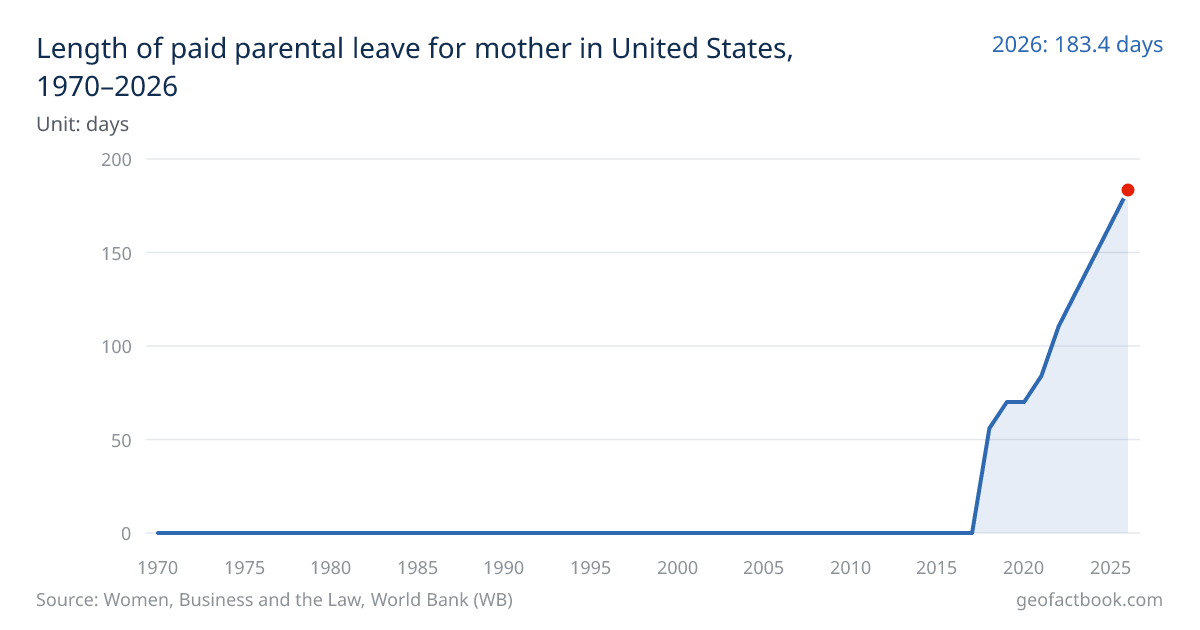
United States's length of paid parental leave for mother in 2026 is 183.40 days (estimate), up 11.0% from 2025. It ranks #7 of 189 countries.
Discover how the length of paid parental leave for mothers varies by country, impacting family well-being and workforce participation. Explore the statistics that highlight this critical social issue.
Estimated value for 2026 (interpolated, no direct source).
Where United States ranks (2026)
#7 of 189- #5
 Iceland288 days
- #6
 Norway185.5 days
- #7
 United States183.4 days
- #8
 France180 days
- #8
 Italy180 days
Length of paid parental leave for mother over timeSome values are estimated based on historical trends
| Year | Value | Change | % Change | Actions |
|---|---|---|---|---|
| 2026 | 183.4 days | +18.2 days | +11.02% | |
| 2025 | 165.2 days | +18.2 days | +12.38% | |
| 2024 | 147 days | +18.2 days | +14.13% | |
| 2023 | 128.8 days | +18.2 days | +16.46% | |
| 2022 | 110.6 days | +26.6 days | +31.67% | |
| 2021 | 84 days | +14 days | +20.00% | |
| 2020 | 70 days | 0 days | 0.00% | |
| 2019 | 70 days | +14 days | +25.00% | |
| 2018 | 56 days | — | — | |
| 2017 | 0 days | — | — | |
| 2016 | 0 days | — | — | |
| 2015 | 0 days | — | — | |
| 2014 | 0 days | — | — | |
| 2013 | 0 days | — | — | |
| 2012 | 0 days | — | — | |
| 2011 | 0 days | — | — | |
| 2010 | 0 days | — | — | |
| 2009 | 0 days | — | — | |
| 2008 | 0 days | — | — | |
| 2007 | 0 days | — | — | |
| 2006 | 0 days | — | — | |
| 2005 | 0 days | — | — | |
| 2004 | 0 days | — | — | |
| 2003 | 0 days | — | — | |
| 2002 | 0 days | — | — | |
| 2001 | 0 days | — | — | |
| 2000 | 0 days | — | — | |
| 1999 | 0 days | — | — | |
| 1998 | 0 days | — | — | |
| 1997 | 0 days | — | — | |
| 1996 | 0 days | — | — | |
| 1995 | 0 days | — | — | |
| 1994 | 0 days | — | — | |
| 1993 | 0 days | — | — | |
| 1992 | 0 days | — | — | |
| 1991 | 0 days | — | — | |
| 1990 | 0 days | — | — | |
| 1989 | 0 days | — | — | |
| 1988 | 0 days | — | — | |
| 1987 | 0 days | — | — | |
| 1986 | 0 days | — | — | |
| 1985 | 0 days | — | — | |
| 1984 | 0 days | — | — | |
| 1983 | 0 days | — | — | |
| 1982 | 0 days | — | — | |
| 1981 | 0 days | — | — | |
| 1980 | 0 days | — | — | |
| 1979 | 0 days | — | — | |
| 1978 | 0 days | — | — | |
| 1977 | 0 days | — | — | |
| 1976 | 0 days | — | — | |
| 1975 | 0 days | — | — | |
| 1974 | 0 days | — | — | |
| 1973 | 0 days | — | — | |
| 1972 | 0 days | — | — | |
| 1971 | 0 days | — | — | |
| 1970 | 0 days | — | — |
Length of paid parental leave for mother in United States, 1970–2026: chart
Cite this page
Geo Factbook. (n.d.). United States: Length of paid parental leave for mother. Retrieved November 29, 2026, from https://geofactbook.com/countries/united-states/length-of-paid-parental-leave-for-mother
The figures on this page come from Women, Business and the Law, World Bank (WB). For academic work, cite the original source as well.
Frequently Asked Questions About United States Length of paid parental leave for mother
What is United States's length of paid parental leave for mother in 2026?▾
United States's length of paid parental leave for mother is 183.40 days in 2026 (estimate), according to Women, Business and the Law, World Bank (WB).
Is United States's length of paid parental leave for mother increasing or decreasing?▾
United States's length of paid parental leave for mother rose by 11.0% from 2025 (165.20 days) to 2026 (183.40 days).
How does United States rank for length of paid parental leave for mother?▾
In 2026, United States has the 7th highest length of paid parental leave for mother out of 189 countries with data.
What was United States's length of paid parental leave for mother in 1970?▾
In 1970, United States's length of paid parental leave for mother was 0 days.
Explore additional statistical insights
Under-five mortality rate in United States
The under-five mortality rate measures the number of deaths per 1,000 live births for children under five. This critical statistic highlights child health and development, reflecting a country's healthcare quality and socioeconomic conditions. Understanding these rates is vital for improving global health initiatives.
Total population in United States
Discover the latest total population statistics for every country and region worldwide. Explore accurate, up-to-date data on global population growth, density, and demographic trends — sourced from trusted international databases like the UN and World Bank. Perfect for researchers, students, and data enthusiasts looking to understand how the world’s population is changing.
Female population of reproductive age in United States
The female population of reproductive age is a crucial demographic statistic that influences healthcare, economic growth, and social policies in countries. Understanding this population helps address reproductive health needs and support family planning initiatives.
Mathematics Proficiency Scores in United States
Mathematics proficiency scores assess students' ability to understand and apply mathematical concepts across countries.
Contraceptive Prevalence Rate in United States
Contraceptive Prevalence Rate indicates the percentage of women using contraception. Explore global rankings, compare countries, and view trends.
Crude Birth Rate in United States
Crude birth rate measures births per 1,000 people. Identify regions with high or low birth rates globally.