
Uganda Urban Population Share 2050 2025: 31.94 %
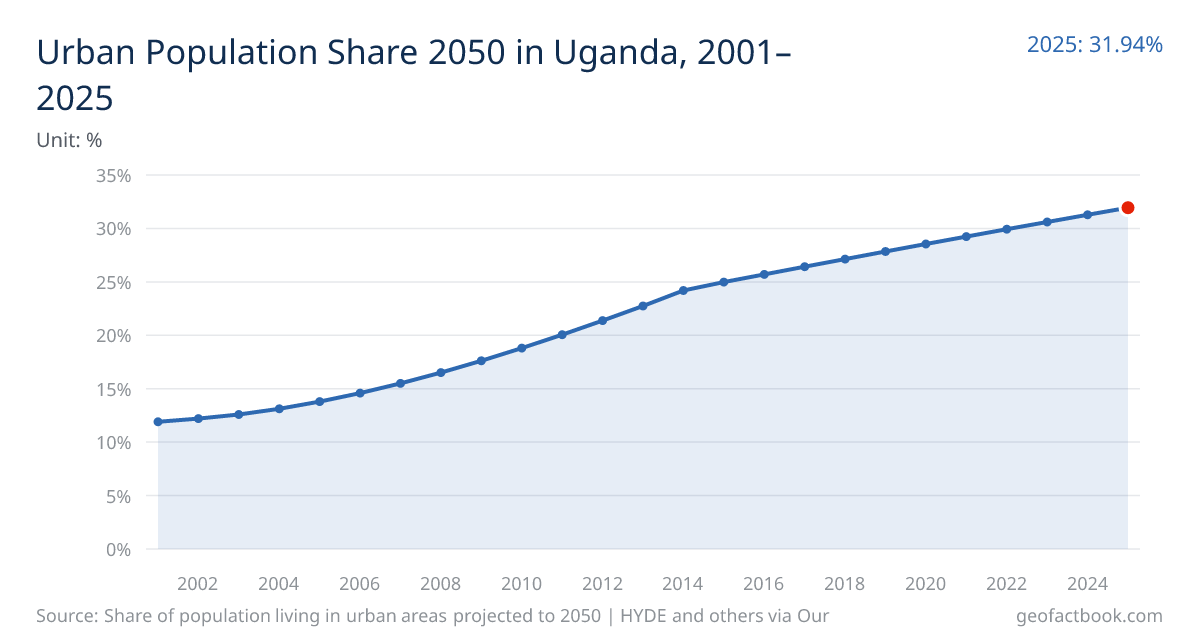
Uganda's urban population share 2050 in 2025 is 31.94 %, up 2.1% from 2024. It ranks #207 of 236 countries.
Urban population share by 2050 shows urbanization trends. Discover which countries will be most urbanized.
Source (2025): Share of population living in urban areas projected to 2050 | Our World in Data
Where Uganda ranks (2025)
#207 of 236- #205
 Mali32.21%
- #206
 Kenya32.21%
- #207
 Uganda31.94%
- #208
 Saint Kitts and Nevis31.9%
- #209
 Solomon Islands31.31%
Urban Population Share 2050 over time
| Year | Value | Change | % Change | Actions |
|---|---|---|---|---|
| 2025 | 31.94 % | +0.66 % | +2.12% | |
| 2024 | 31.28 % | +0.67 % | +2.20% | |
| 2023 | 30.61 % | +0.68 % | +2.27% | |
| 2022 | 29.93 % | +0.69 % | +2.36% | |
| 2021 | 29.24 % | +0.7 % | +2.44% | |
| 2020 | 28.54 % | +0.7 % | +2.53% | |
| 2019 | 27.84 % | +0.71 % | +2.61% | |
| 2018 | 27.13 % | +0.71 % | +2.70% | |
| 2017 | 26.41 % | +0.72 % | +2.80% | |
| 2016 | 25.7 % | +0.72 % | +2.87% | |
| 2015 | 24.98 % | +0.78 % | +3.24% | |
| 2014 | 24.19 % | +1.46 % | +6.41% | |
| 2013 | 22.74 % | +1.36 % | +6.38% | |
| 2012 | 21.37 % | +1.32 % | +6.56% | |
| 2011 | 20.06 % | +1.26 % | +6.69% | |
| 2010 | 18.8 % | +1.19 % | +6.74% | |
| 2009 | 17.61 % | +1.11 % | +6.70% | |
| 2008 | 16.51 % | +1.01 % | +6.54% | |
| 2007 | 15.49 % | +0.91 % | +6.23% | |
| 2006 | 14.59 % | +0.79 % | +5.76% | |
| 2005 | 13.79 % | +0.67 % | +5.10% | |
| 2004 | 13.12 % | +0.53 % | +4.22% | |
| 2003 | 12.59 % | +0.39 % | +3.18% | |
| 2002 | 12.2 % | +0.3 % | +2.53% | |
| 2001 | 11.9 % | — | — |
Urban Population Share 2050 in Uganda, 2001–2025: chart
Cite this page
Geo Factbook. (n.d.). Uganda: Urban Population Share 2050. Retrieved November 29, 2026, from https://geofactbook.com/countries/uganda/urban-population-share-2050
The figures on this page come from Share of population living in urban areas projected to 2050 | HYDE and others via Our World in Data. For academic work, cite the original source as well.
Frequently Asked Questions About Uganda Urban Population Share 2050
What is Uganda's urban population share 2050 in 2025?▾
Uganda's urban population share 2050 is 31.94 % in 2025, according to Share of population living in urban areas projected to 2050 | HYDE and others via Our World in Data.
Is Uganda's urban population share 2050 increasing or decreasing?▾
Uganda's urban population share 2050 rose by 2.1% from 2024 (31.28 %) to 2025 (31.94 %). Over the past decade (2015–2025) it rose by 27.9%.
How does Uganda rank for urban population share 2050?▾
In 2025, Uganda has the 207th highest urban population share 2050 out of 236 countries with data.
What was Uganda's urban population share 2050 in 2001?▾
In 2001, Uganda's urban population share 2050 was 11.90 %. By 2025 it rose by 168.4%.
Explore additional statistical insights
Population density in Uganda
Population density measures how many people live per square kilometer in a country, highlighting urbanization and resource distribution. Understanding this statistic is crucial for assessing living conditions, infrastructure needs, and environmental impact.
Share of Students Studying Abroad in Uganda
Share of students studying abroad tracks the percentage of tertiary-level students enrolled outside their home country.
Population living in slums in Uganda
This statistic measures the percentage of a country's population living in slums, highlighting urban poverty and living conditions. Understanding slum populations is crucial for addressing housing challenges and improving the quality of life.
Total demand for family planning (Percent) in Uganda
Total demand for family planning measures the percentage of individuals seeking access to reproductive health services. Understanding this statistic is crucial for addressing global population growth and improving health outcomes.
Voter Turnout (% of Voting-Age Population) in Uganda
Voting age population denotes individuals eligible to vote based on age, providing insights into electoral demographics.
Currently married (Percent) in Uganda
The percentage of currently married individuals by country highlights societal trends in family structure and relationships. Understanding these statistics can provide insights into cultural norms and demographic shifts, influencing policies and social programs.