
Turkmenistan Fertilizer Use Per Hectare 2024: 337.04 kg/ha
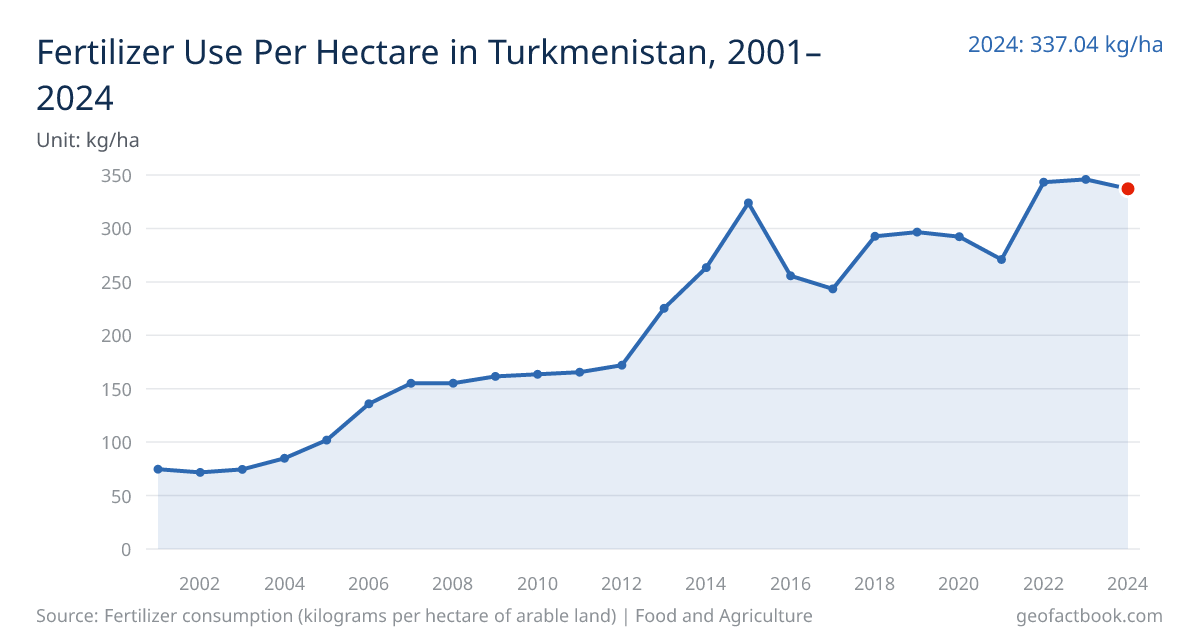
Turkmenistan's fertilizer use per hectare in 2024 is 337.04 kg/ha, down 2.5% from 2023. It ranks #17 of 189 countries.
Fertilizer use per hectare shows how much fertilizer is applied to agricultural land in different countries, impacting crop yield.
Source (2024): Fertilizer use per hectare
Where Turkmenistan ranks (2024)
#17 of 189- #15
 China393.27 kg/ha
- #16
 Oman340.67 kg/ha
- #17
 Turkmenistan337.04 kg/ha
- #18
 Indonesia312.64 kg/ha
- #19
 Seychelles286.67 kg/ha
Fertilizer Use Per Hectare over time
| Year | Value | Change | % Change | Actions |
|---|---|---|---|---|
| 2024 | 337.04 kg/ha | 8.8 kg/ha | -2.55% | |
| 2023 | 345.85 kg/ha | +2.61 kg/ha | +0.76% | |
| 2022 | 343.24 kg/ha | +72.31 kg/ha | +26.69% | |
| 2021 | 270.93 kg/ha | 21.32 kg/ha | -7.30% | |
| 2020 | 292.25 kg/ha | 4.32 kg/ha | -1.46% | |
| 2019 | 296.57 kg/ha | +3.91 kg/ha | +1.34% | |
| 2018 | 292.66 kg/ha | +49.24 kg/ha | +20.23% | |
| 2017 | 243.43 kg/ha | 12.2 kg/ha | -4.77% | |
| 2016 | 255.62 kg/ha | 68.23 kg/ha | -21.07% | |
| 2015 | 323.85 kg/ha | +60.52 kg/ha | +22.98% | |
| 2014 | 263.34 kg/ha | +38.12 kg/ha | +16.92% | |
| 2013 | 225.22 kg/ha | +53.21 kg/ha | +30.93% | |
| 2012 | 172.01 kg/ha | +6.6 kg/ha | +3.99% | |
| 2011 | 165.41 kg/ha | +1.96 kg/ha | +1.20% | |
| 2010 | 163.45 kg/ha | +1.96 kg/ha | +1.21% | |
| 2009 | 161.49 kg/ha | +6.3 kg/ha | +4.06% | |
| 2008 | 155.2 kg/ha | +0.1 kg/ha | +0.06% | |
| 2007 | 155.1 kg/ha | +19.18 kg/ha | +14.11% | |
| 2006 | 135.92 kg/ha | +34.04 kg/ha | +33.41% | |
| 2005 | 101.88 kg/ha | +16.98 kg/ha | +20.00% | |
| 2004 | 84.9 kg/ha | +10.45 kg/ha | +14.03% | |
| 2003 | 74.45 kg/ha | +2.74 kg/ha | +3.81% | |
| 2002 | 71.72 kg/ha | 2.98 kg/ha | -3.99% | |
| 2001 | 74.7 kg/ha | — | — |
Fertilizer Use Per Hectare in Turkmenistan, 2001–2024: chart
Cite this page
Geo Factbook. (n.d.). Turkmenistan: Fertilizer Use Per Hectare. Retrieved November 27, 2026, from https://geofactbook.com/countries/turkmenistan/fertilizer-use-per-hectare
The figures on this page come from Fertilizer consumption (kilograms per hectare of arable land) | Food and Agriculture Organization of the United Nations (FAO) via World Bank. For academic work, cite the original source as well.
Frequently Asked Questions About Turkmenistan Fertilizer Use Per Hectare
What is Turkmenistan's fertilizer use per hectare in 2024?▾
Turkmenistan's fertilizer use per hectare is 337.04 kg/ha in 2024, according to Fertilizer consumption (kilograms per hectare of arable land) | Food and Agriculture Organization of the United Nations (FAO) via World Bank.
Is Turkmenistan's fertilizer use per hectare increasing or decreasing?▾
Turkmenistan's fertilizer use per hectare fell by 2.5% from 2023 (345.85 kg/ha) to 2024 (337.04 kg/ha). Over the past decade (2014–2024) it rose by 28.0%.
How does Turkmenistan rank for fertilizer use per hectare?▾
In 2024, Turkmenistan has the 17th highest fertilizer use per hectare out of 189 countries with data.
What was Turkmenistan's fertilizer use per hectare in 2001?▾
In 2001, Turkmenistan's fertilizer use per hectare was 74.70 kg/ha. By 2024 it rose by 351.2%.
Explore additional statistical insights
Electricity Installed Capacity in Turkmenistan
Electricity Installed Capacity measures the total power generation capability. Compare countries, explore rankings, and view interactive maps.
Energy Consumption per Capita (USD) in Turkmenistan
Energy Consumption per Capita (USD) measures how much energy is consumed per person. Compare countries and explore interactive maps.
Average Annual Temperature in Turkmenistan
Average annual temperature measures the typical warmth of a country over a year, crucial for climate studies.
Water Withdrawals Per Capita in Turkmenistan
Water withdrawals per capita measure the average water use per person, reflecting demand on water resources.
Tree Cover Loss in Turkmenistan
Tree cover loss measures the annual reduction in tree cover across countries, indicating deforestation and environmental impact.
Protected Land Area for Adaptation in Turkmenistan
Protected land as a climate adaptation strategy ensures biodiversity and resilience against climate impacts.