
Timor-Leste Under-five mortality rate 2026: 41.73 per live births
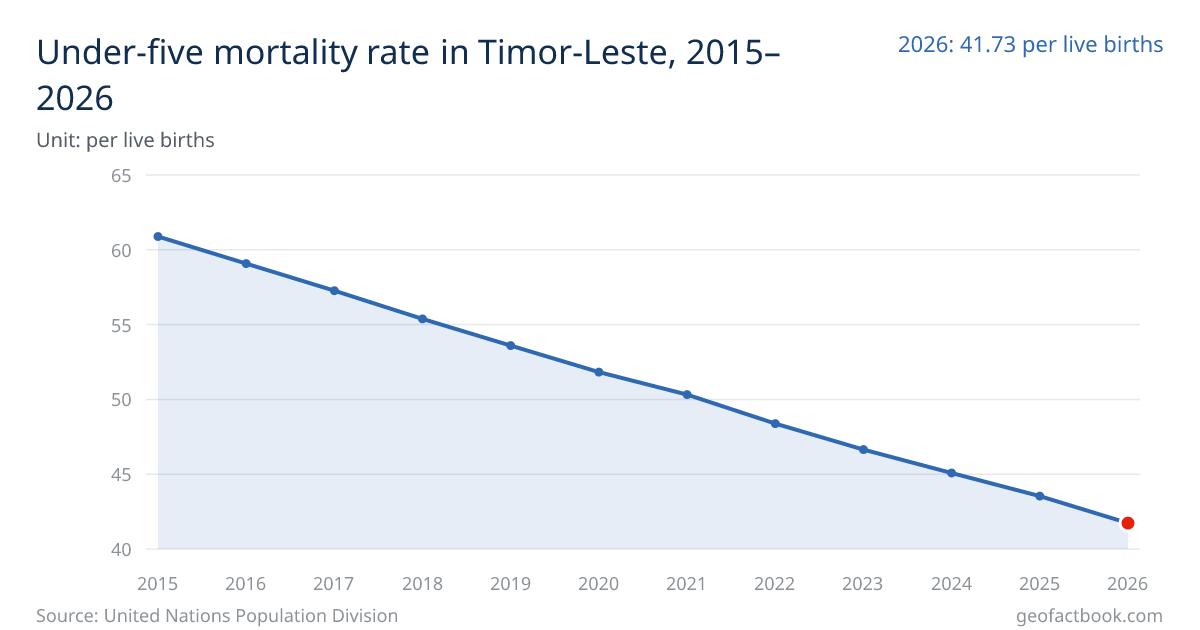
Timor-Leste's under-five mortality rate in 2026 is 41.73 per live births (estimate), down 4.1% from 2025. It ranks #31 of 236 countries.
The under-five mortality rate measures the number of deaths per 1,000 live births for children under five. This critical statistic highlights child health and development, reflecting a country's healthcare quality and socioeconomic conditions. Understanding these rates is vital for improving global health initiatives.
Estimated value for 2026 (interpolated, no direct source).
Where Timor-Leste ranks (2026)
#31 of 236- #29
 Djibouti46.46 per live births
- #30
 Burundi45.5 per live births
- #31
 Timor-Leste41.73 per live births
- #32
 Zimbabwe41.72 per live births
- #33
 Comoros41.59 per live births
Under-five mortality rate over timeSome values are estimated based on historical trends
| Year | Value | Change | % Change | Actions |
|---|---|---|---|---|
| 2026 | 41.73 per live births | 1.8 per live births | -4.14% | |
| 2025 | 43.54 per live births | 1.54 per live births | -3.42% | |
| 2024 | 45.08 per live births | 1.57 per live births | -3.36% | |
| 2023 | 46.65 per live births | 1.73 per live births | -3.58% | |
| 2022 | 48.38 per live births | 1.94 per live births | -3.86% | |
| 2021 | 50.32 per live births | 1.5 per live births | -2.90% | |
| 2020 | 51.83 per live births | 1.77 per live births | -3.30% | |
| 2019 | 53.59 per live births | 1.78 per live births | -3.22% | |
| 2018 | 55.38 per live births | 1.89 per live births | -3.30% | |
| 2017 | 57.27 per live births | 1.81 per live births | -3.07% | |
| 2016 | 59.08 per live births | 1.81 per live births | -2.97% | |
| 2015 | 60.89 per live births | — | — |
Under-five mortality rate in Timor-Leste, 2015–2026: chart
Cite this page
Geo Factbook. (n.d.). Timor-Leste: Under-five mortality rate. Retrieved November 27, 2026, from https://geofactbook.com/countries/timor-leste/under-five-mortality-rate
The figures on this page come from United Nations Population Division. For academic work, cite the original source as well.
Frequently Asked Questions About Timor-Leste Under-five mortality rate
What is Timor-Leste's under-five mortality rate in 2026?▾
Timor-Leste's under-five mortality rate is 41.73 per live births in 2026 (estimate), according to United Nations Population Division.
Is Timor-Leste's under-five mortality rate increasing or decreasing?▾
Timor-Leste's under-five mortality rate fell by 4.1% from 2025 (43.54 per live births) to 2026 (41.73 per live births). Over the past decade (2016–2026) it fell by 29.4%.
How does Timor-Leste rank for under-five mortality rate?▾
In 2026, Timor-Leste has the 31st highest under-five mortality rate out of 236 countries with data.
What was Timor-Leste's under-five mortality rate in 2015?▾
In 2015, Timor-Leste's under-five mortality rate was 60.89 per live births. By 2026 it fell by 31.5%.
Explore additional statistical insights
Physician Density in Timor-Leste
Physician density measures healthcare access, showing the number of doctors per square kilometer. Compare countries and explore interactive maps.
Total deaths in Timor-Leste
Total deaths in countries measure the number of individuals who have passed away within a specific timeframe. This statistic is crucial for understanding health trends, mortality rates, and the impact of various factors on population dynamics.
Birth Rate (%) in Timor-Leste
Explore birth rate data across countries. Compare rankings, view interactive maps, and analyze historical trends.
Female Tertiary Enrollment Rate (%) in Timor-Leste
This measures the percentage of female students enrolling in tertiary education, reflecting gender parity in higher education globally.
Learning-adjusted years of school in Timor-Leste
Learning-adjusted years of school measures educational quality by accounting for both enrollment and learning outcomes. This statistic highlights the effectiveness of education systems across countries, emphasizing the need for improved learning environments.
Life expectancy at birth in Timor-Leste
Life expectancy at birth measures the average years a newborn is expected to live, reflecting a country's health standards and quality of life. This vital statistic highlights disparities in healthcare and living conditions across nations, making it essential for global health assessments.