
Thailand Press Freedom Index Score 2025: 56.72 points
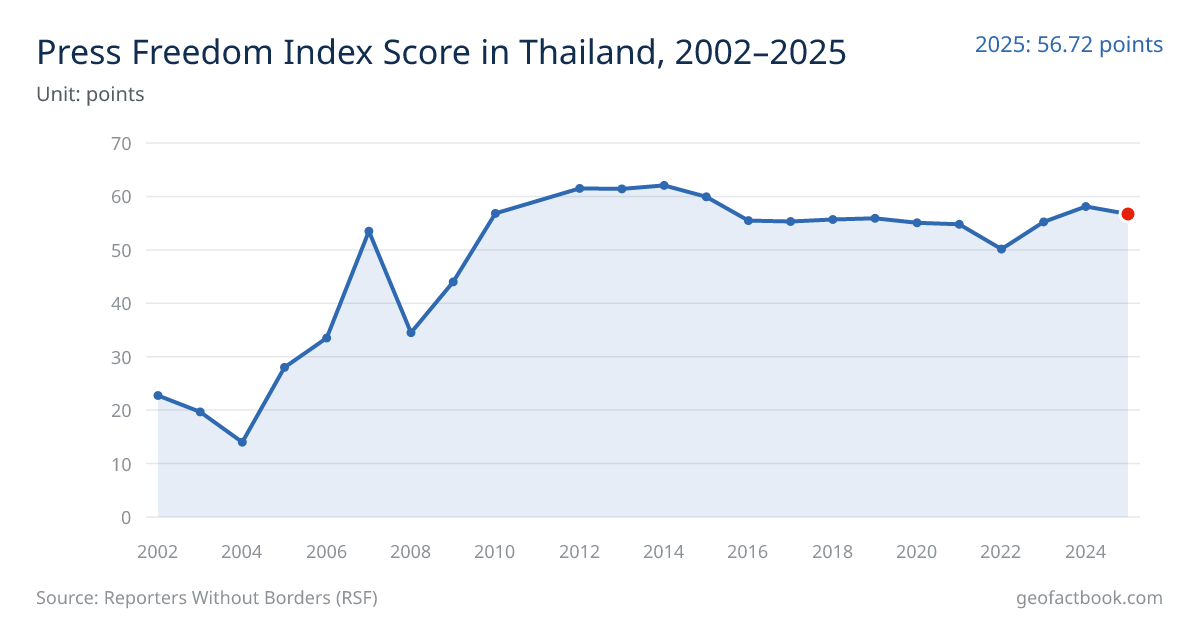
Thailand's press freedom index score in 2025 is 56.72 points, down 2.4% from 2024. It ranks #84 of 178 countries.
The Press Freedom Index Score measures the level of media freedom in countries worldwide. A higher score indicates stronger press independence, essential for democracy and transparency. Understanding these scores helps highlight the importance of free expression in society.
Where Thailand ranks (2025)
#84 of 178- #82
 Niger57.05 points
- #83
 Paraguay56.84 points
- #84
 Thailand56.72 points
- #85
 Bosnia and Herzegovina56.33 points
- #86
 Argentina56.14 points
Press Freedom Index Score over time
| Year | Value | Change | % Change | Actions |
|---|---|---|---|---|
| 2025 | 56.72 points | 1.4 points | -2.41% | |
| 2024 | 58.12 points | +2.88 points | +5.21% | |
| 2023 | 55.24 points | +5.09 points | +10.15% | |
| 2022 | 50.15 points | 4.63 points | -8.45% | |
| 2021 | 54.78 points | 0.28 points | -0.51% | |
| 2020 | 55.06 points | 0.84 points | -1.50% | |
| 2019 | 55.9 points | +0.21 points | +0.38% | |
| 2018 | 55.69 points | +0.38 points | +0.69% | |
| 2017 | 55.31 points | 0.16 points | -0.29% | |
| 2016 | 55.47 points | 4.46 points | -7.44% | |
| 2015 | 59.93 points | 2.13 points | -3.43% | |
| 2014 | 62.06 points | +0.66 points | +1.07% | |
| 2013 | 61.4 points | 0.1 points | -0.16% | |
| 2012 | 61.5 points | +4.67 points | +8.22% | |
| 2010 | 56.83 points | +12.83 points | +29.16% | |
| 2009 | 44 points | +9.5 points | +27.54% | |
| 2008 | 34.5 points | 19 points | -35.51% | |
| 2007 | 53.5 points | +20 points | +59.70% | |
| 2006 | 33.5 points | +5.5 points | +19.64% | |
| 2005 | 28 points | +14 points | +100.00% | |
| 2004 | 14 points | 5.67 points | -28.83% | |
| 2003 | 19.67 points | 3.08 points | -13.54% | |
| 2002 | 22.75 points | — | — |
Press Freedom Index Score in Thailand, 2002–2025: chart
Cite this page
Geo Factbook. (n.d.). Thailand: Press Freedom Index Score. Retrieved November 27, 2026, from https://geofactbook.com/countries/thailand/press-freedom-index-score
The figures on this page come from Reporters Without Borders (RSF). For academic work, cite the original source as well.
Frequently Asked Questions About Thailand Press Freedom Index Score
What is Thailand's press freedom index score in 2025?▾
Thailand's press freedom index score is 56.72 points in 2025, according to Reporters Without Borders (RSF).
Is Thailand's press freedom index score increasing or decreasing?▾
Thailand's press freedom index score fell by 2.4% from 2024 (58.12 points) to 2025 (56.72 points). Over the past decade (2015–2025) it fell by 5.4%.
How does Thailand rank for press freedom index score?▾
In 2025, Thailand has the 84th highest press freedom index score out of 178 countries with data.
What was Thailand's press freedom index score in 2002?▾
In 2002, Thailand's press freedom index score was 22.75 points. By 2025 it rose by 149.3%.
Explore additional statistical insights
Fixed Broadband Penetration in Thailand
Fixed broadband penetration indicates the availability and use of high-speed internet connections in households.
Waterways in Thailand
Waterways data highlights the extent of navigable routes in each country. Explore rankings, compare nations, and view interactive maps.
Internet Usage Rate by Country (% of Population) in Thailand
Discover the internet usage rate by country, showcasing the percentage of the population online. This statistic highlights digital accessibility and connectivity trends globally, emphasizing the importance of internet access in today's world.
Annual Scholarly AI Publications in Thailand
Annual scholarly AI publications quantify research output. High numbers indicate active research and innovation in AI fields.
Internet Users (% of Population) in Thailand
Explore Internet Users worldwide, compare usage rates by country, and visualize trends with interactive maps and rankings.
Learning-adjusted years of school in Thailand
Learning-adjusted years of school measures educational quality by accounting for both enrollment and learning outcomes. This statistic highlights the effectiveness of education systems across countries, emphasizing the need for improved learning environments.