
Syrian Arab Republic Annual Forest Area Change Rate 2025: 31.99 %
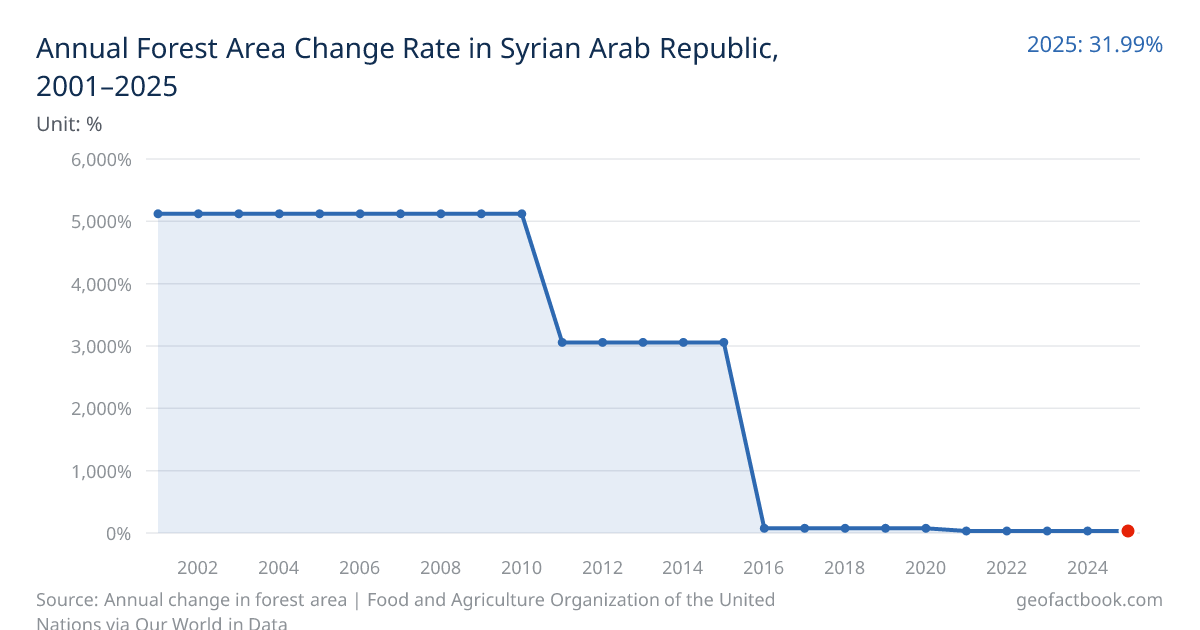
Syrian Arab Republic's annual forest area change rate in 2025 is 31.99 %, unchanged from 2024. It ranks #75 of 216 countries.
Annual forest area change rate indicates how quickly a country's forests are expanding or shrinking each year.
Source (2025): Annual change in forest area | Our World in Data
Where Syrian Arab Republic ranks (2025)
#75 of 216- #73
 Kyrgyzstan63.99%
- #74
 Saint Lucia50%
- #75
 Syrian Arab Republic31.99%
- #76
 Micronesia (Fed. States of)30%
- #77
 Sao Tome and Principe26%
Annual Forest Area Change Rate over time
| Year | Value | Change | % Change | Actions |
|---|---|---|---|---|
| 2025 | 31.99 % | 0 % | 0.00% | |
| 2024 | 31.99 % | 0 % | 0.00% | |
| 2023 | 31.99 % | 0 % | 0.00% | |
| 2022 | 31.99 % | 0 % | 0.00% | |
| 2021 | 31.99 % | 44.01 % | -57.90% | |
| 2020 | 76 % | 0 % | 0.00% | |
| 2019 | 76 % | 0 % | 0.00% | |
| 2018 | 76 % | 0 % | 0.00% | |
| 2017 | 76 % | 0 % | 0.00% | |
| 2016 | 76 % | 2.98K % | -97.51% | |
| 2015 | 3.06K % | 0 % | 0.00% | |
| 2014 | 3.06K % | 0 % | 0.00% | |
| 2013 | 3.06K % | 0 % | 0.00% | |
| 2012 | 3.06K % | 0 % | 0.00% | |
| 2011 | 3.06K % | 2.06K % | -40.29% | |
| 2010 | 5.12K % | 0 % | 0.00% | |
| 2009 | 5.12K % | 0 % | 0.00% | |
| 2008 | 5.12K % | 0 % | 0.00% | |
| 2007 | 5.12K % | 0 % | 0.00% | |
| 2006 | 5.12K % | 0 % | 0.00% | |
| 2005 | 5.12K % | 0 % | 0.00% | |
| 2004 | 5.12K % | 0 % | 0.00% | |
| 2003 | 5.12K % | 0 % | 0.00% | |
| 2002 | 5.12K % | 0 % | 0.00% | |
| 2001 | 5.12K % | — | — |
Annual Forest Area Change Rate in Syrian Arab Republic, 2001–2025: chart
Cite this page
Geo Factbook. (n.d.). Syrian Arab Republic: Annual Forest Area Change Rate. Retrieved November 28, 2026, from https://geofactbook.com/countries/syrian-arab-republic/annual-forest-area-change-rate
The figures on this page come from Annual change in forest area | Food and Agriculture Organization of the United Nations via Our World in Data. For academic work, cite the original source as well.
Frequently Asked Questions About Syrian Arab Republic Annual Forest Area Change Rate
What is Syrian Arab Republic's annual forest area change rate in 2025?▾
Syrian Arab Republic's annual forest area change rate is 31.99 % in 2025, according to Annual change in forest area | Food and Agriculture Organization of the United Nations via Our World in Data.
Is Syrian Arab Republic's annual forest area change rate increasing or decreasing?▾
Syrian Arab Republic's annual forest area change rate was essentially unchanged from 2024 (31.99 %) to 2025 (31.99 %). Over the past decade (2015–2025) it fell by 99.0%.
How does Syrian Arab Republic rank for annual forest area change rate?▾
In 2025, Syrian Arab Republic has the 75th highest annual forest area change rate out of 216 countries with data.
What was Syrian Arab Republic's annual forest area change rate in 2001?▾
In 2001, Syrian Arab Republic's annual forest area change rate was 5,121 %. By 2025 it fell by 99.4%.
Explore additional statistical insights
Fertilizer Use Per Hectare in Syrian Arab Republic
Fertilizer use per hectare shows how much fertilizer is applied to agricultural land in different countries, impacting crop yield.
Electricity from Nuclear Fuels in Syrian Arab Republic
Electricity from nuclear fuels measures energy production in countries. Compare data, explore rankings, and visualize trends with interactive maps.
Electricity Installed Capacity in Syrian Arab Republic
Electricity Installed Capacity measures the total power generation capability. Compare countries, explore rankings, and view interactive maps.
Above-Ground Biomass in Forest (tonnes/ha) in Syrian Arab Republic
Above-ground biomass in forest measures carbon storage per hectare. Explore rankings and compare data across 266+ countries with interactive maps.
Threatened Bird Species Count in Syrian Arab Republic
Threatened bird species count measures the number of bird species at risk of extinction in each country.
Population living in slums in Syrian Arab Republic
This statistic measures the percentage of a country's population living in slums, highlighting urban poverty and living conditions. Understanding slum populations is crucial for addressing housing challenges and improving the quality of life.