
State of Palestine Percentage of land area by degree of urbanization 2026: 24.56 %
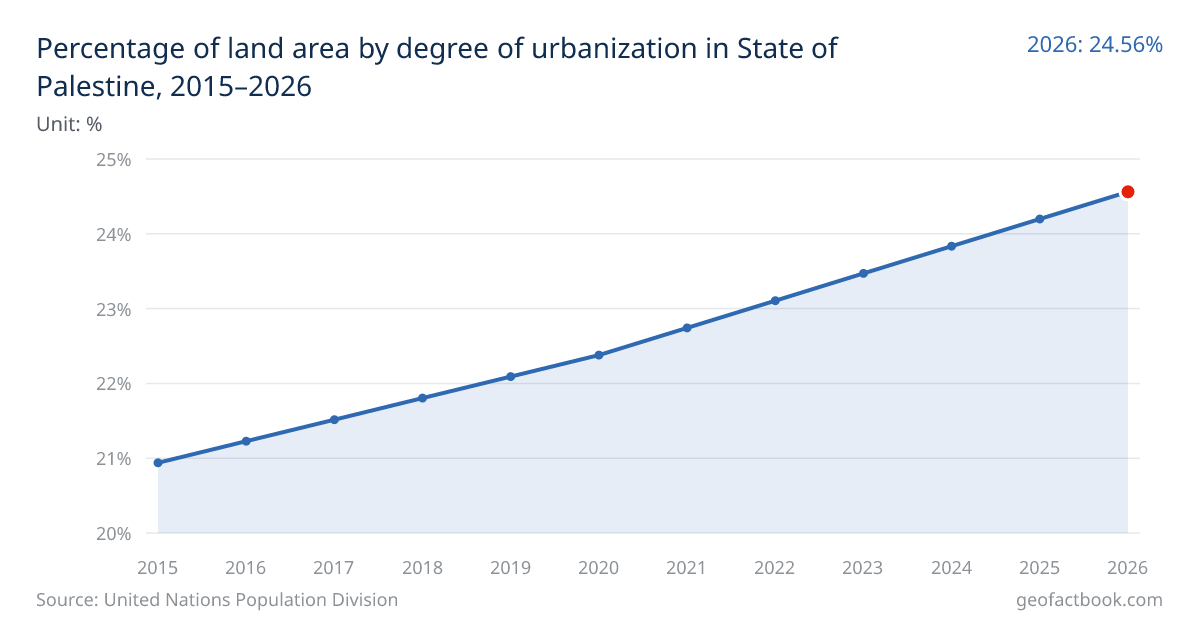
State of Palestine's percentage of land area by degree of urbanization in 2026 is 24.56 % (estimate), up 1.5% from 2025. It ranks #28 of 237 countries.
Explore the percentage of land area by degree of urbanization, highlighting how urban development shapes countries' landscapes and influences economic growth. Understanding this statistic reveals the balance between urban and rural spaces, essential for sustainable planning.
Estimated value for 2026 (interpolated, no direct source).
Where State of Palestine ranks (2026)
#28 of 237- #26
 Uganda24.89%
- #27
 Grenada24.78%
- #28
 State of Palestine24.56%
- #29
 Mauritius23.94%
- #30
 Curaçao23.93%
Percentage of land area by degree of urbanization over timeSome values are estimated based on historical trends
| Year | Value | Change | % Change | Actions |
|---|---|---|---|---|
| 2026 | 24.56 % | +0.36 % | +1.50% | |
| 2025 | 24.2 % | +0.36 % | +1.53% | |
| 2024 | 23.83 % | +0.36 % | +1.55% | |
| 2023 | 23.47 % | +0.36 % | +1.58% | |
| 2022 | 23.11 % | +0.36 % | +1.60% | |
| 2021 | 22.74 % | +0.36 % | +1.63% | |
| 2020 | 22.38 % | +0.29 % | +1.30% | |
| 2019 | 22.09 % | +0.29 % | +1.32% | |
| 2018 | 21.8 % | +0.29 % | +1.34% | |
| 2017 | 21.52 % | +0.29 % | +1.36% | |
| 2016 | 21.23 % | +0.29 % | +1.38% | |
| 2015 | 20.94 % | — | — |
Percentage of land area by degree of urbanization in State of Palestine, 2015–2026: chart
Cite this page
Geo Factbook. (n.d.). State of Palestine: Percentage of land area by degree of urbanization. Retrieved November 29, 2026, from https://geofactbook.com/countries/state-of-palestine/percentage-of-land-area-by-degree-of-urbanization
The figures on this page come from United Nations Population Division. For academic work, cite the original source as well.
Frequently Asked Questions About State of Palestine Percentage of land area by degree of urbanization
What is State of Palestine's percentage of land area by degree of urbanization in 2026?▾
State of Palestine's percentage of land area by degree of urbanization is 24.56 % in 2026 (estimate), according to United Nations Population Division.
Is State of Palestine's percentage of land area by degree of urbanization increasing or decreasing?▾
State of Palestine's percentage of land area by degree of urbanization rose by 1.5% from 2025 (24.20 %) to 2026 (24.56 %). Over the past decade (2016–2026) it rose by 15.7%.
How does State of Palestine rank for percentage of land area by degree of urbanization?▾
In 2026, State of Palestine has the 28th highest percentage of land area by degree of urbanization out of 237 countries with data.
What was State of Palestine's percentage of land area by degree of urbanization in 2015?▾
In 2015, State of Palestine's percentage of land area by degree of urbanization was 20.94 %. By 2026 it rose by 17.3%.
Explore additional statistical insights
Infrastructure Resilience Score in State of Palestine
Infrastructure Resilience Score evaluates a country's ability to withstand and recover from disasters.
Arable Land Per Person in State of Palestine
Arable land per person measures the amount of farmable land available to each individual in a country.
Duration of Compulsory Education in State of Palestine
Duration of compulsory education varies across countries, impacting educational outcomes and workforce readiness.
Internet Penetration Rate (%) in State of Palestine
The Internet Penetration Rate indicates the percentage of the population with internet access, crucial for digital public service access.
Oil Production in State of Palestine
Oil Production data reveals output levels across countries. Compare rankings, explore trends, and view interactive maps.
Total population in State of Palestine
Discover the latest total population statistics for every country and region worldwide. Explore accurate, up-to-date data on global population growth, density, and demographic trends — sourced from trusted international databases like the UN and World Bank. Perfect for researchers, students, and data enthusiasts looking to understand how the world’s population is changing.