
Spain Urban Population Share 2050 2025: 80.51 %
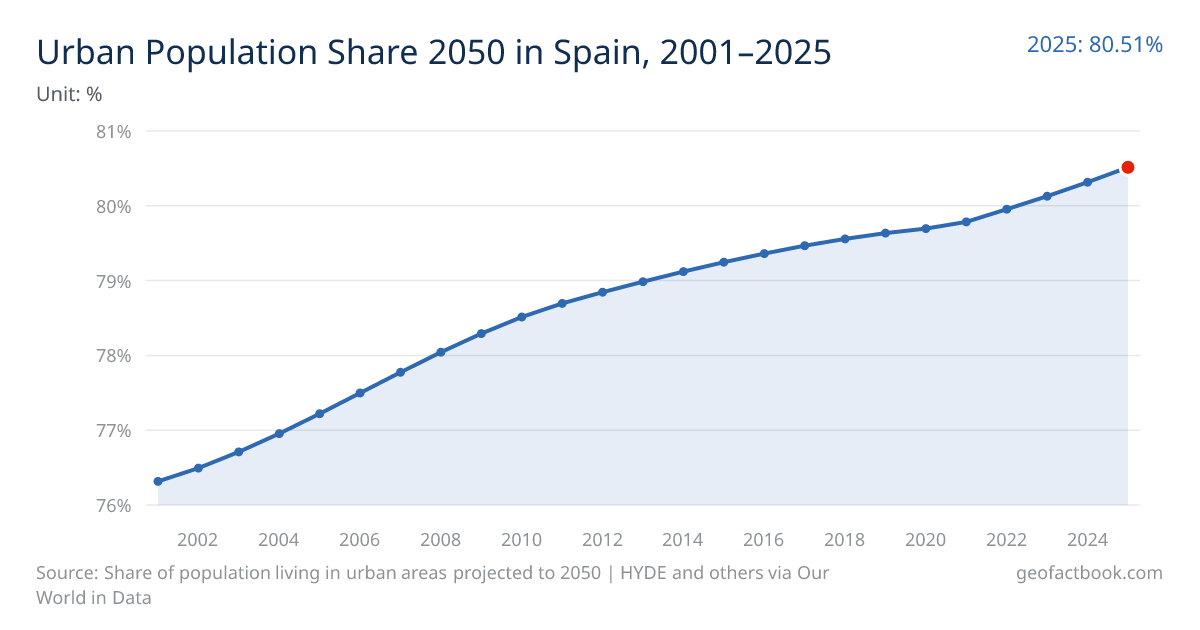
Spain's urban population share 2050 in 2025 is 80.51 %, up 0.2% from 2024. It ranks #67 of 236 countries.
Urban population share by 2050 shows urbanization trends. Discover which countries will be most urbanized.
Source (2025): Share of population living in urban areas projected to 2050 | Our World in Data
Where Spain ranks (2025)
#67 of 236- #65
 South Korea81.17%
- #66
 Bonaire, Sint Eustatius and Saba81.1%
- #67
 Spain80.51%
- #68
 American Samoa80.51%
- #69
 United States80.19%
Urban Population Share 2050 over time
| Year | Value | Change | % Change | Actions |
|---|---|---|---|---|
| 2025 | 80.51 % | +0.2 % | +0.25% | |
| 2024 | 80.32 % | +0.19 % | +0.23% | |
| 2023 | 80.13 % | +0.17 % | +0.22% | |
| 2022 | 79.95 % | +0.17 % | +0.21% | |
| 2021 | 79.78 % | +0.09 % | +0.11% | |
| 2020 | 79.7 % | +0.06 % | +0.08% | |
| 2019 | 79.63 % | +0.08 % | +0.10% | |
| 2018 | 79.56 % | +0.09 % | +0.12% | |
| 2017 | 79.47 % | +0.1 % | +0.13% | |
| 2016 | 79.36 % | +0.12 % | +0.15% | |
| 2015 | 79.25 % | +0.13 % | +0.16% | |
| 2014 | 79.12 % | +0.13 % | +0.17% | |
| 2013 | 78.99 % | +0.14 % | +0.18% | |
| 2012 | 78.85 % | +0.15 % | +0.19% | |
| 2011 | 78.7 % | +0.18 % | +0.23% | |
| 2010 | 78.51 % | +0.22 % | +0.28% | |
| 2009 | 78.29 % | +0.25 % | +0.32% | |
| 2008 | 78.04 % | +0.27 % | +0.34% | |
| 2007 | 77.77 % | +0.28 % | +0.36% | |
| 2006 | 77.5 % | +0.28 % | +0.36% | |
| 2005 | 77.22 % | +0.27 % | +0.35% | |
| 2004 | 76.95 % | +0.25 % | +0.32% | |
| 2003 | 76.71 % | +0.22 % | +0.28% | |
| 2002 | 76.49 % | +0.18 % | +0.23% | |
| 2001 | 76.32 % | — | — |
Urban Population Share 2050 in Spain, 2001–2025: chart
Cite this page
Geo Factbook. (n.d.). Spain: Urban Population Share 2050. Retrieved November 29, 2026, from https://geofactbook.com/countries/spain/urban-population-share-2050
The figures on this page come from Share of population living in urban areas projected to 2050 | HYDE and others via Our World in Data. For academic work, cite the original source as well.
Frequently Asked Questions About Spain Urban Population Share 2050
What is Spain's urban population share 2050 in 2025?▾
Spain's urban population share 2050 is 80.51 % in 2025, according to Share of population living in urban areas projected to 2050 | HYDE and others via Our World in Data.
Is Spain's urban population share 2050 increasing or decreasing?▾
Spain's urban population share 2050 rose by 0.2% from 2024 (80.32 %) to 2025 (80.51 %). Over the past decade (2015–2025) it rose by 1.6%.
How does Spain rank for urban population share 2050?▾
In 2025, Spain has the 67th highest urban population share 2050 out of 236 countries with data.
What was Spain's urban population share 2050 in 2001?▾
In 2001, Spain's urban population share 2050 was 76.32 %. By 2025 it rose by 5.5%.
Explore additional statistical insights
Mathematics Proficiency Scores in Spain
Mathematics proficiency scores assess students' ability to understand and apply mathematical concepts across countries.
Total demand for family planning (Percent) in Spain
Total demand for family planning measures the percentage of individuals seeking access to reproductive health services. Understanding this statistic is crucial for addressing global population growth and improving health outcomes.
Share of Students Studying Abroad in Spain
Share of students studying abroad tracks the percentage of tertiary-level students enrolled outside their home country.
Death Rate (%) in Spain
Explore death rate statistics across countries. Compare rates, view historical trends, and interact with dynamic maps for deeper insights.
Life expectancy at birth in Spain
Life expectancy at birth measures the average years a newborn is expected to live, reflecting a country's health standards and quality of life. This vital statistic highlights disparities in healthcare and living conditions across nations, making it essential for global health assessments.
Primary School Pupil-Teacher Ratio in Spain
Pupil-teacher ratio in primary schools reflects educational quality; lower ratios indicate more personalized attention.