
Spain Under-five mortality rate 2026: 2.59 per live births
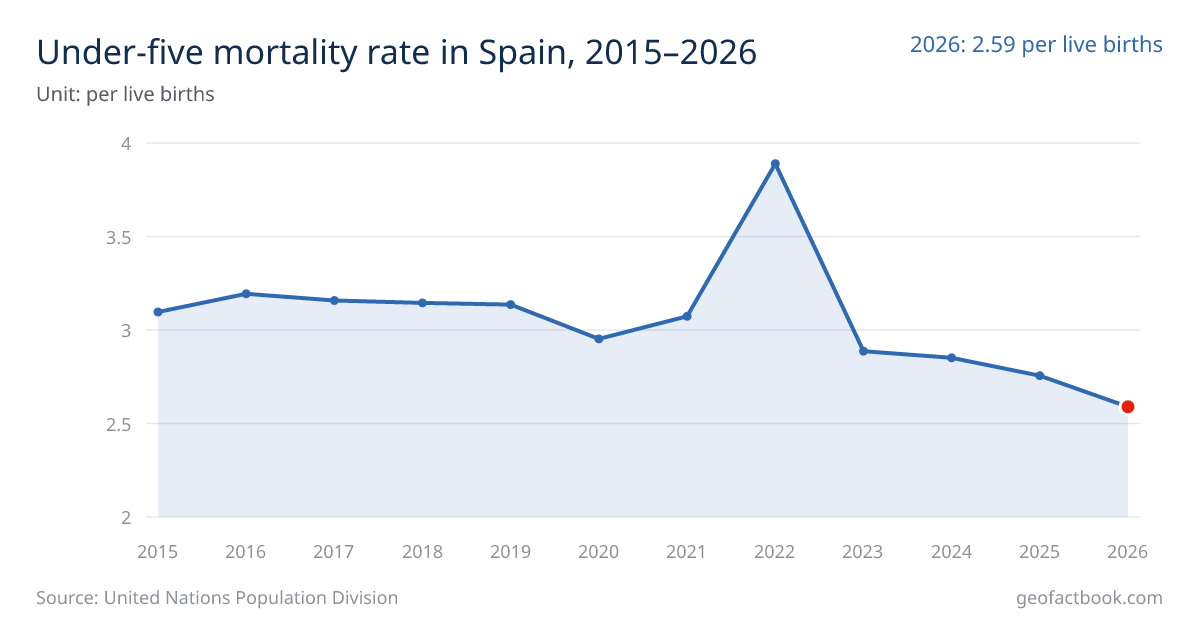
Spain's under-five mortality rate in 2026 is 2.59 per live births (estimate), down 6.0% from 2025. It ranks #221 of 236 countries.
The under-five mortality rate measures the number of deaths per 1,000 live births for children under five. This critical statistic highlights child health and development, reflecting a country's healthcare quality and socioeconomic conditions. Understanding these rates is vital for improving global health initiatives.
Estimated value for 2026 (interpolated, no direct source).
Where Spain ranks (2026)
#221 of 236- #219
 Australia2.81 per live births
- #220
 Cyprus2.6 per live births
- #221
 Spain2.59 per live births
- #222
 Czech Republic2.5 per live births
- #223
 Italy2.43 per live births
Under-five mortality rate over timeSome values are estimated based on historical trends
| Year | Value | Change | % Change | Actions |
|---|---|---|---|---|
| 2026 | 2.59 per live births | 0.17 per live births | -6.04% | |
| 2025 | 2.76 per live births | 0.1 per live births | -3.37% | |
| 2024 | 2.85 per live births | 0.03 per live births | -1.21% | |
| 2023 | 2.89 per live births | 1 per live births | -25.78% | |
| 2022 | 3.89 per live births | +0.82 per live births | +26.54% | |
| 2021 | 3.07 per live births | +0.12 per live births | +4.10% | |
| 2020 | 2.95 per live births | 0.18 per live births | -5.85% | |
| 2019 | 3.14 per live births | 0.01 per live births | -0.29% | |
| 2018 | 3.14 per live births | 0.01 per live births | -0.40% | |
| 2017 | 3.16 per live births | 0.04 per live births | -1.12% | |
| 2016 | 3.19 per live births | +0.1 per live births | +3.15% | |
| 2015 | 3.1 per live births | — | — |
Under-five mortality rate in Spain, 2015–2026: chart
Cite this page
Geo Factbook. (n.d.). Spain: Under-five mortality rate. Retrieved November 27, 2026, from https://geofactbook.com/countries/spain/under-five-mortality-rate
The figures on this page come from United Nations Population Division. For academic work, cite the original source as well.
Frequently Asked Questions About Spain Under-five mortality rate
What is Spain's under-five mortality rate in 2026?▾
Spain's under-five mortality rate is 2.59 per live births in 2026 (estimate), according to United Nations Population Division.
Is Spain's under-five mortality rate increasing or decreasing?▾
Spain's under-five mortality rate fell by 6.0% from 2025 (2.76 per live births) to 2026 (2.59 per live births). Over the past decade (2016–2026) it fell by 18.9%.
How does Spain rank for under-five mortality rate?▾
In 2026, Spain has the 221st highest under-five mortality rate out of 236 countries with data.
What was Spain's under-five mortality rate in 2015?▾
In 2015, Spain's under-five mortality rate was 3.10 per live births. By 2026 it fell by 16.4%.
Explore additional statistical insights
Voter Turnout (% of Voting-Age Population) in Spain
Voting age population denotes individuals eligible to vote based on age, providing insights into electoral demographics.
Average Female Breast Size by Country: Worldwide Data & Rankings in Spain
Average female breast size by country reveals intriguing global trends. Explore interactive maps and rankings to compare statistics across 266+ nations.
Female Tertiary Enrollment Rate (%) in Spain
This measures the percentage of female students enrolling in tertiary education, reflecting gender parity in higher education globally.
Human Capital Index in Spain
The Human Capital Index measures a country's investment in education and health, reflecting its potential for economic growth and productivity. This vital statistic highlights the importance of nurturing human resources for sustainable development.
Physician Density in Spain
Physician density measures healthcare access, showing the number of doctors per square kilometer. Compare countries and explore interactive maps.
Total population in Spain
Discover the latest total population statistics for every country and region worldwide. Explore accurate, up-to-date data on global population growth, density, and demographic trends — sourced from trusted international databases like the UN and World Bank. Perfect for researchers, students, and data enthusiasts looking to understand how the world’s population is changing.