
Community of Madrid in Numbers

Population, economy, jobs, age and life expectancy in Community of Madrid, how it ranks among the 17 autonomous communities and 2 autonomous cities, and which countries it is comparable to. Every number shows its official source and year.
Population
#3 of 197.11 million
3rd highest in Spain · full ranking
2025 · Eurostat, Population on 1 January by NUTS 2 region (demo_r_d2jan)
GDP
#1 of 19$342 billion
highest in Spain · full ranking
2024 · Eurostat, Gross domestic product by NUTS 2 region, converted from euro at the year's average exchange rate (World Bank PA.NUS.FCRF, euro area) (nama_10r_2gdp)
GDP per capita
#1 of 19$48,382
highest in Spain · full ranking
2024 · Eurostat, GDP per inhabitant by NUTS 2 region, converted from euro at the year's average exchange rate (World Bank PA.NUS.FCRF, euro area) (nama_10r_2gdp)
Unemployment rate
#15 of 198.0%
5th lowest in Spain · full ranking
2025 · Eurostat, Unemployment rates by NUTS 2 region, Labour Force Survey (lfst_r_lfu3rt)
Median age
#15 of 1944.2 years
5th lowest in Spain · full ranking
2025 · Eurostat, Population structure indicators by NUTS 2 region, median age (demo_r_pjanind2)
Life expectancy
#1 of 1985.7 years
highest in Spain · full ranking
2024 · Eurostat, Life expectancy at birth by NUTS 2 region (demo_r_mlifexp)
If Community of Madrid were a country
Population like
🇵🇾 ParaguayCommunity of Madrid has about as many people as Paraguay: 7.11 million vs 7.01 million.
Community of Madrid vs Paraguay →Economy like
🇱🇰 Sri LankaCommunity of Madrid's economy is roughly the size of Sri Lanka's: $342 billion vs about $334 billion.
Community of Madrid vs Sri Lanka →Country figures are 2025 estimates from Gapminder. Country GDP is measured in international dollars (purchasing power parity), while autonomous community GDP is in current prices, so treat the economy match as a rough size comparison.
More about Community of Madrid
GDP per capita vs EU average
#1 of 19125% of EU average
highest in Spain · full ranking
2024 · Eurostat, GDP per inhabitant in PPS, % of the EU27 (from 2020) average (nama_10r_2gdp)
Employment rate
#1 of 1977.9%
highest in Spain · full ranking
2025 · Eurostat, Employment rates by NUTS 2 region, ages 20–64, Labour Force Survey (lfst_r_lfe2emprt)
Population density
#3 of 19886 per km²
3rd highest in Spain · full ranking
2024 · Eurostat, Population density by NUTS 3 region (demo_r_d3dens)
Birth rate
#5 of 197.2 per 1,000
5th highest in Spain · full ranking
2024 · Eurostat, Crude birth rate by NUTS 3 region (demo_r_gind3)
Death rate
#17 of 197.0 per 1,000
3rd lowest in Spain · full ranking
2024 · Eurostat, Crude death rate by NUTS 3 region (demo_r_gind3)
How Community of Madrid ranks
- Community of Madrid has the 3rd highest population of any autonomous community (7.11 million in 2025). See the ranking
- Community of Madrid has the highest GDP of any autonomous community ($342 billion in 2024). See the ranking
- Community of Madrid has the highest GDP per person of any autonomous community ($48,382 in 2024). See the ranking
- Community of Madrid has the highest GDP per person adjusted for prices of any autonomous community (125% of EU average in 2024). See the ranking
- Community of Madrid has the 5th lowest unemployment rate of any autonomous community (8.0% in 2025). See the ranking
- Community of Madrid has the highest employment rate of any autonomous community (77.9% in 2025). See the ranking
- Community of Madrid has the 5th lowest median age of any autonomous community (44.2 years in 2025). See the ranking
- Community of Madrid has the highest life expectancy of any autonomous community (85.7 years in 2024). See the ranking
- Community of Madrid has the 3rd highest population density of any autonomous community (886 per km² in 2024). See the ranking
- Community of Madrid has the 5th highest birth rate of any autonomous community (7.2 per 1,000 in 2024). See the ranking
- Community of Madrid has the 3rd lowest death rate of any autonomous community (7.0 per 1,000 in 2024). See the ranking
Frequently Asked Questions About Community of Madrid
What is the population of Community of Madrid?▾
Community of Madrid had 7.11 million people in 2025, the 3rd highest of the 17 autonomous communities and 2 autonomous cities. Source: Eurostat.
What is the GDP of Community of Madrid?▾
Community of Madrid's GDP was $342 billion in 2024 (current dollars), the highest in Spain. Source: Eurostat.
What is the unemployment rate in Community of Madrid?▾
Community of Madrid's unemployment rate averaged 8.0% in 2025. Source: Eurostat.
Which country has a similar population to Community of Madrid?▾
Community of Madrid has about as many people as Paraguay: 7.11 million vs 7.01 million.
Where is Community of Madrid?
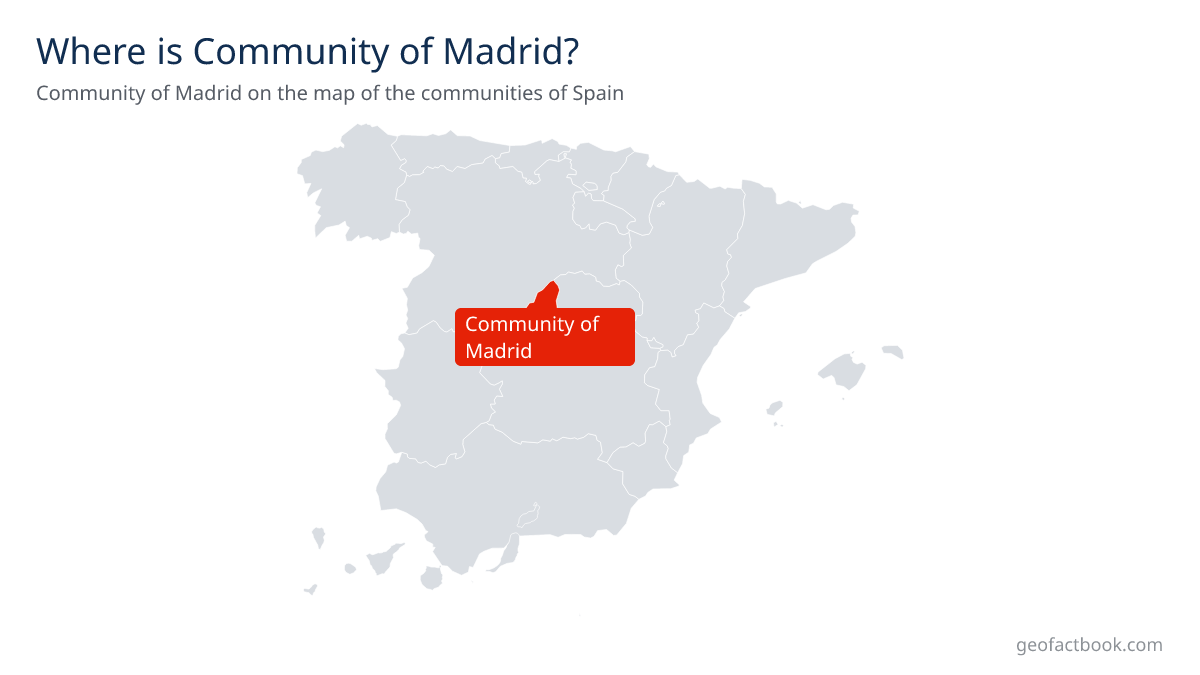
Compare Community of Madrid with another autonomous community


Explore More
Cite this page
Geo Factbook. (n.d.). Community of Madrid in Numbers. Retrieved November 27, 2026, from https://geofactbook.com/countries/spain/communities/madrid
The figures on this page come from Eurostat. For academic work, cite the original source as well.