
Slovenia Press Freedom Index Score 2025: 74.06 points
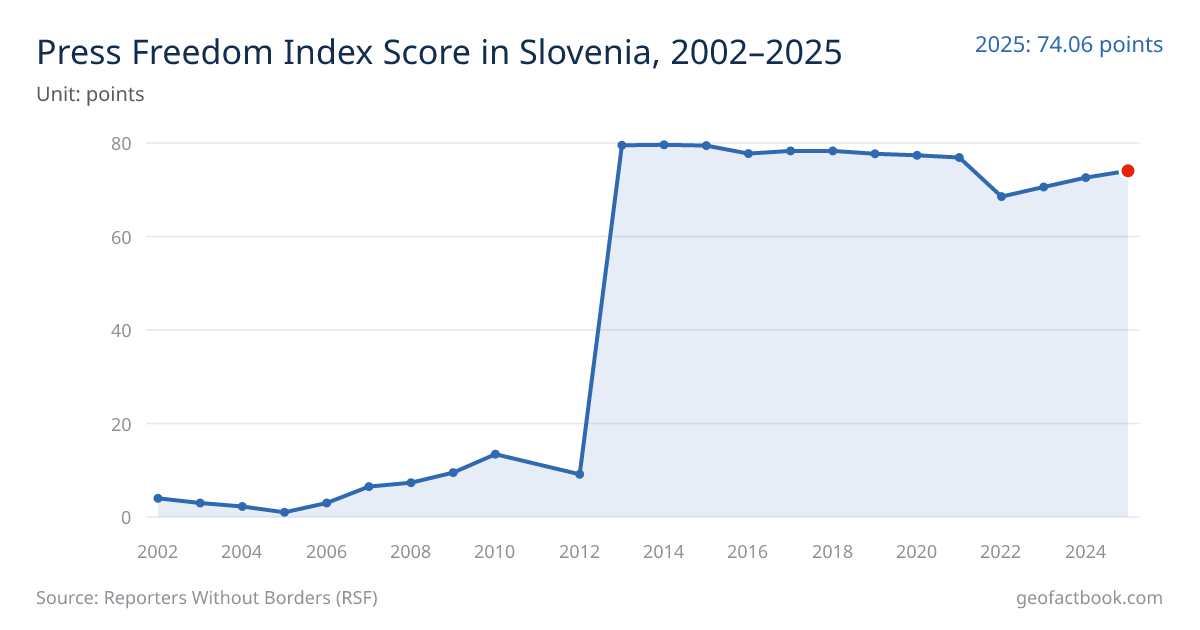
Slovenia's press freedom index score in 2025 is 74.06 points, up 2.0% from 2024. It ranks #33 of 178 countries.
The Press Freedom Index Score measures the level of media freedom in countries worldwide. A higher score indicates stronger press independence, essential for democracy and transparency. Understanding these scores helps highlight the importance of free expression in society.
Where Slovenia ranks (2025)
#33 of 178- #31
 Poland74.79 points
- #32
 Suriname74.49 points
- #33
 Slovenia74.06 points
- #34
 Armenia73.96 points
- #35
 Republic of Moldova73.36 points
Press Freedom Index Score over time
| Year | Value | Change | % Change | Actions |
|---|---|---|---|---|
| 2025 | 74.06 points | +1.46 points | +2.01% | |
| 2024 | 72.6 points | +2.01 points | +2.85% | |
| 2023 | 70.59 points | +2.05 points | +2.99% | |
| 2022 | 68.54 points | 8.36 points | -10.87% | |
| 2021 | 76.9 points | 0.46 points | -0.59% | |
| 2020 | 77.36 points | 0.33 points | -0.42% | |
| 2019 | 77.69 points | 0.62 points | -0.79% | |
| 2018 | 78.31 points | +0.01 points | +0.01% | |
| 2017 | 78.3 points | +0.56 points | +0.72% | |
| 2016 | 77.74 points | 1.71 points | -2.15% | |
| 2015 | 79.45 points | 0.17 points | -0.21% | |
| 2014 | 79.62 points | +0.11 points | +0.14% | |
| 2013 | 79.51 points | +70.37 points | +769.91% | |
| 2012 | 9.14 points | 4.3 points | -31.99% | |
| 2010 | 13.44 points | +3.94 points | +41.47% | |
| 2009 | 9.5 points | +2.17 points | +29.60% | |
| 2008 | 7.33 points | +0.83 points | +12.77% | |
| 2007 | 6.5 points | +3.5 points | +116.67% | |
| 2006 | 3 points | +2 points | +200.00% | |
| 2005 | 1 points | 1.25 points | -55.56% | |
| 2004 | 2.25 points | 0.75 points | -25.00% | |
| 2003 | 3 points | 1 points | -25.00% | |
| 2002 | 4 points | — | — |
Press Freedom Index Score in Slovenia, 2002–2025: chart
Cite this page
Geo Factbook. (n.d.). Slovenia: Press Freedom Index Score. Retrieved November 27, 2026, from https://geofactbook.com/countries/slovenia/press-freedom-index-score
The figures on this page come from Reporters Without Borders (RSF). For academic work, cite the original source as well.
Frequently Asked Questions About Slovenia Press Freedom Index Score
What is Slovenia's press freedom index score in 2025?▾
Slovenia's press freedom index score is 74.06 points in 2025, according to Reporters Without Borders (RSF).
Is Slovenia's press freedom index score increasing or decreasing?▾
Slovenia's press freedom index score rose by 2.0% from 2024 (72.60 points) to 2025 (74.06 points). Over the past decade (2015–2025) it fell by 6.8%.
How does Slovenia rank for press freedom index score?▾
In 2025, Slovenia has the 33rd highest press freedom index score out of 178 countries with data.
What was Slovenia's press freedom index score in 2002?▾
In 2002, Slovenia's press freedom index score was 4 points. By 2025 it rose by 1751.5%.
Explore additional statistical insights
Waterways in Slovenia
Waterways data highlights the extent of navigable routes in each country. Explore rankings, compare nations, and view interactive maps.
Fixed Broadband Penetration in Slovenia
Fixed broadband penetration indicates the availability and use of high-speed internet connections in households.
Internet Penetration Rate (%) in Slovenia
The Internet Penetration Rate indicates the percentage of the population with internet access, crucial for digital public service access.
Broadband Internet Penetration in Slovenia
Broadband internet penetration measures the percentage of the population with access to high-speed internet.
AI Preparedness Index in Slovenia
The IMF's AI Preparedness Index scores how ready a country is to adopt artificial intelligence, on a scale from 0 to 1 (higher is better prepared). It combines four areas: digital infrastructure, human capital and labour market policies, innovation and economic integration, and regulation and ethics. It measures readiness, not how many jobs AI has replaced or could affect.
Life expectancy at birth in Slovenia
Life expectancy at birth measures the average years a newborn is expected to live, reflecting a country's health standards and quality of life. This vital statistic highlights disparities in healthcare and living conditions across nations, making it essential for global health assessments.