
Saint Kitts and Nevis Internet Usage Rate by Country (% of Population) 2023: 76.42 %
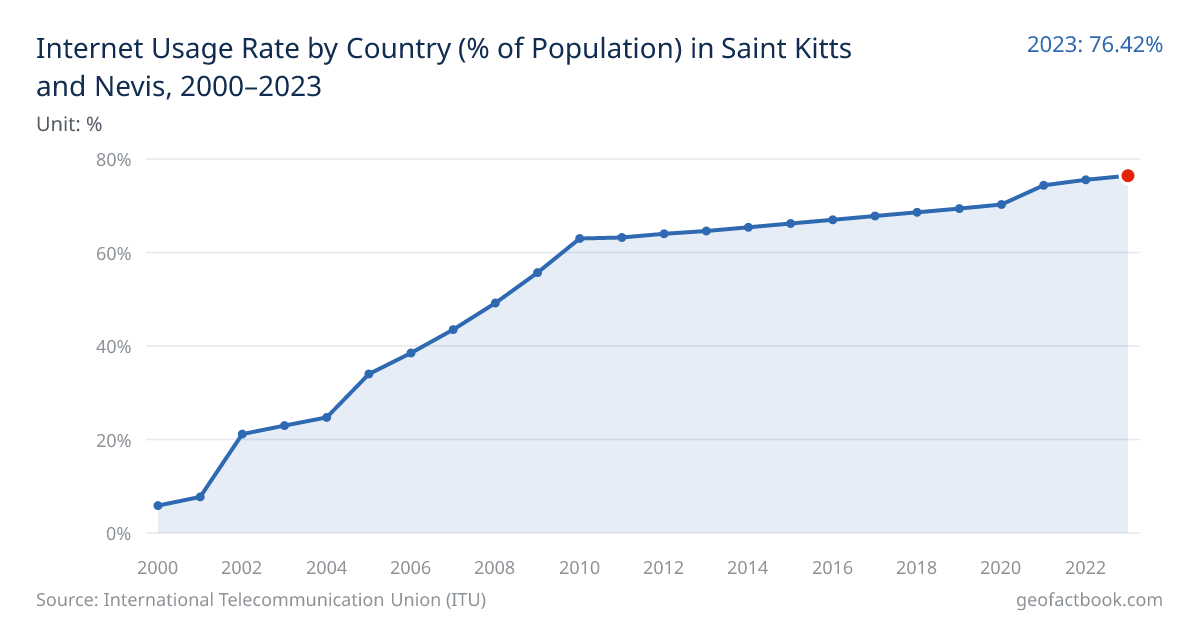
Saint Kitts and Nevis's internet usage rate by country (% of population) in 2023 is 76.42 %, up 1.1% from 2022.
Discover the internet usage rate by country, showcasing the percentage of the population online. This statistic highlights digital accessibility and connectivity trends globally, emphasizing the importance of internet access in today's world.
Internet Usage Rate by Country (% of Population) over time
| Year | Value | Change | % Change | Actions |
|---|---|---|---|---|
| 2024 | — | — | — | |
| 2023 | 76.42 % | +0.86 % | +1.14% | |
| 2022 | 75.56 % | +1.19 % | +1.59% | |
| 2021 | 74.37 % | +4.1 % | +5.83% | |
| 2020 | 70.28 % | +0.88 % | +1.26% | |
| 2019 | 69.4 % | +0.8 % | +1.17% | |
| 2018 | 68.6 % | +0.8 % | +1.18% | |
| 2017 | 67.8 % | +0.8 % | +1.19% | |
| 2016 | 67 % | +0.8 % | +1.21% | |
| 2015 | 66.2 % | +0.8 % | +1.22% | |
| 2014 | 65.4 % | +0.8 % | +1.24% | |
| 2013 | 64.6 % | +0.6 % | +0.94% | |
| 2012 | 64 % | +0.8 % | +1.27% | |
| 2011 | 63.2 % | +0.2 % | +0.32% | |
| 2010 | 63 % | +7.3 % | +13.11% | |
| 2009 | 55.7 % | +6.5 % | +13.21% | |
| 2008 | 49.2 % | +5.7 % | +13.10% | |
| 2007 | 43.5 % | +5 % | +12.99% | |
| 2006 | 38.5 % | +4.5 % | +13.24% | |
| 2005 | 34 % | +9.26 % | +37.44% | |
| 2004 | 24.74 % | +1.77 % | +7.70% | |
| 2003 | 22.97 % | +1.82 % | +8.59% | |
| 2002 | 21.15 % | +13.44 % | +174.18% | |
| 2001 | 7.71 % | +1.85 % | +31.59% | |
| 2000 | 5.86 % | — | — |
Internet Usage Rate by Country (% of Population) in Saint Kitts and Nevis, 2000–2023: chart
Cite this page
Geo Factbook. (n.d.). Saint Kitts and Nevis: Internet Usage Rate by Country (% of Population). Retrieved November 29, 2026, from https://geofactbook.com/countries/saint-kitts-and-nevis/internet-usage-rate-by-country-percentage-of-population
The figures on this page come from International Telecommunication Union (ITU). For academic work, cite the original source as well.
Frequently Asked Questions About Saint Kitts and Nevis Internet Usage Rate by Country (% of Population)
What is Saint Kitts and Nevis's internet usage rate by country (% of population) in 2023?▾
Saint Kitts and Nevis's internet usage rate by country (% of population) is 76.42 % in 2023, according to International Telecommunication Union (ITU).
Is Saint Kitts and Nevis's internet usage rate by country (% of population) increasing or decreasing?▾
Saint Kitts and Nevis's internet usage rate by country (% of population) rose by 1.1% from 2022 (75.56 %) to 2023 (76.42 %). Over the past decade (2013–2023) it rose by 18.3%.
What was Saint Kitts and Nevis's internet usage rate by country (% of population) in 2000?▾
In 2000, Saint Kitts and Nevis's internet usage rate by country (% of population) was 5.86 %. By 2023 it rose by 1203.5%.
Explore additional statistical insights
Broadband Internet Penetration in Saint Kitts and Nevis
Broadband internet penetration measures the percentage of the population with access to high-speed internet.
Annual Scholarly AI Publications in Saint Kitts and Nevis
Annual scholarly AI publications quantify research output. High numbers indicate active research and innovation in AI fields.
Internet Penetration Rate (%) in Saint Kitts and Nevis
The Internet Penetration Rate indicates the percentage of the population with internet access, crucial for digital public service access.
Annual Area Burnt by Wildfires in Saint Kitts and Nevis
Annual area burnt by wildfires measures the total land affected by wildfires each year in hectares.
Median age of population in Saint Kitts and Nevis
The median age of a population is a key demographic indicator, reflecting the age distribution within a country. Understanding median age helps assess economic development, healthcare needs, and social dynamics. Countries with a higher median age may face challenges related to aging populations, while younger populations often indicate growth potential.
Total demand for family planning (Percent) in Saint Kitts and Nevis
Total demand for family planning measures the percentage of individuals seeking access to reproductive health services. Understanding this statistic is crucial for addressing global population growth and improving health outcomes.