
Russia Agricultural land 2026: 2.15 Million sq. km
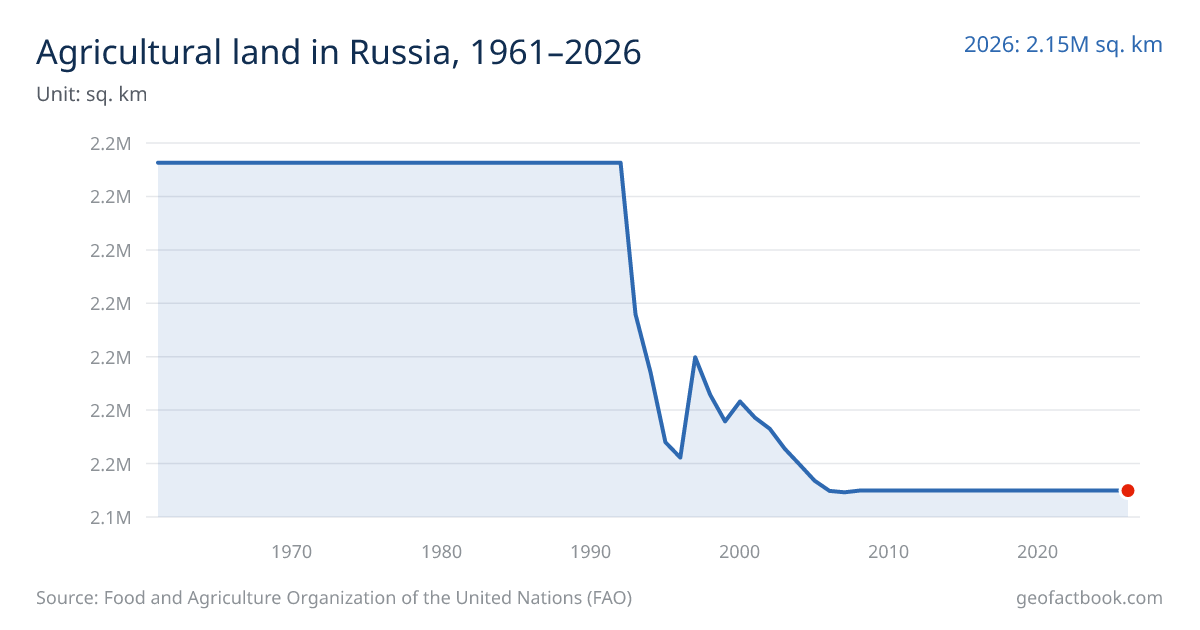
Russia's agricultural land in 2026 is 2.15 Million sq. km (estimate), unchanged from 2025. It ranks #5 of 209 countries.
Agricultural land measures the area dedicated to farming and cultivation in countries, impacting food production and sustainability. Understanding this statistic is crucial for assessing agricultural capacity and economic development.
Estimated value for 2026 (interpolated, no direct source).
Where Russia ranks (2026)
#5 of 209- #3
 Australia3.67M sq. km
- #4
 Brazil2.37M sq. km
- #5
 Russia2.15M sq. km
- #6
 Kazakhstan2.13M sq. km
- #7
 India1.78M sq. km
Agricultural land over timeSome values are estimated based on historical trends
| Year | Value | Change | % Change | Actions |
|---|---|---|---|---|
| 2026 | 2.15M sq. km | 0 sq. km | 0.00% | |
| 2025 | 2.15M sq. km | 0 sq. km | 0.00% | |
| 2024 | 2.15M sq. km | 0 sq. km | 0.00% | |
| 2023 | 2.15M sq. km | 0 sq. km | 0.00% | |
| 2022 | 2.15M sq. km | 0 sq. km | 0.00% | |
| 2021 | 2.15M sq. km | 0 sq. km | 0.00% | |
| 2020 | 2.15M sq. km | 0 sq. km | 0.00% | |
| 2019 | 2.15M sq. km | 0 sq. km | 0.00% | |
| 2018 | 2.15M sq. km | 0 sq. km | 0.00% | |
| 2017 | 2.15M sq. km | 0 sq. km | 0.00% | |
| 2016 | 2.15M sq. km | 0 sq. km | 0.00% | |
| 2015 | 2.15M sq. km | 0 sq. km | 0.00% | |
| 2014 | 2.15M sq. km | 0 sq. km | 0.00% | |
| 2013 | 2.15M sq. km | 0 sq. km | 0.00% | |
| 2012 | 2.15M sq. km | 0 sq. km | 0.00% | |
| 2011 | 2.15M sq. km | 0 sq. km | 0.00% | |
| 2010 | 2.15M sq. km | 0 sq. km | 0.00% | |
| 2009 | 2.15M sq. km | 0 sq. km | 0.00% | |
| 2008 | 2.15M sq. km | +310 sq. km | +0.01% | |
| 2007 | 2.15M sq. km | 250 sq. km | -0.01% | |
| 2006 | 2.15M sq. km | 1.92K sq. km | -0.09% | |
| 2005 | 2.16M sq. km | 3.00K sq. km | -0.14% | |
| 2004 | 2.16M sq. km | 2.97K sq. km | -0.14% | |
| 2003 | 2.16M sq. km | 3.74K sq. km | -0.17% | |
| 2002 | 2.17M sq. km | 2.10K sq. km | -0.10% | |
| 2001 | 2.17M sq. km | 3.01K sq. km | -0.14% | |
| 2000 | 2.17M sq. km | +3.72K sq. km | +0.17% | |
| 1999 | 2.17M sq. km | 4.97K sq. km | -0.23% | |
| 1998 | 2.17M sq. km | 7.02K sq. km | -0.32% | |
| 1997 | 2.18M sq. km | +18.78K sq. km | +0.87% | |
| 1996 | 2.16M sq. km | 2.89K sq. km | -0.13% | |
| 1995 | 2.16M sq. km | 13.11K sq. km | -0.60% | |
| 1994 | 2.18M sq. km | 10.84K sq. km | -0.50% | |
| 1993 | 2.19M sq. km | 28.36K sq. km | -1.28% | |
| 1992 | 2.22M sq. km | 0 sq. km | 0.00% | |
| 1991 | 2.22M sq. km | 0 sq. km | 0.00% | |
| 1990 | 2.22M sq. km | 0 sq. km | 0.00% | |
| 1989 | 2.22M sq. km | 0 sq. km | 0.00% | |
| 1988 | 2.22M sq. km | 0 sq. km | 0.00% | |
| 1987 | 2.22M sq. km | 0 sq. km | 0.00% | |
| 1986 | 2.22M sq. km | 0 sq. km | 0.00% | |
| 1985 | 2.22M sq. km | 0 sq. km | 0.00% | |
| 1984 | 2.22M sq. km | 0 sq. km | 0.00% | |
| 1983 | 2.22M sq. km | 0 sq. km | 0.00% | |
| 1982 | 2.22M sq. km | 0 sq. km | 0.00% | |
| 1981 | 2.22M sq. km | 0 sq. km | 0.00% | |
| 1980 | 2.22M sq. km | 0 sq. km | 0.00% | |
| 1979 | 2.22M sq. km | 0 sq. km | 0.00% | |
| 1978 | 2.22M sq. km | 0 sq. km | 0.00% | |
| 1977 | 2.22M sq. km | 0 sq. km | 0.00% | |
| 1976 | 2.22M sq. km | 0 sq. km | 0.00% | |
| 1975 | 2.22M sq. km | 0 sq. km | 0.00% | |
| 1974 | 2.22M sq. km | 0 sq. km | 0.00% | |
| 1973 | 2.22M sq. km | 0 sq. km | 0.00% | |
| 1972 | 2.22M sq. km | 0 sq. km | 0.00% | |
| 1971 | 2.22M sq. km | 0 sq. km | 0.00% | |
| 1970 | 2.22M sq. km | 0 sq. km | 0.00% | |
| 1969 | 2.22M sq. km | 0 sq. km | 0.00% | |
| 1968 | 2.22M sq. km | 0 sq. km | 0.00% | |
| 1967 | 2.22M sq. km | 0 sq. km | 0.00% | |
| 1966 | 2.22M sq. km | 0 sq. km | 0.00% | |
| 1965 | 2.22M sq. km | 0 sq. km | 0.00% | |
| 1964 | 2.22M sq. km | 0 sq. km | 0.00% | |
| 1963 | 2.22M sq. km | 0 sq. km | 0.00% | |
| 1962 | 2.22M sq. km | 0 sq. km | 0.00% | |
| 1961 | 2.22M sq. km | — | — |
Agricultural land in Russia, 1961–2026: chart
Cite this page
Geo Factbook. (n.d.). Russia: Agricultural land. Retrieved November 27, 2026, from https://geofactbook.com/countries/russia/agricultural-land
The figures on this page come from Food and Agriculture Organization of the United Nations (FAO). For academic work, cite the original source as well.
Frequently Asked Questions About Russia Agricultural land
What is Russia's agricultural land in 2026?▾
Russia's agricultural land is 2.15 Million sq. km in 2026 (estimate), according to Food and Agriculture Organization of the United Nations (FAO).
Is Russia's agricultural land increasing or decreasing?▾
Russia's agricultural land was essentially unchanged from 2025 (2.15 Million sq. km) to 2026 (2.15 Million sq. km). Over the past decade (2016–2026) it was essentially unchanged.
How does Russia rank for agricultural land?▾
In 2026, Russia has the 5th highest agricultural land out of 209 countries with data.
What was Russia's agricultural land in 1961?▾
In 1961, Russia's agricultural land was 2.22 Million sq. km. By 2026 it fell by 2.8%.
Explore additional statistical insights
Electricity from Hydroelectric Plants in Russia
Electricity from hydroelectric plants shows renewable energy production. Explore country rankings, compare data, and view interactive maps.
Electricity from Nuclear Fuels in Russia
Electricity from nuclear fuels measures energy production in countries. Compare data, explore rankings, and visualize trends with interactive maps.
Dam capacity per capita in Russia
Dam capacity per capita measures the amount of water storage available for each individual in a country, expressed in cubic meters. This statistic highlights water resource management and its impact on sustainability and development. Understanding dam capacity is crucial for addressing water security and supporting agriculture, industry, and communities.
Arable Land Per Person in Russia
Arable land per person measures the amount of farmable land available to each individual in a country.
Annual Forest Area Change Rate in Russia
Annual forest area change rate indicates how quickly a country's forests are expanding or shrinking each year.
Electricity from Fossil Fuels in Russia
Electricity from fossil fuels measures energy generation trends. Compare countries, explore rankings, and analyze historical data with interactive maps.