
Papua New Guinea Urban Population Share 2050 2025: 15.78 %
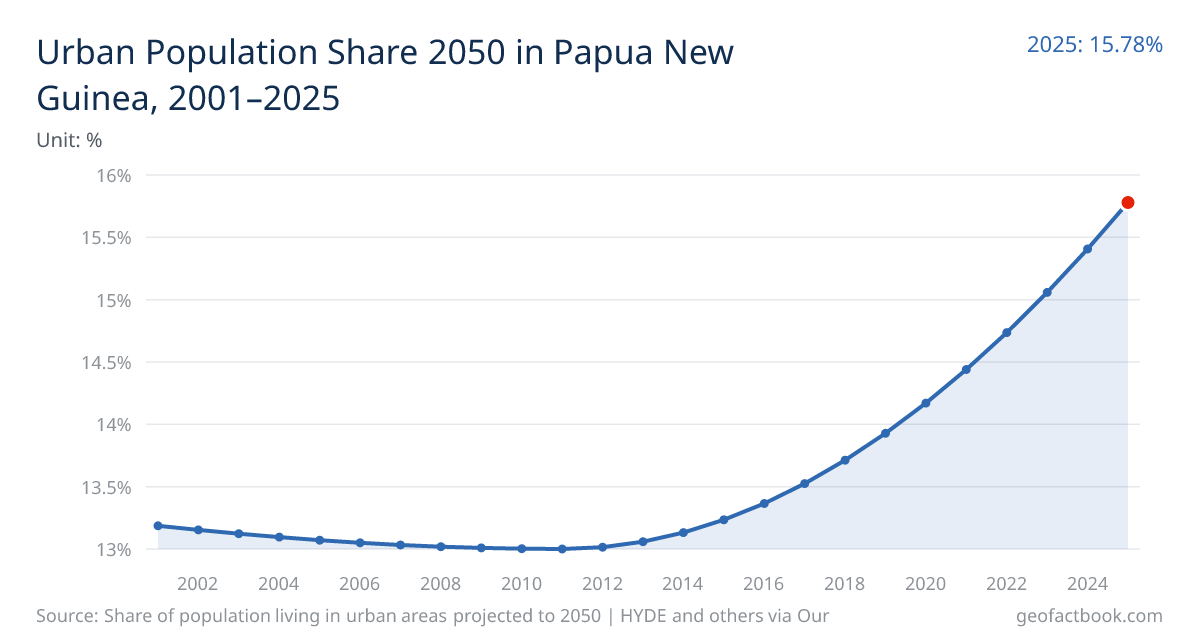
Papua New Guinea's urban population share 2050 in 2025 is 15.78 %, up 2.4% from 2024. It ranks #232 of 236 countries.
Urban population share by 2050 shows urbanization trends. Discover which countries will be most urbanized.
Source (2025): Share of population living in urban areas projected to 2050 | Our World in Data
Where Papua New Guinea ranks (2025)
#232 of 236- #230
 Malawi17.59%
- #231
 Samoa17.51%
- #232
 Papua New Guinea15.78%
- #233
 Liechtenstein14.63%
- #234
 Montserrat8.98%
Urban Population Share 2050 over time
| Year | Value | Change | % Change | Actions |
|---|---|---|---|---|
| 2025 | 15.78 % | +0.37 % | +2.42% | |
| 2024 | 15.41 % | +0.35 % | +2.31% | |
| 2023 | 15.06 % | +0.32 % | +2.19% | |
| 2022 | 14.74 % | +0.3 % | +2.05% | |
| 2021 | 14.44 % | +0.27 % | +1.90% | |
| 2020 | 14.17 % | +0.24 % | +1.74% | |
| 2019 | 13.93 % | +0.22 % | +1.57% | |
| 2018 | 13.71 % | +0.19 % | +1.39% | |
| 2017 | 13.52 % | +0.16 % | +1.19% | |
| 2016 | 13.37 % | +0.13 % | +0.99% | |
| 2015 | 13.23 % | +0.1 % | +0.78% | |
| 2014 | 13.13 % | +0.07 % | +0.56% | |
| 2013 | 13.06 % | +0.04 % | +0.34% | |
| 2012 | 13.01 % | +0.01 % | +0.11% | |
| 2011 | 13 % | 0 % | -0.02% | |
| 2010 | 13 % | 0.01 % | -0.05% | |
| 2009 | 13.01 % | 0.01 % | -0.08% | |
| 2008 | 13.02 % | 0.01 % | -0.11% | |
| 2007 | 13.03 % | 0.02 % | -0.13% | |
| 2006 | 13.05 % | 0.02 % | -0.16% | |
| 2005 | 13.07 % | 0.02 % | -0.19% | |
| 2004 | 13.1 % | 0.03 % | -0.21% | |
| 2003 | 13.12 % | 0.03 % | -0.23% | |
| 2002 | 13.15 % | 0.03 % | -0.25% | |
| 2001 | 13.19 % | — | — |
Urban Population Share 2050 in Papua New Guinea, 2001–2025: chart
Cite this page
Geo Factbook. (n.d.). Papua New Guinea: Urban Population Share 2050. Retrieved November 29, 2026, from https://geofactbook.com/countries/papua-new-guinea/urban-population-share-2050
The figures on this page come from Share of population living in urban areas projected to 2050 | HYDE and others via Our World in Data. For academic work, cite the original source as well.
Frequently Asked Questions About Papua New Guinea Urban Population Share 2050
What is Papua New Guinea's urban population share 2050 in 2025?▾
Papua New Guinea's urban population share 2050 is 15.78 % in 2025, according to Share of population living in urban areas projected to 2050 | HYDE and others via Our World in Data.
Is Papua New Guinea's urban population share 2050 increasing or decreasing?▾
Papua New Guinea's urban population share 2050 rose by 2.4% from 2024 (15.41 %) to 2025 (15.78 %). Over the past decade (2015–2025) it rose by 19.2%.
How does Papua New Guinea rank for urban population share 2050?▾
In 2025, Papua New Guinea has the 232nd highest urban population share 2050 out of 236 countries with data.
What was Papua New Guinea's urban population share 2050 in 2001?▾
In 2001, Papua New Guinea's urban population share 2050 was 13.19 %. By 2025 it rose by 19.7%.
Explore additional statistical insights
Population living in slums in Papua New Guinea
This statistic measures the percentage of a country's population living in slums, highlighting urban poverty and living conditions. Understanding slum populations is crucial for addressing housing challenges and improving the quality of life.
Military Service Age and Obligation in Papua New Guinea
Military service age and obligation details for 266+ countries. Compare requirements, explore rankings, and view interactive maps.
Primary School Pupil-Teacher Ratio in Papua New Guinea
Pupil-teacher ratio in primary schools reflects educational quality; lower ratios indicate more personalized attention.
Academic Freedom Index in Papua New Guinea
Explore the Academic Freedom Index measuring educational liberties globally. Compare countries' scores, view rankings, and analyze historical trends.
Average Spirits Consumption Per Capita in Papua New Guinea
Average spirits consumption per capita highlights drinking habits in different countries, measured in liters annually.
Egg Consumption per Capita in Papua New Guinea
Egg consumption per capita measures the average number of eggs consumed annually by individuals in a country.