
Papua New Guinea Share of population in poverty ($3 a day) 2009: 52.21
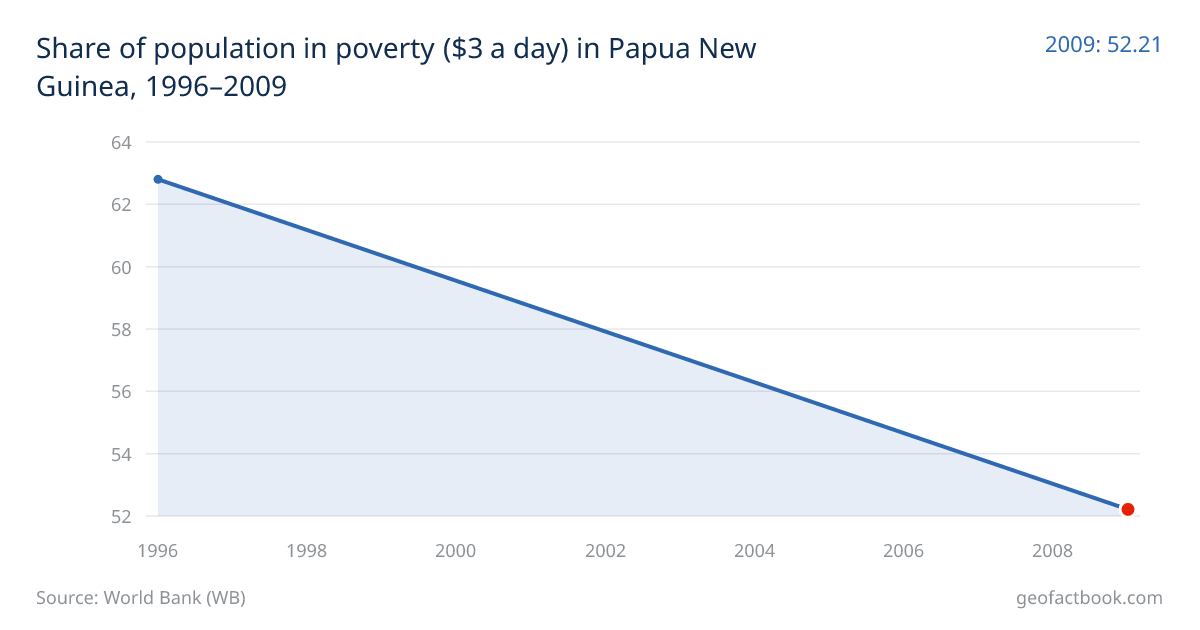
Papua New Guinea's share of population in poverty ($3 a day) in 2009 is 52.21, down 16.9% from 1996. It ranks #5 of 79 countries.
Share of population in poverty ($3 a day) statistics by country with historical data from Our World in Data.
Where Papua New Guinea ranks (2009)
#5 of 79- #3
 Mali63.34
- #4
 Eswatini58.22
- #5
 Papua New Guinea52.21
- #6
 South Sudan44.88
- #7
 Namibia38.59
Share of population in poverty ($3 a day) over time
| Year | Value | Change | % Change | Actions |
|---|---|---|---|---|
| 2009 | 52.21 | 10.59 | -16.87% | |
| 1996 | 62.8 | — | — |
Share of population in poverty ($3 a day) in Papua New Guinea, 1996–2009: chart
Cite this page
Geo Factbook. (n.d.). Papua New Guinea: Share of population in poverty ($3 a day). Retrieved November 29, 2026, from https://geofactbook.com/countries/papua-new-guinea/share-of-population-in-poverty-3-a-day
The figures on this page come from World Bank (WB). For academic work, cite the original source as well.
Frequently Asked Questions About Papua New Guinea Share of population in poverty ($3 a day)
What is Papua New Guinea's share of population in poverty ($3 a day) in 2009?▾
Papua New Guinea's share of population in poverty ($3 a day) is 52.21 in 2009, according to World Bank (WB).
Is Papua New Guinea's share of population in poverty ($3 a day) increasing or decreasing?▾
Papua New Guinea's share of population in poverty ($3 a day) fell by 16.9% from 1996 (62.80) to 2009 (52.21).
How does Papua New Guinea rank for share of population in poverty ($3 a day)?▾
In 2009, Papua New Guinea has the 5th highest share of population in poverty ($3 a day) out of 79 countries with data.
What was Papua New Guinea's share of population in poverty ($3 a day) in 1996?▾
In 1996, Papua New Guinea's share of population in poverty ($3 a day) was 62.80. By 2009 it fell by 16.9%.
Explore additional statistical insights
Tax Burden (% of GDP) in Papua New Guinea
Tax Burden measures the proportion of GDP collected by governments as taxes, influencing economic freedom.
Female Labor Force Participation Rate in Papua New Guinea
Female labor force participation rate measures the active engagement of women in the workforce, indicating economic inclusivity.
Net FDI Outflows in Papua New Guinea
Net FDI outflows measure the total outbound foreign investments by a country, indicating its economic expansion strategy.
Cereal Production Volume in Papua New Guinea
Cereal production volume measures total cereal output in tons. It tracks agricultural productivity across nations.
Aquaculture Production Volume in Papua New Guinea
Aquaculture production volume measures the total output of farmed aquatic organisms in a country. It's vital for food supply analysis.
Total Meat Production Volume in Papua New Guinea
Explore total meat production volume in tons across countries, highlighting key producers and trends in the global market.