
Panama Beer Consumption per Capita 2022: 5.34 liters
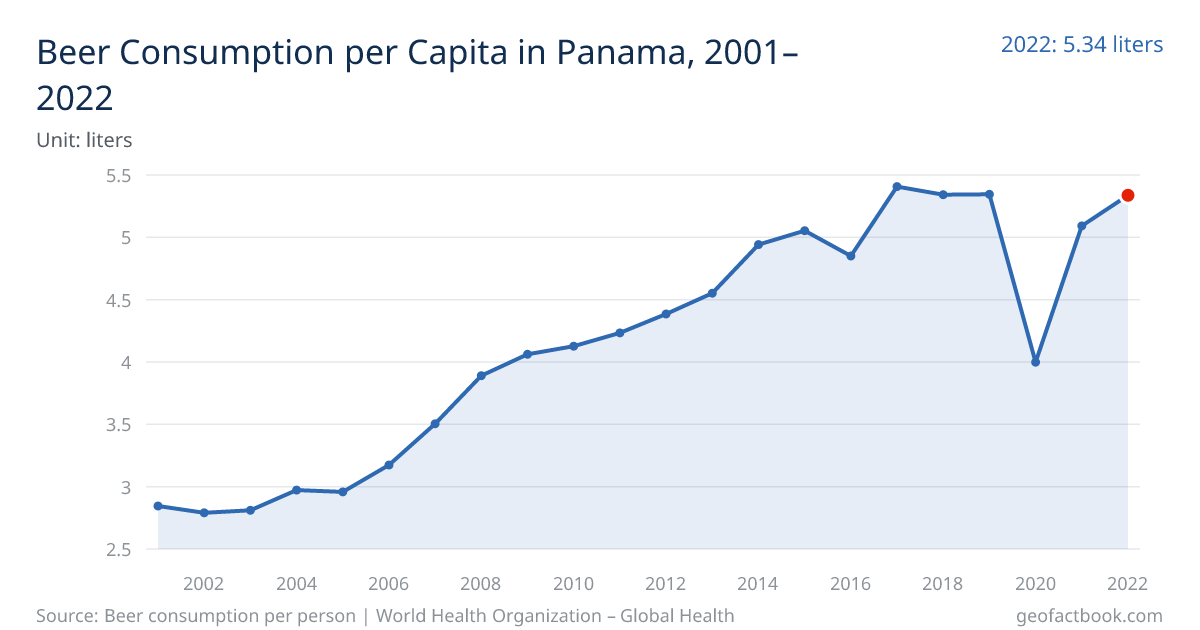
Panama's beer consumption per capita in 2022 is 5.34 liters, up 4.8% from 2021. It ranks #6 of 186 countries.
Beer consumption per capita measures the average liters of beer consumed by each person in a country annually.
Source (2022): Beer consumption per person | Our World in Data
Where Panama ranks (2022)
#6 of 186




Beer Consumption per Capita over time
| Year | Value | Change | % Change | Actions |
|---|---|---|---|---|
| 2022 | 5.34 liters | +0.25 liters | +4.82% | |
| 2021 | 5.09 liters | +1.09 liters | +27.35% | |
| 2020 | 4 liters | 1.35 liters | -25.19% | |
| 2019 | 5.34 liters | +0 liters | +0.05% | |
| 2018 | 5.34 liters | 0.07 liters | -1.20% | |
| 2017 | 5.41 liters | +0.56 liters | +11.48% | |
| 2016 | 4.85 liters | 0.2 liters | -4.01% | |
| 2015 | 5.05 liters | +0.11 liters | +2.25% | |
| 2014 | 4.94 liters | +0.39 liters | +8.58% | |
| 2013 | 4.55 liters | +0.17 liters | +3.79% | |
| 2012 | 4.39 liters | +0.15 liters | +3.59% | |
| 2011 | 4.23 liters | +0.11 liters | +2.59% | |
| 2010 | 4.13 liters | +0.06 liters | +1.60% | |
| 2009 | 4.06 liters | +0.17 liters | +4.41% | |
| 2008 | 3.89 liters | +0.39 liters | +11.02% | |
| 2007 | 3.5 liters | +0.33 liters | +10.40% | |
| 2006 | 3.17 liters | +0.22 liters | +7.30% | |
| 2005 | 2.96 liters | 0.01 liters | -0.48% | |
| 2004 | 2.97 liters | +0.16 liters | +5.75% | |
| 2003 | 2.81 liters | +0.02 liters | +0.72% | |
| 2002 | 2.79 liters | 0.05 liters | -1.92% | |
| 2001 | 2.85 liters | — | — |
Beer Consumption per Capita in Panama, 2001–2022: chart
Cite this page
Geo Factbook. (n.d.). Panama: Beer Consumption per Capita. Retrieved November 27, 2026, from https://geofactbook.com/countries/panama/beer-consumption-per-capita
The figures on this page come from Beer consumption per person | World Health Organization – Global Health Observatory via Our World in Data. For academic work, cite the original source as well.
Frequently Asked Questions About Panama Beer Consumption per Capita
What is Panama's beer consumption per capita in 2022?▾
Panama's beer consumption per capita is 5.34 liters in 2022, according to Beer consumption per person | World Health Organization – Global Health Observatory via Our World in Data.
Is Panama's beer consumption per capita increasing or decreasing?▾
Panama's beer consumption per capita rose by 4.8% from 2021 (5.09 liters) to 2022 (5.34 liters). Over the past decade (2012–2022) it rose by 21.7%.
How does Panama rank for beer consumption per capita?▾
In 2022, Panama has the 6th highest beer consumption per capita out of 186 countries with data.
What was Panama's beer consumption per capita in 2001?▾
In 2001, Panama's beer consumption per capita was 2.85 liters. By 2022 it rose by 87.6%.
Explore additional statistical insights
Total deaths in Panama
Total deaths in countries measure the number of individuals who have passed away within a specific timeframe. This statistic is crucial for understanding health trends, mortality rates, and the impact of various factors on population dynamics.
Old-Age Dependency Ratio in Panama
Old-age dependency ratio compares the number of elderly dependents to working-age people, affecting economic sustainability.
Education Expenditure (% of GDP) in Panama
Education expenditure measures the percentage of GDP spent on education. Compare countries and explore interactive rankings and trends.
Female Tertiary Enrollment Rate (%) in Panama
This measures the percentage of female students enrolling in tertiary education, reflecting gender parity in higher education globally.
Urban Population Share 2050 in Panama
Urban population share by 2050 shows urbanization trends. Discover which countries will be most urbanized.
Total population in Panama
Discover the latest total population statistics for every country and region worldwide. Explore accurate, up-to-date data on global population growth, density, and demographic trends — sourced from trusted international databases like the UN and World Bank. Perfect for researchers, students, and data enthusiasts looking to understand how the world’s population is changing.